Ducking Underground – les Grottes de Saulges

Now THAT’s an Old House! – Rochefort Cave

Le printemps (spring) is in full swing. Lashings of rain are broken by days of limpid blue skies and freshening sunshine. The first flowers have already come and gone and most of the trees are already robed in this year’s new line of greenery. So what better way is there than to celebrate this rejuvenating season than to crawl into a hole in the french countryside. Bien sûr.
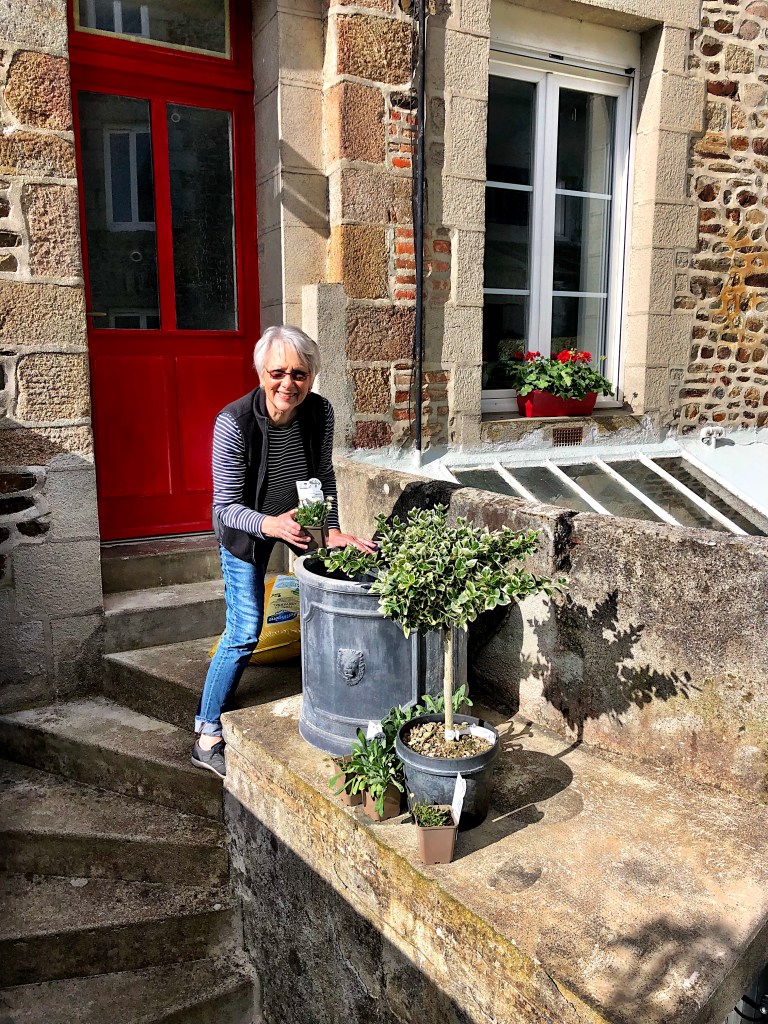
Where’s Her Work Visa? – Valerie in Her Element

Cherie’s mother, Valerie, has come to visit us once again. We therefore put her right to work. As you do. In our defense, she asked for it. Seriously, she literally asked us what she could do to help out. Our work on fixing up an old apartment and turning it into a holiday rental continues. And that kind of work is right up Val’s alley. She loves it. Don’t ask me why. But we’re not ones to look a gift mother/mother-in-law in the mouth so we gratefully let her loose on the place. With her help, we’ve accomplished quite a bit. So much so that we are fast approaching completion. Thanks, Val!
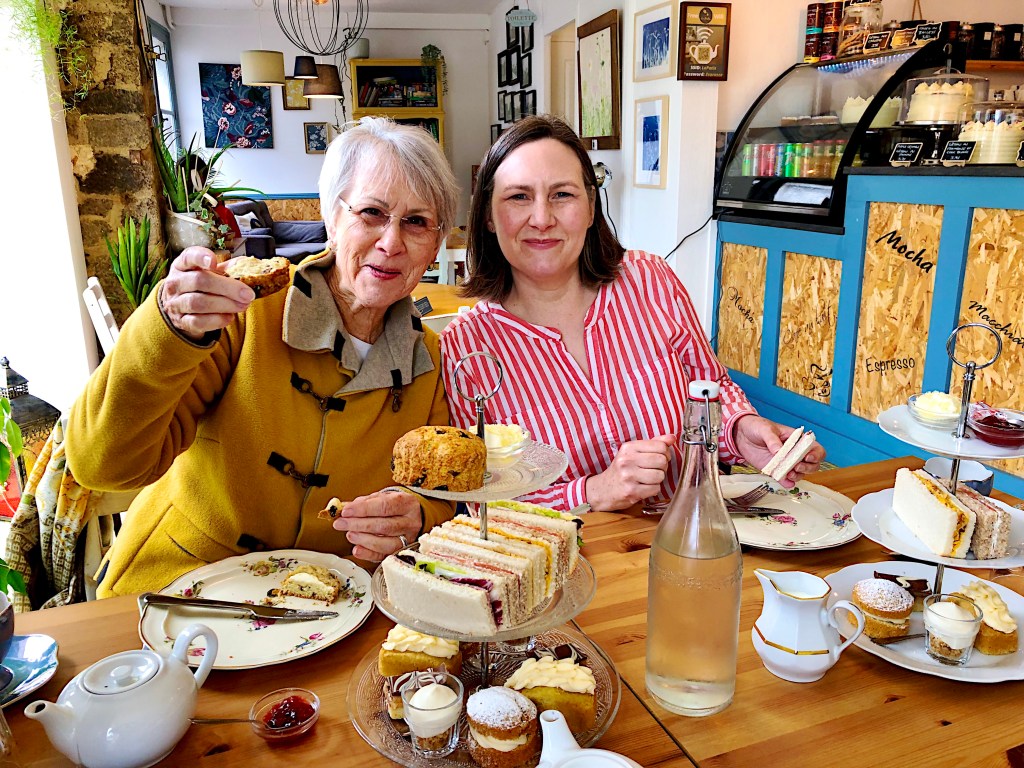
Our Happy Place!

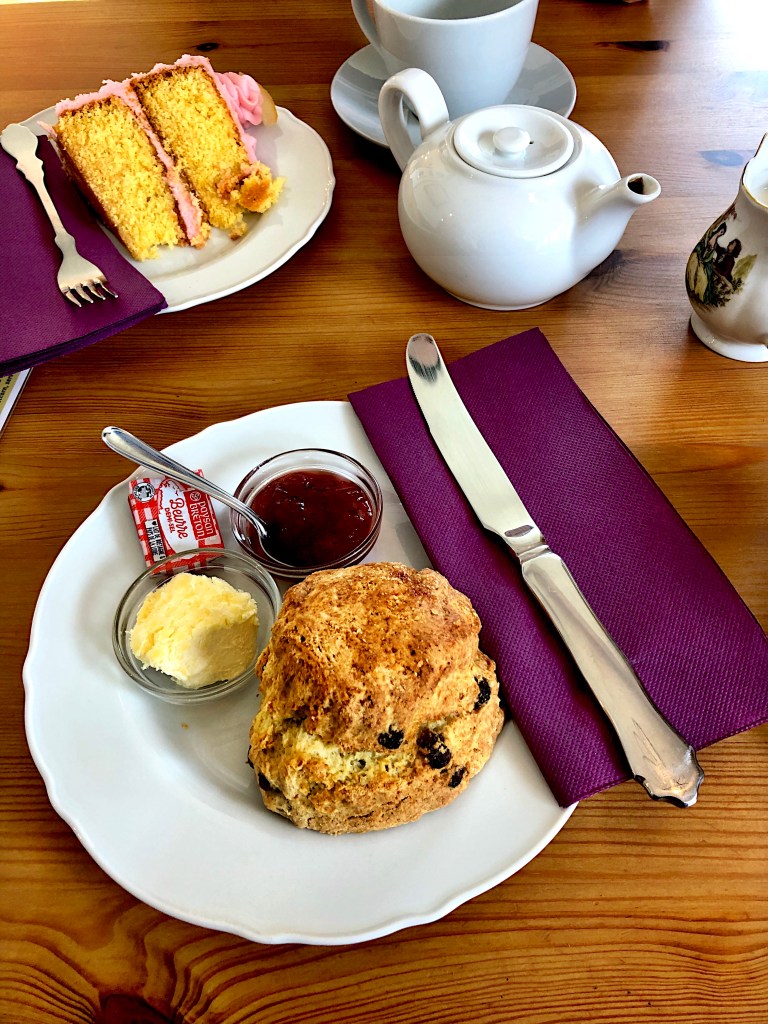
Valerie has been laser-focused on renovating the apartment. But Cherie and I finally had to cry for mercy. We needed a break. So we have been taking a day off, here and there, to reenergize ourselves. And what better way to recharge than an afternoon tea? We returned to le Patis in Landivy [see our recent post here] for the full Monty: buckets of tea, sandwiches (without the crust, of course), scones with cream and jam, and scrumptious little cakes. It was so good, but so filling I swore off any more food for the rest of the day.

Wisteria Doorway: Sainte-Suzanne

Our next break was more ambitious. Hoping for no rain, we travelled east to the beautiful lands of Mayenne and the town of St. Suzanne (about which I wrote in more detail in our post here). As you know, we love this little town. And it didn’t disappoint this time either. The weather was lovely and the ville was impossibly picturesque as we wandered its worn cobbled streets, explored the ruins of the Norman keep, and meandered the path encircling its ancient ramparts amidst wildflowers humming with bumblebees and tiny lizards sunbathing on the honey-colored stone walls. Sublime.

Valley of the Caves

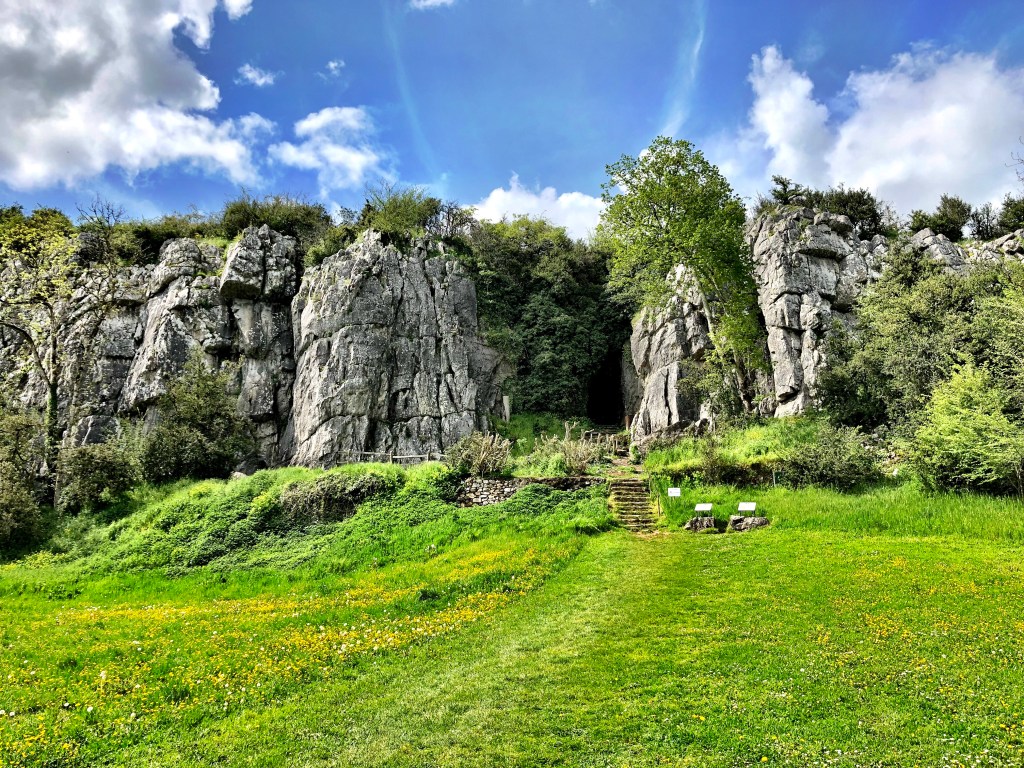
Moving on from Sainte-Suzanne, we made our way southward to a rocky gorge near the village of Saulges, about halfway between the large towns of Laval and Le Mans. There, in the cliff faces of the gorge, sit several caves (or, grottes, as they are known in French). A few of these grottes have been utilized by hominids (homo sapiens and, probably, homo neanderthalensis) for at least 29,000 years.

Are they Judging Me? – Artifacts in the Musée Préhistoire

In this gorge on the river Erve is a ticket office and small museum which houses a nicely-displayed collection of prehistoric artifacts. It was interesting to have a close view of the various stone and bone tools used by the early humans who lived here, as well as their items of adornment (beads, pendants, etc) and other bits of evidence of habitation in this valley. It’s with recurring astonishment when I’m reminded that these people lived alongside rhinoceroses, leopards, and mammoths. How different the landscape must have been!

Trail Along the Banks of the Evre

There is a restaurant next to the museum, so one can plan on having a meal here. We had already eaten lunch in Sainte-Suzanne so we didn’t try it. Lots of picnic tables throughout the valley as well – great places to enjoy a leisurely lunch or snack in a peaceful and beautiful setting. There are also a few hiking trails.

Cherie and Val at the Entrance to Margot’s Cave

But the stars of the show are definitely the cave tours. Two caves (Margot and Rochefort) can be visited. These guided tours can be reserved online or at the ticket desk in the museum. Unfortunately, we only had time to visit one cave (Margot), but it was well worth it. With a small group our knowledgeable guide took us through the ancient, water-worn openings of the cave system, giving us an informative overview of the grotte’s geology and history of human habitation. She pointed out four gravures (figures scratched into the calcified layer covering the limestone) on the walls, rendered by the hands of humans who used these caverns many thousands of years ago. A wonderment to behold. Witnessing these representations forms such a profound visual connection between us and our ancestors – from their eyes to ours across the millennia. It really makes you think. Which is a good thing, in my opinion. There’s far too little of it these days. Thinking, that is.

Can You Spot the Rhinoceros? – Prehistoric Gravure

Something you should know if you’re considering a visit to the Grottes de Saulges: the cave tours are not a walk in the park. If you are a practicing contortionist, then this is right up your alley. But for those of you who find bending and crouching difficult or painful, this might not be the way you want to spend an hour underground. Try the subway instead. Sturdy shoes are highly recommended and avoid wearing white – it’s wet and muddy. You are not allowed to touch any part of the cave surface in order to protect the gravures and rock formations as well as minimize the introduction of pathogens to the several species of bats which winter there.

The Living Rock

[N.B. Photos are strictly forbidden inside the caves. Those included in this blog are from their website.]

The ceilings of the passages are sometimes low and irregular too. At one point we had to shuffle through a small opening with a muddy puddle directly underneath it while bending over nearly double. Kind of a reverse limbo, but without the tiki torches and Caribbean music. I’m happy to report that the three of us traversed all obstacles well, but there were a few in our group who struggled a bit. Consider yourself, intrepid adventurer, forewarned.

We emerged from Margot’s cave more thoughtful, enriched, and grateful to see the open sky above us. It had been an altogether good day. Lucky, lucky us. We try to be mindful that our ability to immerse ourselves in beautiful and historic towns, grand estates, mighty castles, dramatic countrysides, vibrant cities and, yes, even dank and dark prehistoric caves, is a true privilege. Something that far too few people ever get the chance to experience. We hope that, in sharing our journeys through our blog, we can spread the joy just that little bit further. Thanks for reading and stick with us for more humble little adventures in France. Take care!
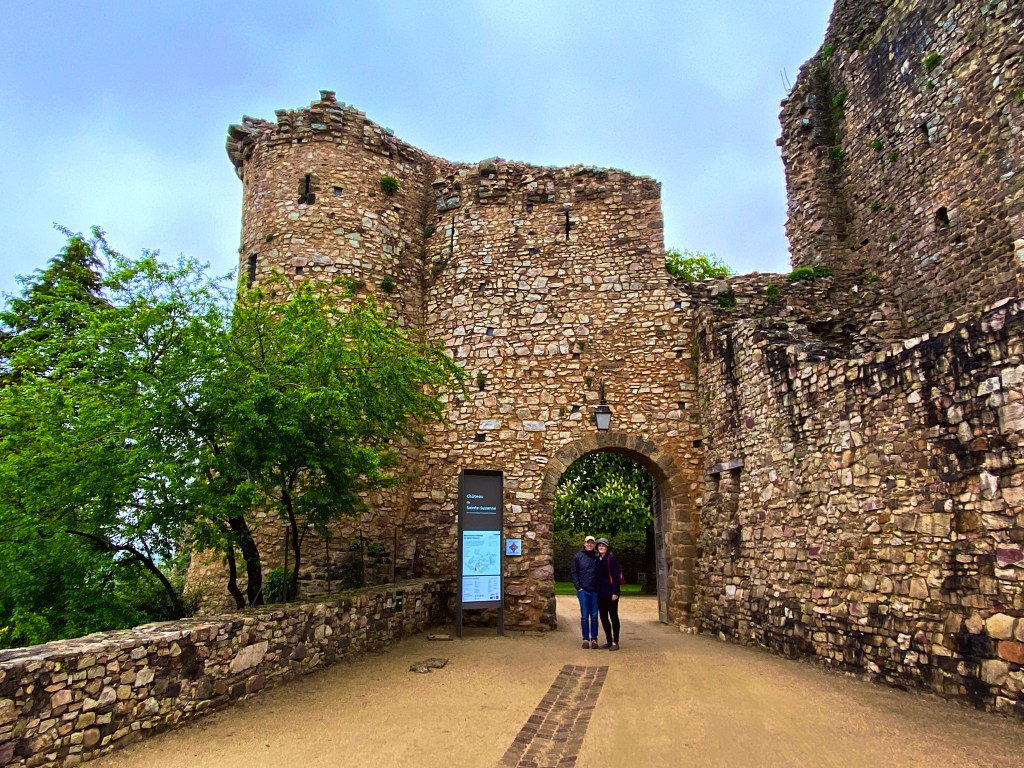
Before the Gateway of Château Sainte-Suzanne

Tea in Landivy!

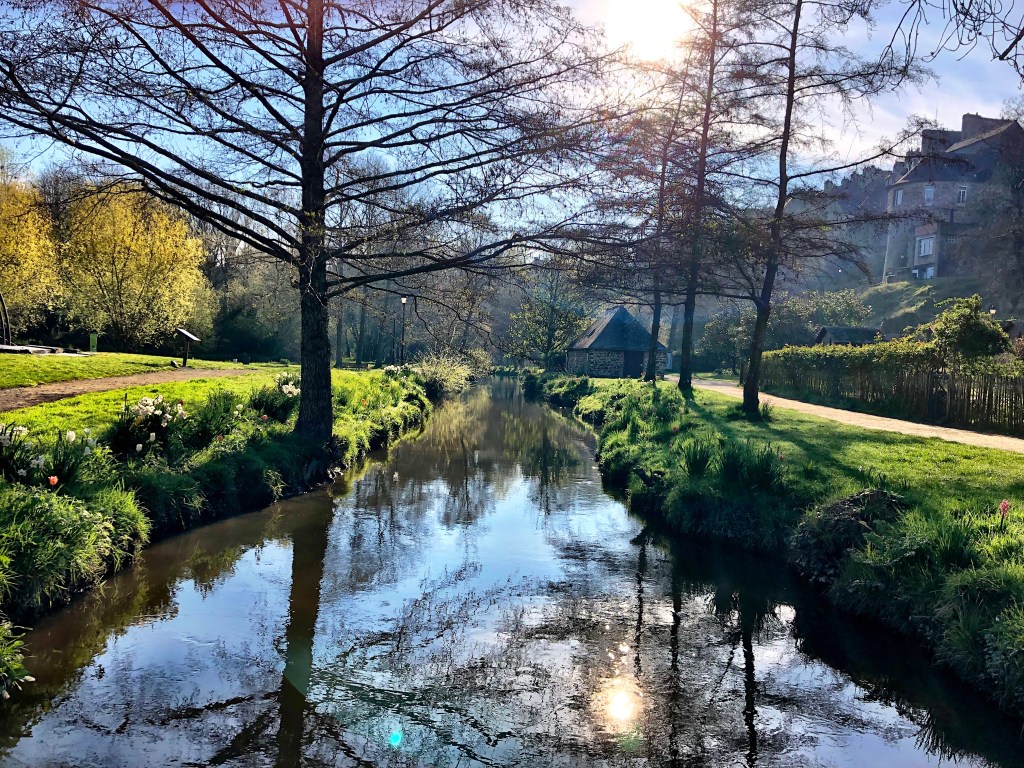
Le Printemps: the Parc du Nançon With Our Tower Looming Above (far right)

Two things I wish there were more of in France: pubs and cream teas. Not necessarily in that order.

So, when we found out that there is a British tea room in a nearby town, we both raised our pinkies and said, “Yes, please!” A couple of weeks earlier, Cherie was at the market talking with a local farmer who suggested that we check out a little café in the town near his farm where they offer cakes and tea. He probably assumed we were English. Most people here do. I guess, to them, our accents are indistinguishable from the British. So, naturally, he thought we would be eager to try this place out. Even though he was slightly off the mark about our origins, our farmer friend was spot-on about our love of a good tea room. Plus, he raises excellent pigs resulting in very tasty porc and sausage. Clever man.

A bit of detective work revealed that the café was named Le Patis. We’re still not quite sure what it means in French. On reference suggests it means a type of fish sauce. But that seems … doubtful in this context. Another indicates that it can refer to pastries. More likely, I think. And yet another source I found indicated that it defines a region in eastern Bretagne/western Mayenne and Loire, known as Le Patis Haut – essentially the area which once roughly formed the marches between oft-independent Bretagne and the kingdom of France. The café is located within this area. Maybe the name is meant to be a double-entendre of these two latter meanings. That, too, would be clever.

The Rules

With dreams of jammy scones and hot brown water* dancing through our heads, Cherie and I drove northeast about 25 minutes to the small town of Landivy. That day, we had to weave in and out of one of the many bicycle races that stretch along the country lanes. In France, you never know when you’re going to encounter one, no matter far out in the country you find yourself. Bicycle races seem to happen spontaneously here. Like rain, or caterpillar parades. This was on a Tuesday. Unfortunately for us (and our dreams of overdosing on clotted cream), we found the café closed. We read the sign in the window with long faces: Le Patis is only open Wednesday, Thursday and Friday afternoons. Of course it is. Occasionally, we revert to our old expectations that businesses are open all day, all of the week, forgetting that we’re in France. Silly us.

Sullen, we drove back home, made our own tea, and regrouped. We had deliveries to receive and work to do on our newest addition to the empire for the remainder of the week. So, on the following week, we scheduled out a Thursday and off we drove to Landivy again. There were no bicycles to dodge this time. A good sign. And, sure enough, we arrived to find Le Patis open and welcoming, full of customers jonesing for a proper tea.

A quick word about tea in France. The French drink it, though they, like Americans, generally prefer coffee. Although one can find black tea without too much trouble, they tend to drink tisane (herbal infusion) teas. Because of this, they seem to find the concept of putting milk in tea to be a bit odd. When we order it in restaurants, we have to repeatedly ask for milk with our tea. Even when they eventually bring the milk, it is in a thimble. Hardly enough for even one cup. So, it can be a little frustrating to order a cup of black tea in France. It’s always an interesting experience though.

Yeah! That’s the Stuff!

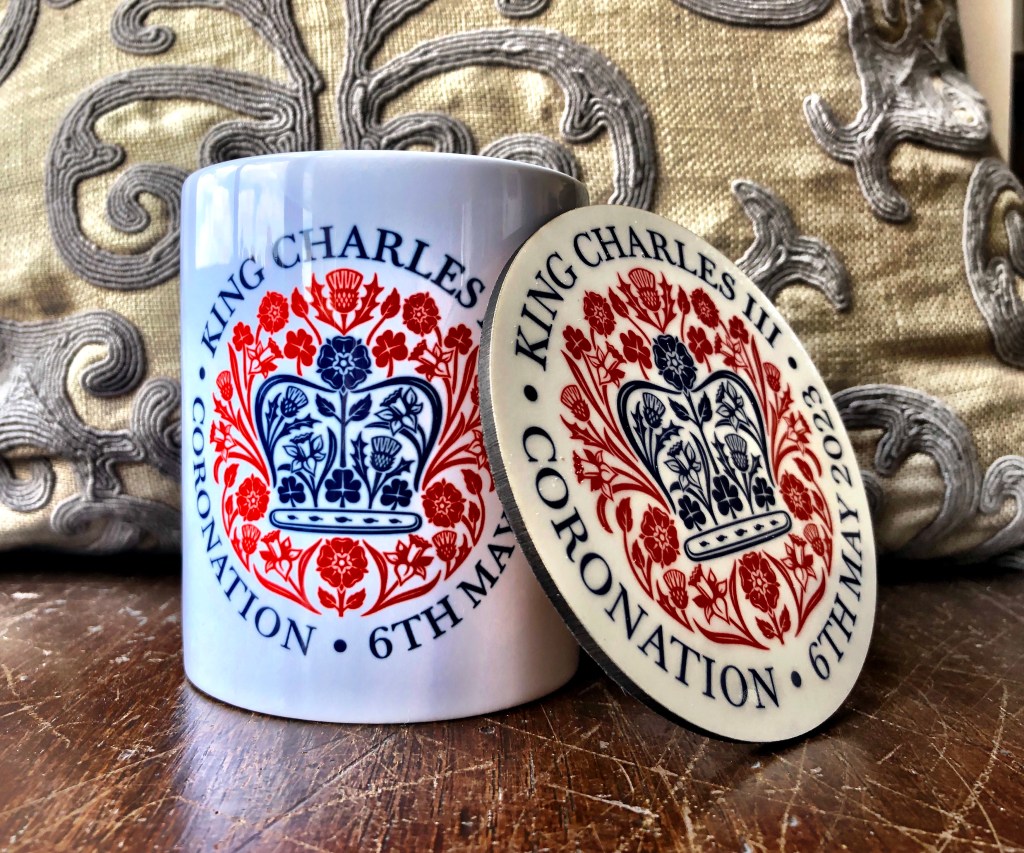
Le Patis is a pleasant tea shop run by two partners originally from the U.K. Both were very nice and they both took time out to have a good chat with all of their customers. Customers who, as far as we could tell, were all British except for a pair who sounded as though they were either Canadian or American. Interesting. It must be a magnet for all English-speaking expats in the area. We had some fine tea and enjoyed some excellent scones and cake. In fact, they had several different scones (sweet and savory) and cakes to choose from. Not wanting to limit ourselves to just one type of cake, we selected a couple of slices of other cakes to take home with us. As you do. To top it off, Le Patis was selling a variety of commemorative items for the upcoming coronation of King Charles III. So, yeah, we scooped up a pair of mugs and matching coasters too. Long may he reign!

It’s Good to be the King

Our visit to the tea shop in Landivy was a pleasant afternoon’s diversion. No doubt, it will become a regular break for us. I suppose we’re pretty lucky in that respect. We get to enjoy the wonders of a life in France while having a bit of the U.K on our doorstep as well. Now, if I could just find a cozy pub …

So Many Cakes, So Little Time

*That’s for all of you smug, coffee-drinking Ted Lasso fans out there. A funny joke, but hardly fair. I mean, isn’t coffee also just hot brown water? [Please keep your angry responses to less than fifty words. Thank you.]

Rising From Ruin: Abbaye de Clairmont

An Aged Face – The Nave of the Abbey Church

Today, a quick post for a quick outing. About 45 minutes to the southeast of us, just inside the Pays de la Loire, sits the old Abbaye de Notre-Dame de Clairmont. It’s not too far from the city of Laval, which we have also visited (see our previous post about Laval here: A Light Late Lunch in Laval). It’s not the easiest place to find. Especially if you are coming from the less well-travelled direction. Google Maps got us lost down an old dirt track. But we were determined to find the abbey so we hit the main road between Laval and Ernée where we had seen a historical marker sign for the site. From there it was fairly simple. There were yet more signs leading us down some pleasant country lanes and, finally, down a graveled drive to the abbey itself. Piece of cake!

A Bit of a Fixer-Upper

We had been under the impression that this was a working abbey. Boy, were we wrong! The only work going on at Clairmont now is the work to save it from crumbling into the ground. And even that seems to be intermittent at best. Still, it is an evocative place and there is much to see. As we exited our car were greeted by a couple of volunteers who were on their way out. They cheerily directed us to the billetterie (ticket office). Much more grand than it sounds – especially in French – the ticket office consisted of a small, room with limewashed walls storing, amongst a seemingly random collection of household items and old furniture, an old gentleman with a table. He greeted us with a reserve customarily extended to invitees of a tax audit. The day was chilly, and so was monsieur.

After taking our payment for the nominal entrance fee, the man launched into a fifteen-minute recitation on the history of the abbey. Despite my instinct to eject myself from this uncomfortable situation, the old man’s well-rehearsed speech was interesting. I held fast. At one point during his spiel, Cherie attempted to improve the connection with monsieur by injecting that we were familiar with a location he had just spoken about. But he was having none of it. Ignoring her attempt at warmth, he simply continued on, displaying admirable breath control for someone of his age. At length, he came to the end of his presentation, handed us an informative pamphlet and directed us out of his room toward the rest of the abbey grounds. We might well have been his only visitors that day. I think he had things to do.

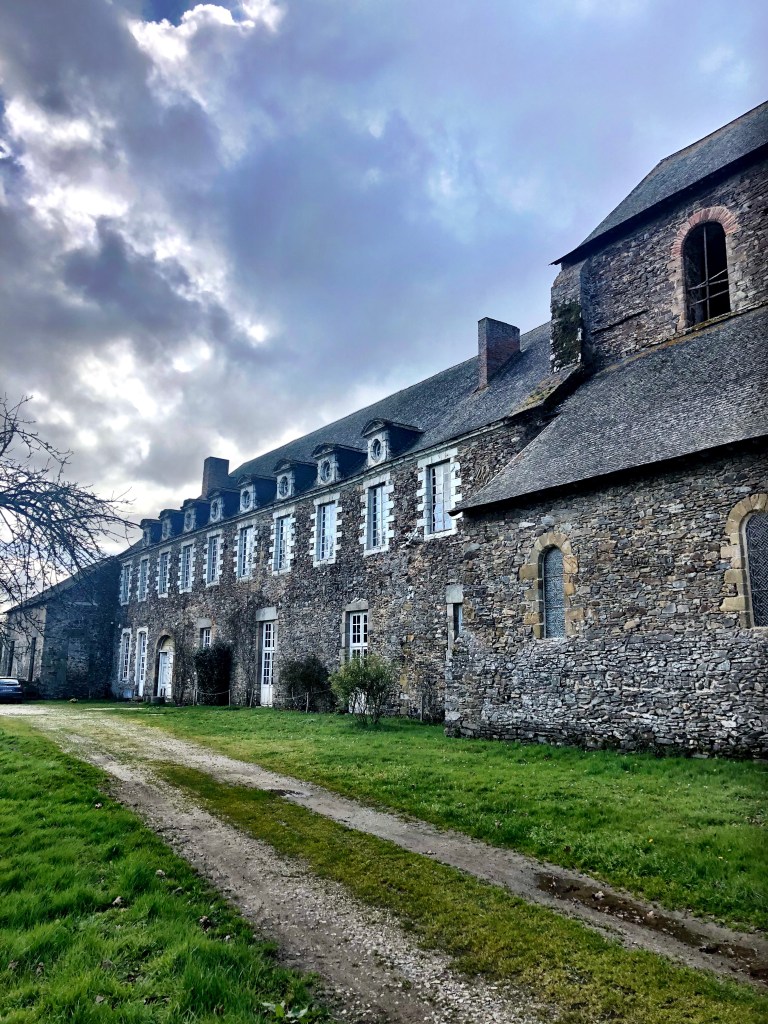
The Lay Brothers’ House

L’Abbaye de Clairmont was founded in 1142. Established by monks of the Cistercian order, the monastery was initiated at the behest of the baron of Laval so that he and other lords of the region might have a sacred place of burial secured by the daily prayers of its inmates. At its height, Clairmont was home to 40 monks and 60 lay brothers, active in their rigorous religious devotions. It was a thriving and wealthy abbey until decline set in toward the end of the 17th century. By 1791, the last few monks had left. The abbey became a working farm, with even the church converted into agricultural use to store hay, grain, carts and tools. It remained a farm until 1952. But by then the buildings had fallen into ruin. Two friends, beguiled by the history and romance of its medieval heritage, purchased the entire site and initiated a program of restoration which continues up to today.

La Porterie: The Porter’s Gatehouse

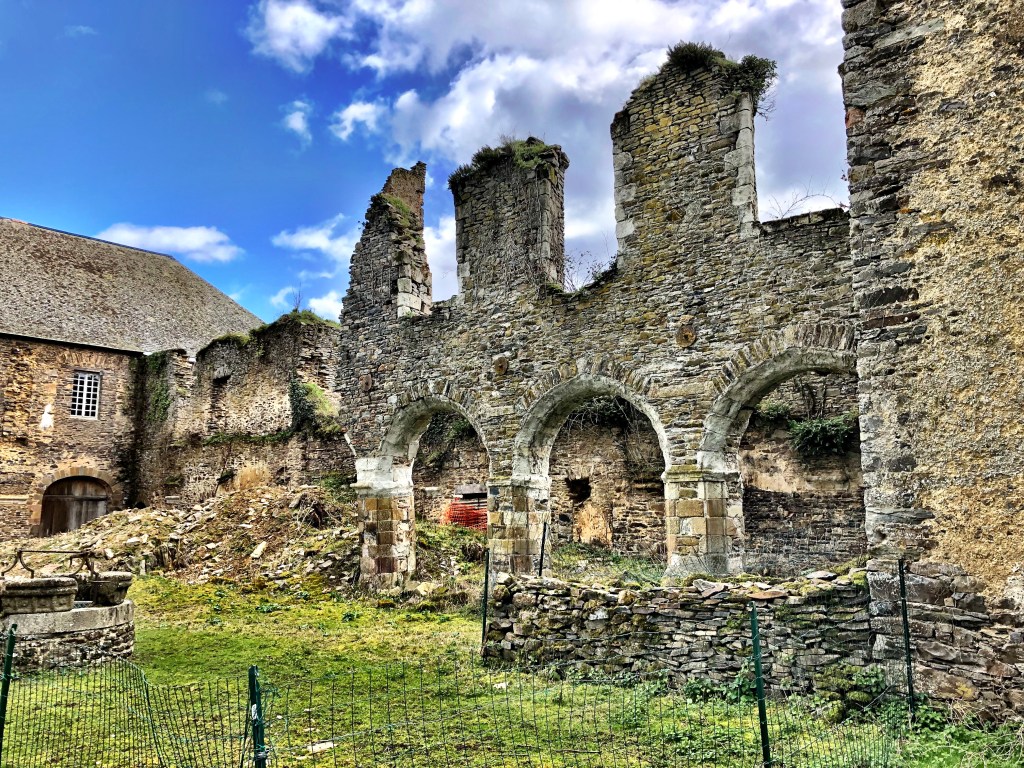
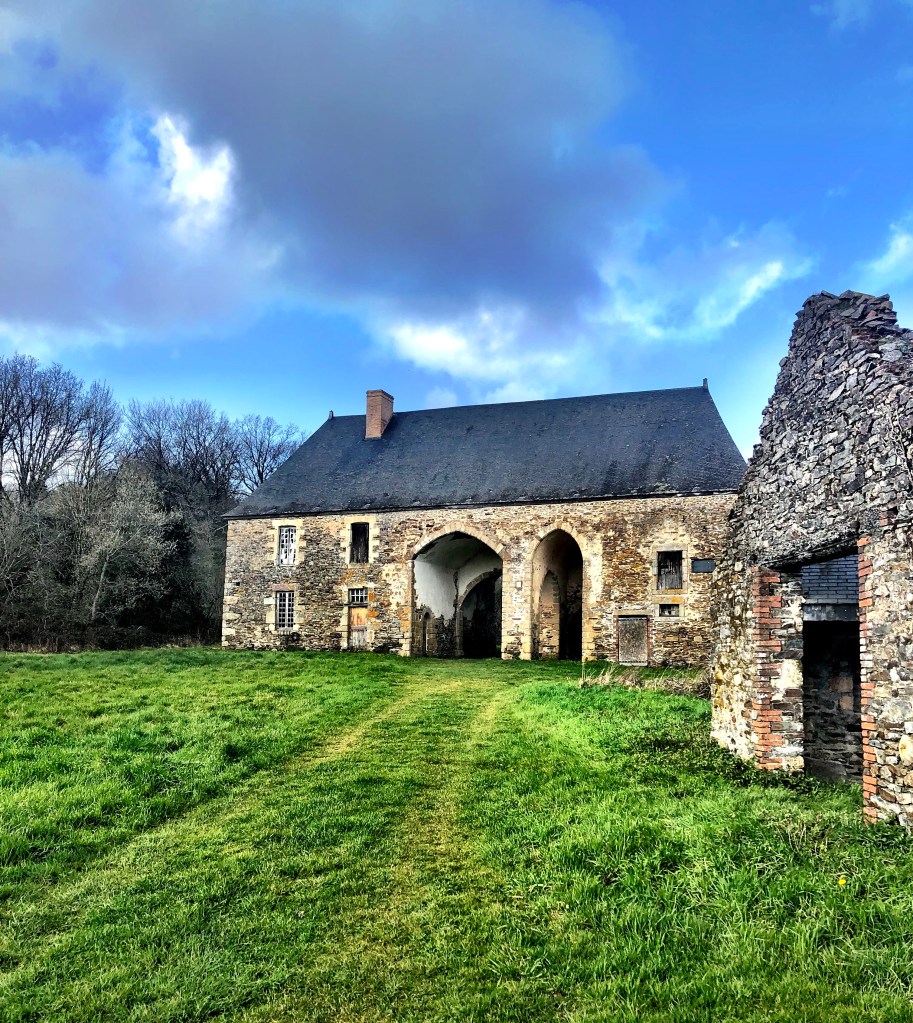
From what we could discern, most of the monastic building are from the 12th century, except for a large dormitory which was added in the 17th century. Much of the complex remains in a partially- or fully-ruined state, though much work has clearly been done to shore up and stabilize the various historic structures. Despite this, there is definitely a rough beauty to this place, highly evocative of its rich and interesting history. The architecture is simple, functional and solid. But it is also, in its own way, graceful, elegant in that early Cistercian style of design which pleasingly weds form and purpose to a sense of the divine.

Inside the Abbey Church

We spent a good hour wandering around the monastic buildings, letting our imaginations mingle with the tranquil atmosphere, interrupted only by the rustle of wind in the trees and an occasional plea from the small black sheep which meandered furtively within and without the cloister. We truly had the place to ourselves. In spite of its ruinous state, there is much to see. And it is not difficult to gain a picture of how it must have once looked.

There are Still Halos to be Found Here

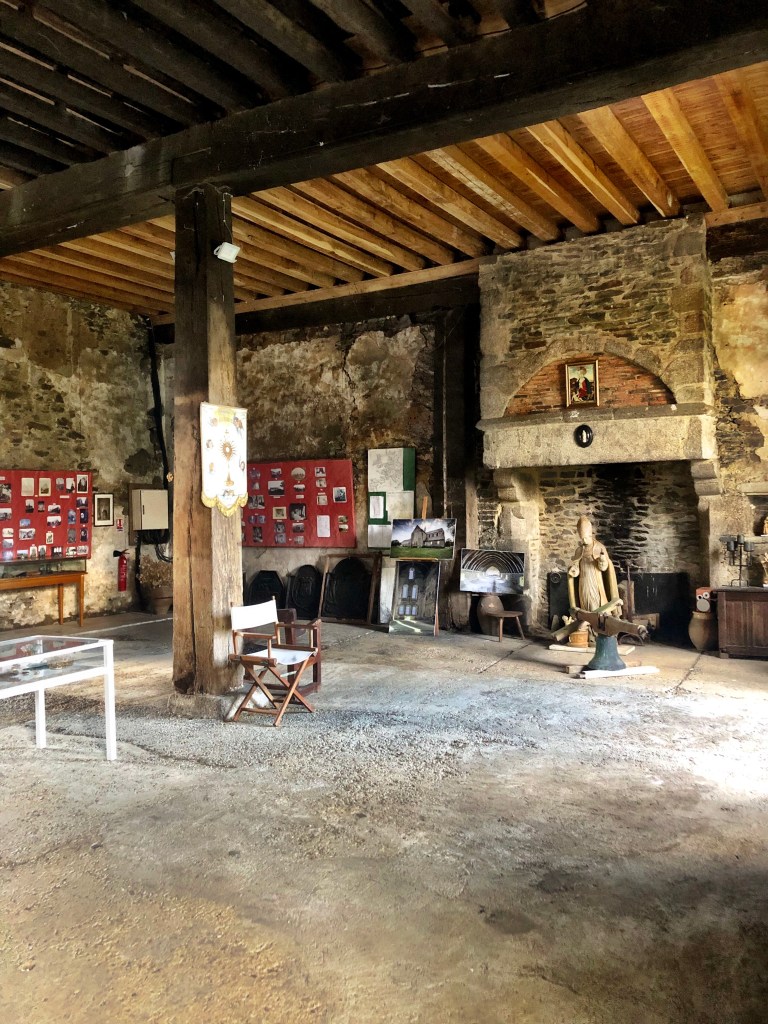
On our way back to the car, another volunteer appeared and offered to show us into what we think was the old chapter house. It now serves as a repository for any remaining stone or wood carvings, decorative tiles, and other ephemera from the time of the active monastery. There are just enough items in here to hint at the former glory of the place. It must have been really something. We were also shown an old chapel room. Small, dark, with a vaulted ceiling, it is little more than a cave. But it still, apparently, serves as a place of occasional worship. This volunteer was very warm and inviting and we ended up chatting with her for sometime in the afternoon sun in the carpark. At length, we said our goodbyes and she returned to her work.

A “New” Addition: The 17th Century Monks Dormitory

Although it wasn’t quite what we thought it would be, we enjoyed our visit to Abbaye de Notre-Dame de Clairmont. It tugs at our souls to see such a once-magnificent monument reduced to a sad ruin. But seeing the continued efforts of volunteers to restore it gives us hope. It’s perhaps impossible to save everything – there is so much around here to save – but it is good to see that people do care. Saving some of this remarkable cultural heritage is surely far better than allowing it all to disappear. What a sad and empty world it would be without these beautiful and important reminders of our past.

The Old Chapter House, Now an Exhibition Hall