Cherie and I have been in a bit of a self-imposed lockdown. Not due to illness or lack of interest. We’ve just been busy with the many little things in life which can bog you down if you are not careful. Bills, banking, tax preparation (for two separate countries), a thousand little house projects, managing the holiday rental … how do people accomplish all of these things when they have jobs and kids?
The tasks just keep coming. But sometimes you just have to throw down the tools and have some fun. So we bravely ran away and took an afternoon off to visit a nice village about an hour’s drive southeast of us: Parné-sur-Roc.
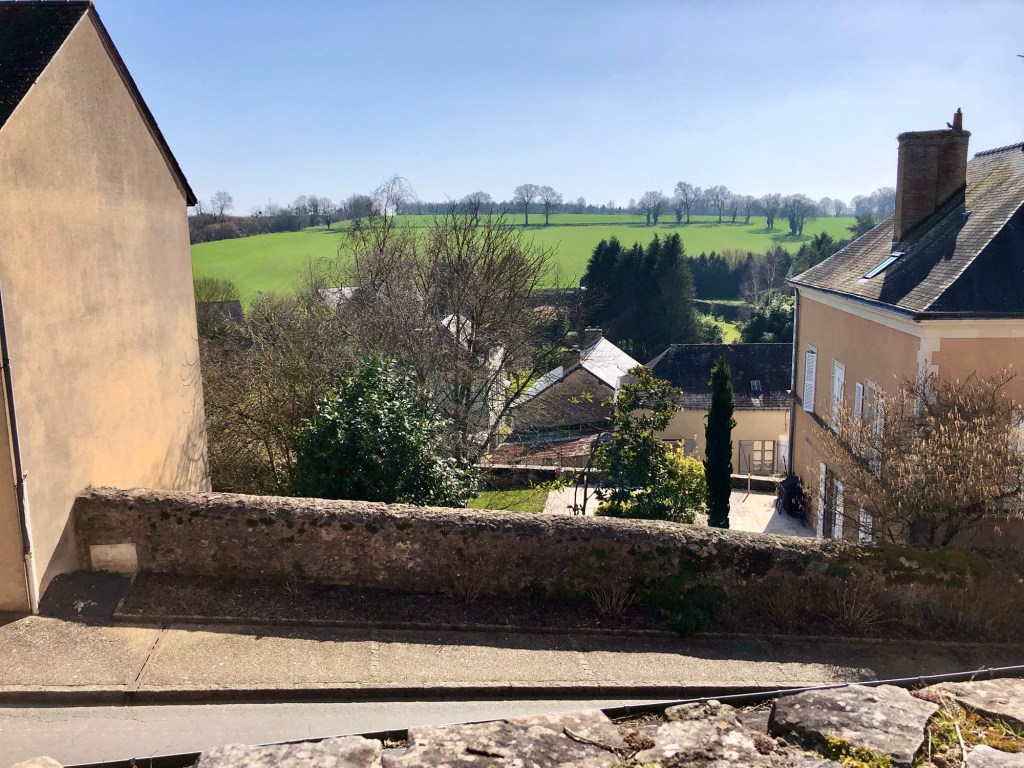
Looking Out Over the Val d’Ouette
Driving south, a few kilometers past the city of Laval, a country road takes you to Parné. We were lucky, in early March, to have sunny weather so we parked the car and took a long stroll through the village streets. Much of Parné stands upon a slope which rises from the Val d’Ouette where the small river slowly winds its way westward between verdant hills.
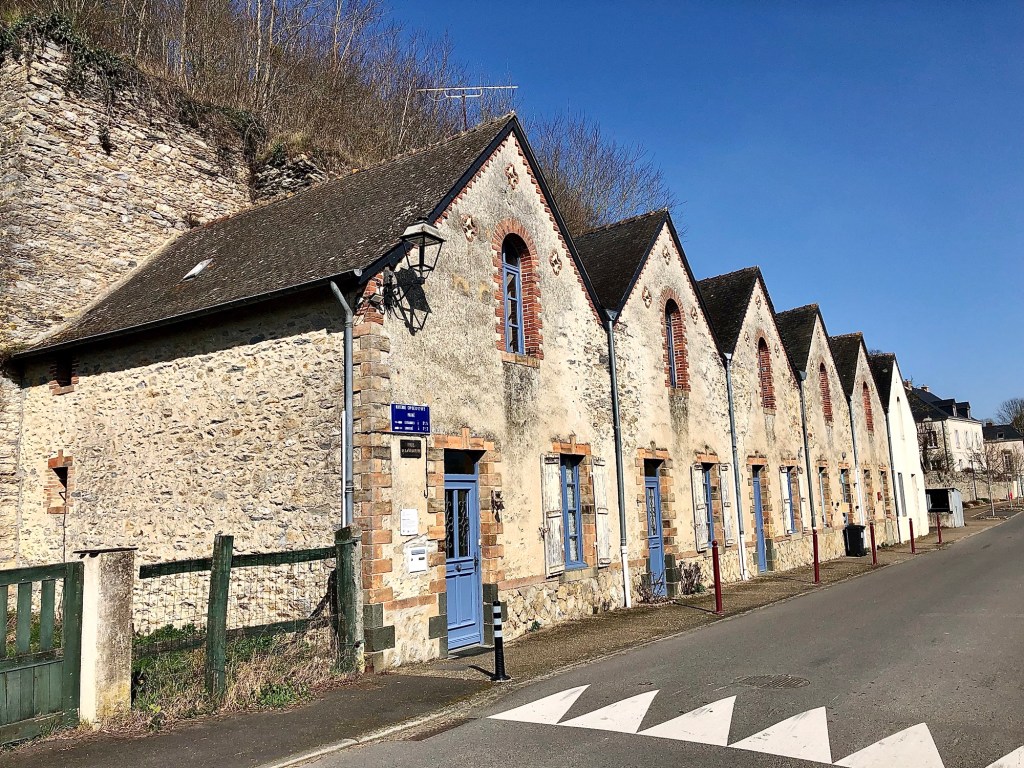
Les Fours à Chaux – The 19th Century Lime Kilns
Parné’s a small place, home to around 1,300 inhabitants. But it has been around for several centuries. Probably since at least the time when the area was a province of the Roman Empire. They must be doing something right. During the Middle Ages the village found itself on the main pilgrimage route leading from Tours to Mont-Saint-Michel. In the 19th century, entrepreneurs of the area took advantage of local limestone deposits by building a series of successful lime kilns, the remains of which continue to rise above a row of workers’ cottages built to house their employees. Now, the main occupations are in agriculture, manufacture of aluminum and PVC building construction components, and a trout hatchery.
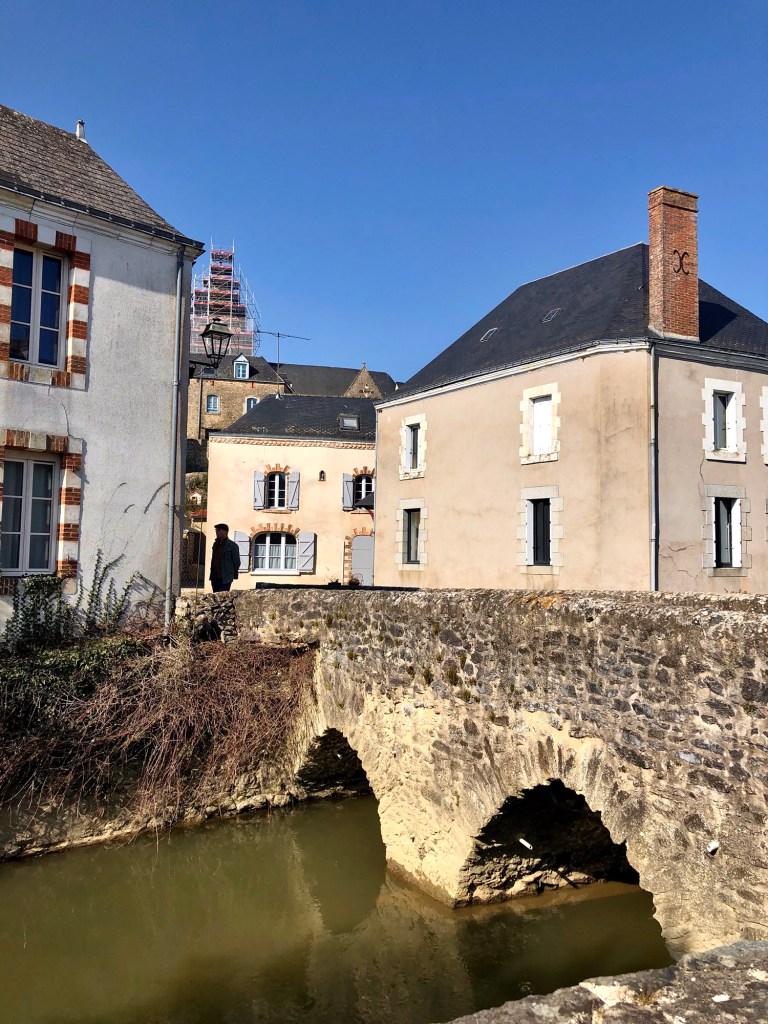
John Enjoying a Moment of Reflection on the Medieval Bridge
At the point where the old pilgrims’ way crossed the river spans a medieval bridge. Simple, with two arches (a third was added in the last century to facilitate water flow), this ancient bridge has somehow managed to last for centuries. It has seen countless travelers tread its roadway – ranging from the most humble animals to the very kings and queens of France itself. It’s a beautiful thing, with its quiet, timeless solidity and imbued with such deep history. Spending a few quiet moments here, with the sound of the burbling river and the songbirds chirping in the trees will do you much good.
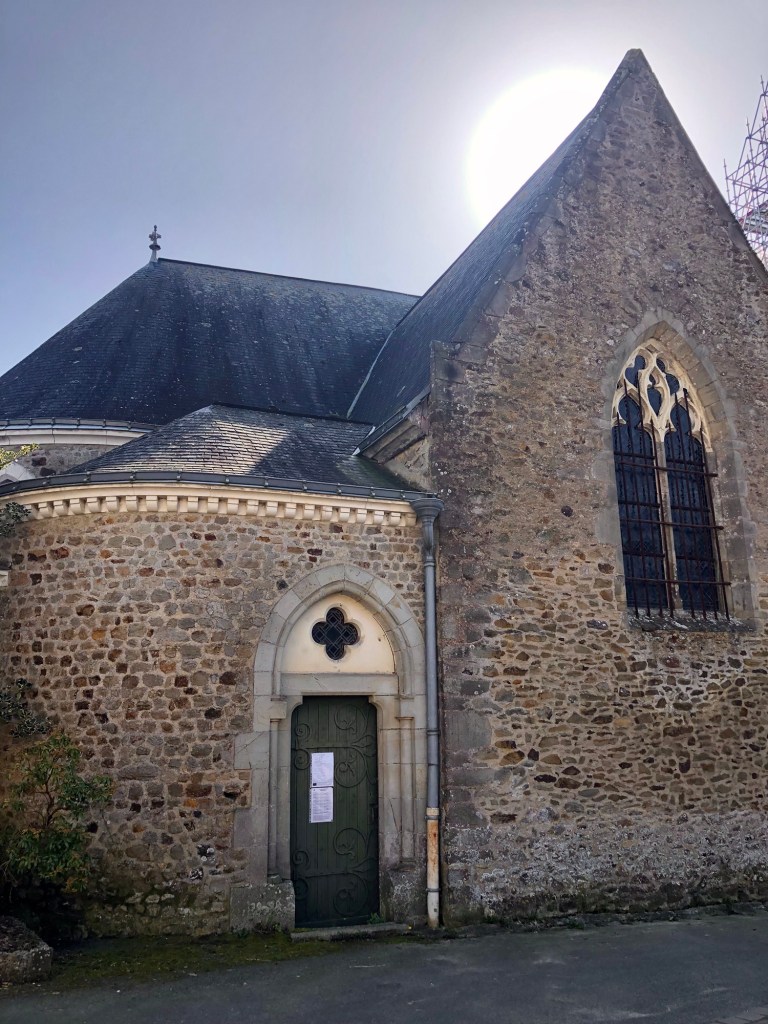
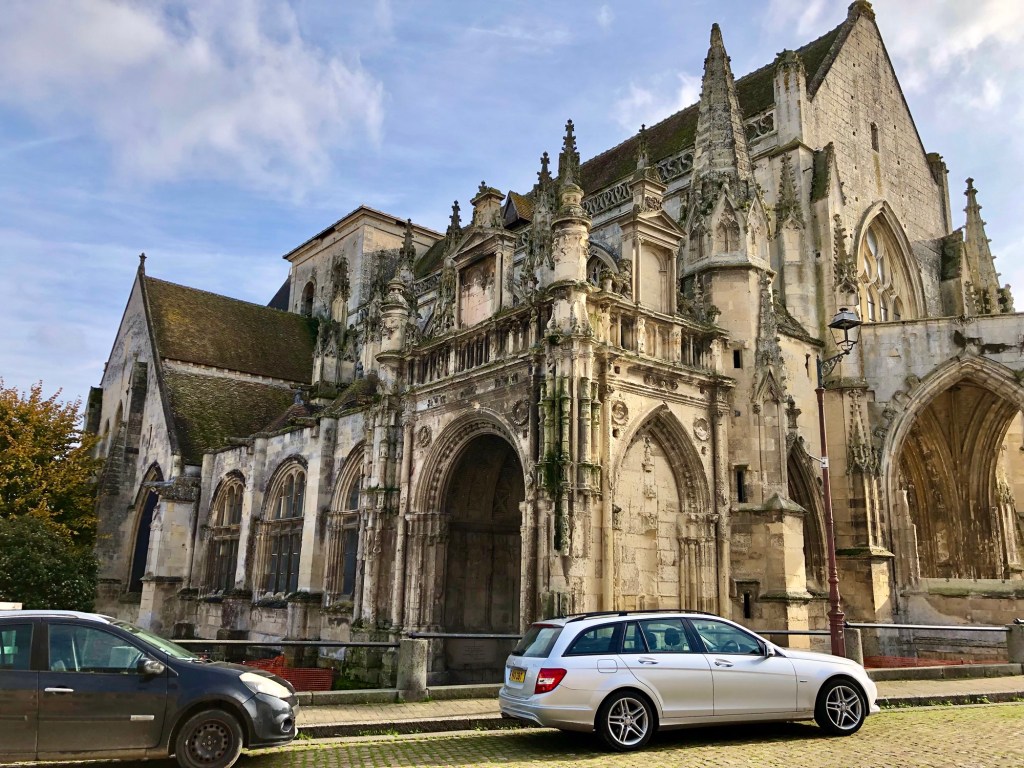
A Small Part of Église St. Pierre Without Scaffolding
Strolling up the hillside to the center of the village, we came upon a lovely church. Or, at least that’s how it seems in photos I’ve seen. We were disappointed to discover that Église St. Pierre is currently enshrouded in scaffolding. Head to toe. Front to back. Restoration is a constant fact of life in Europe. Which is, of course, a good thing. But it was a shame on this day. Because this 11th century church is also reputed to have 13th, 16th and 17th century fragments of frescoes remaining on the walls. We would have loved to see them, but the inside of the church was closed off as well. Perhaps another time.
A Few of the Village Darlings (click on each photo to enlarge)
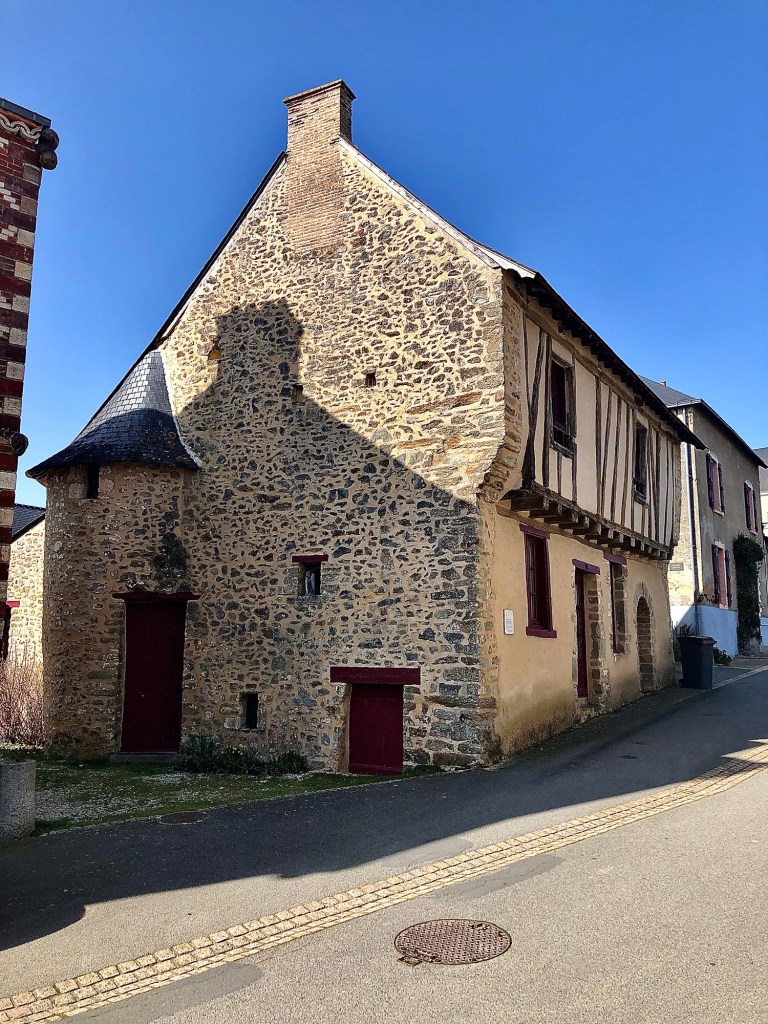
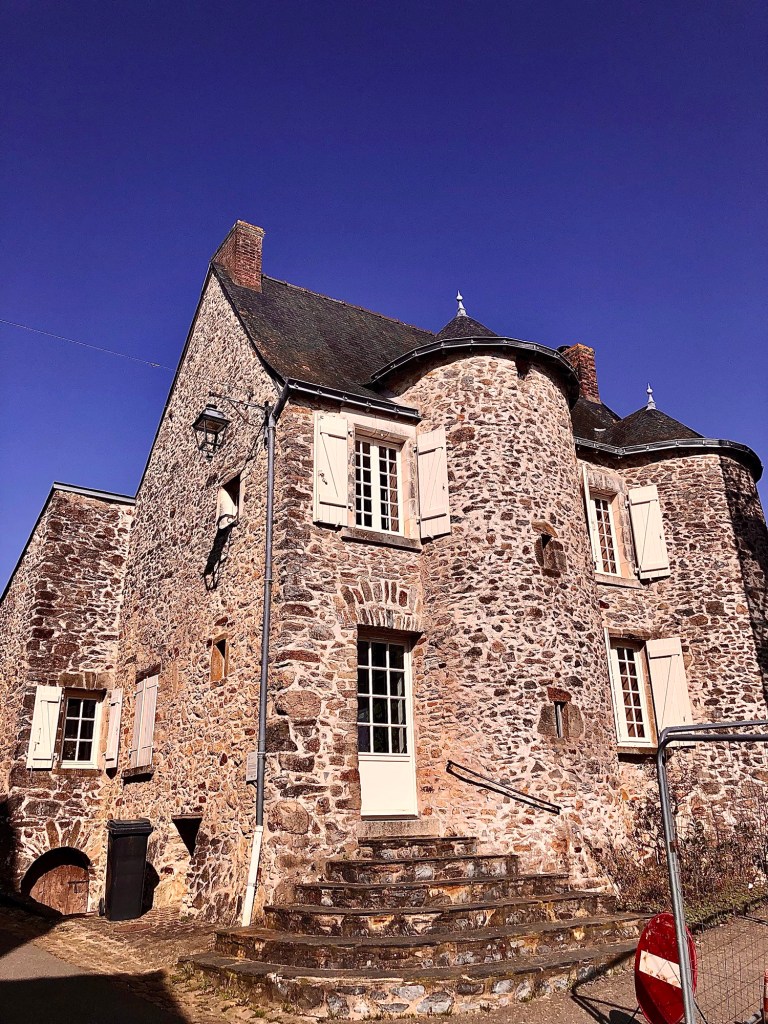
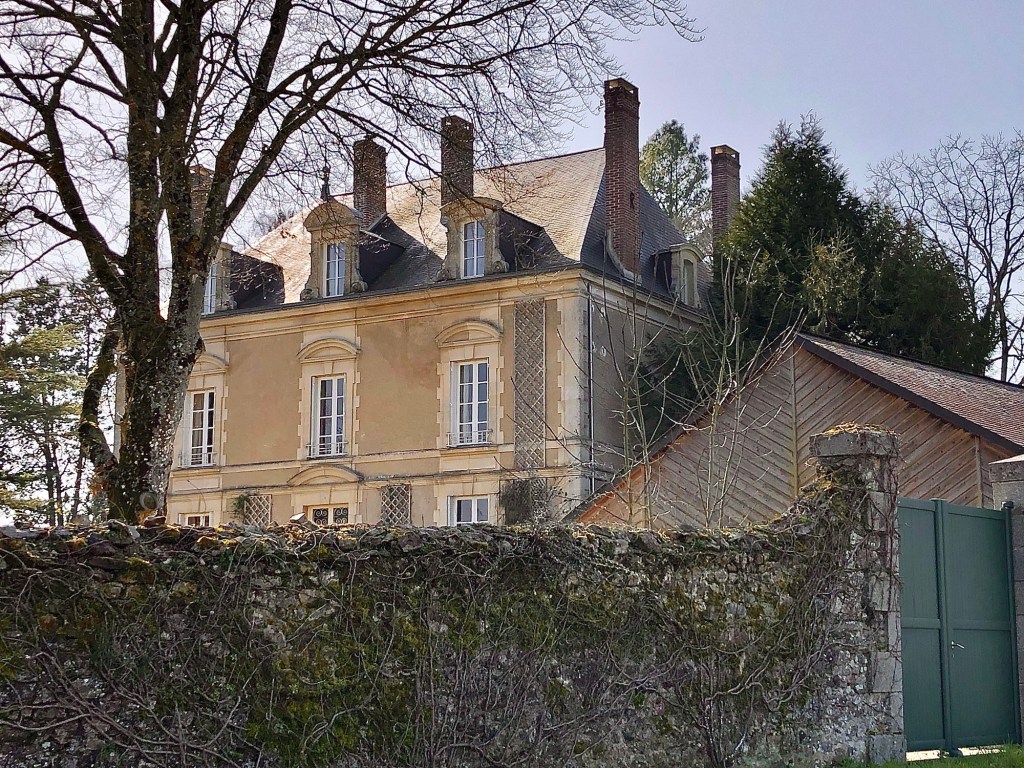
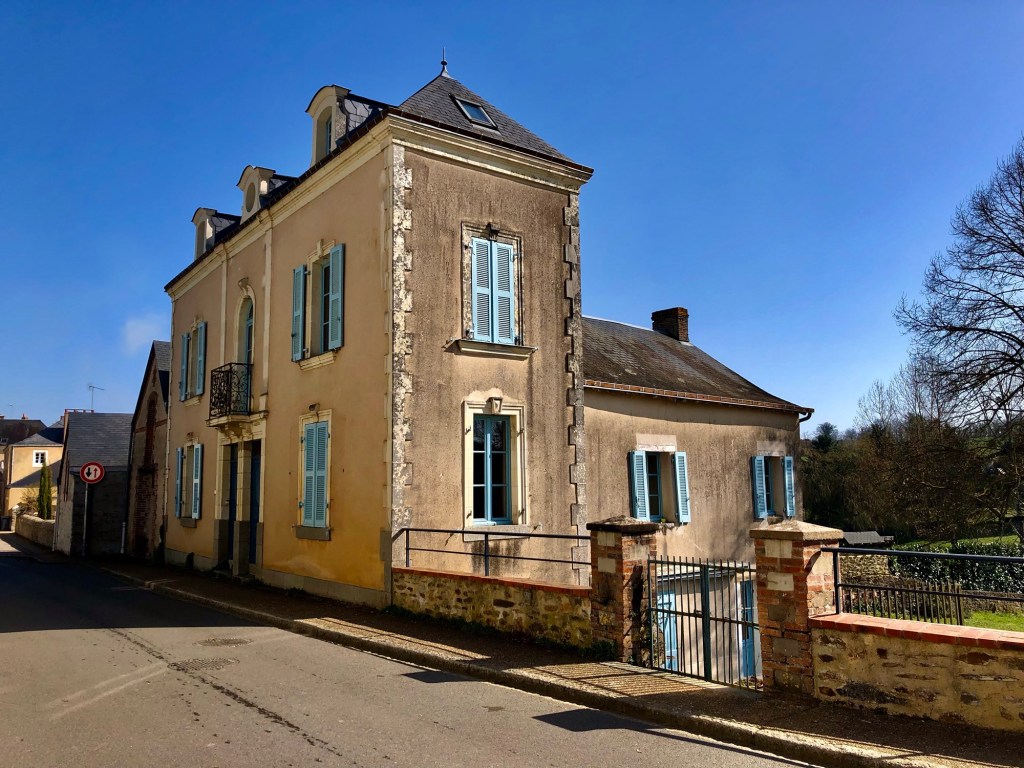
There are several lovely houses ranging around the core of the village. There are some nice examples of medieval domestic architecture (my favorite) as well as from later periods. All of them blend together in a very pleasing way. Many have plaques which present a brief history of the building. We found them to be informative and interesting and they helped us better understand the area’s past. I wish our own town would do something similar.
19th Century Workers’ Cottages
We enjoyed our visit to Parné-sur-Roc. Because it’s a small place, it is probably best to include it as part of a day-trip to nearby Laval and Entrammes. The three together make for a full and well-rounded day of sightseeing. You won’t find any food or window shopping in Parné (or Entramme, for that matter), but Laval will serve you well in those respects. This small village is definitely worth a look.
Fanciful 19th Century Ode to William the Conqueror in Falaise
This post has taken a few months to produce. Principally, because I am an arch-procrastinator. There is no task that I can’t put off until later.
Much later.
But, in my defense, it also took this long because the post covers two separate visits which – conveniently, for the purposes of stitching together this weak excuse – happened several months apart. Earlier this summer (June) we made a somewhat rushed trip to the town of Bayeux. Then, just a couple of days ago, we had a look around the town of Falaise. So, how could I have possibly written this post until today?
Erm … we’ll just ignore the fact that I could have simply done two separate blog posts. Arch-procrastinator, remember? Also, there is a through-line connecting these two town visits: the life of William the Conqueror. So let’s focus on that. Stay with me on this …
William (Guillaume in French or, commonly, Gulielmus, in Latin) was born in Falaise around 1027 or 1028. At the time, the town was the seat of power for the duchy of Normandie. A castle already stood on the rocky outcrop where the remains of the last fortifications exist today. After his father died while returning from pilgrimage to Jerusalem, little Billy became duke at the age of 7 or 8. Many years passed, during which the young ruler gained much experience in waging war and governing an expanding duchy. Finally, in 1066, he took a short sailing trip with a few buddies. On the way, they decided to conquer England and commission the stitching of the longest “Mission Accomplished” banner ever made. That banner ended up in Bayeux where boatloads of visitors (and their buddies) travel to see it firsthand. There. See? Through-line.
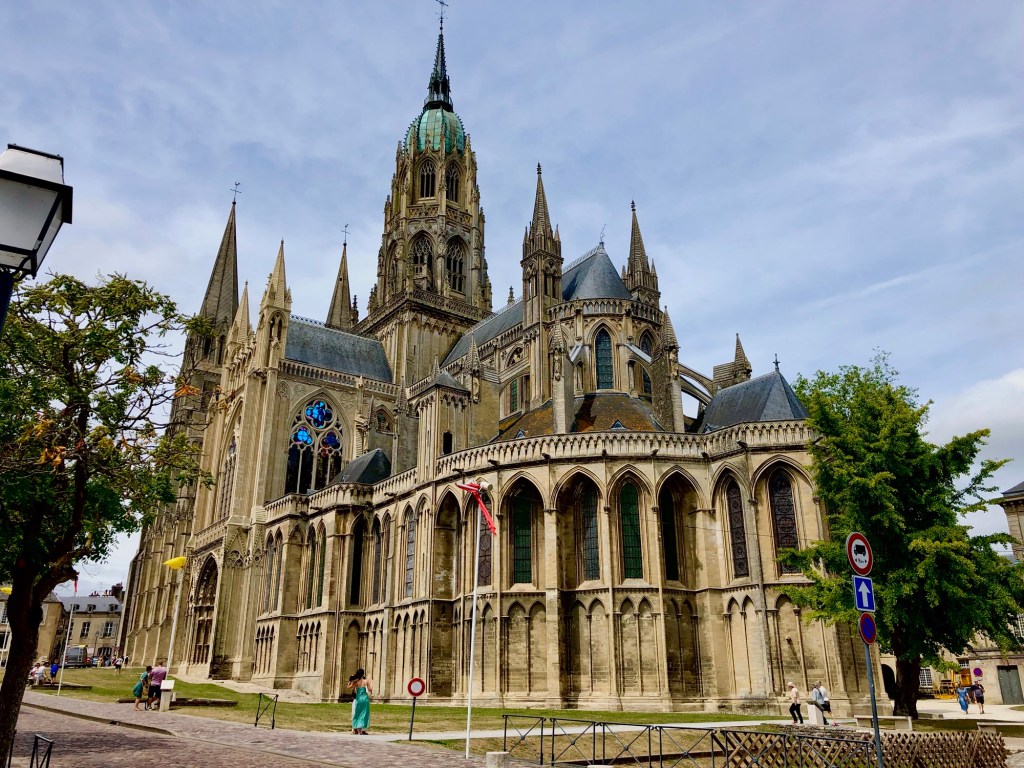
Bayeux Cathedral
Bayeux is a small town of around 13,000 inhabitants, just a few kilometers northwest of Caen, in the département of Calvados. It’s also not very far from the D-day beaches. Interestingly, it is this relative proximity to the allied invasion landing sites that helped to spare the town from destruction. As a result, it is one of the very few villes in this part of Normandie to have retained its pre-war character.
Elegant Entrance to the Forecourt of the Tapestry Museum
We arrived in Bayeux on a beautiful day with only one solid objective in mind: the Bayeux tapestry. But that would come after lunch. We found a nice local bistro where we had a bite to eat and then made our way to Le Musée de La Tapisserie de Bayeux. Housed in a former 17th century seminary, this well-organized and well-presented museum houses excellent displays on the town’s history. But the star of the show is undoubtedly the tapestry itself. Actually, it is an embroidery: a linen textile base onto which wool thread of ten different colors is stitched.
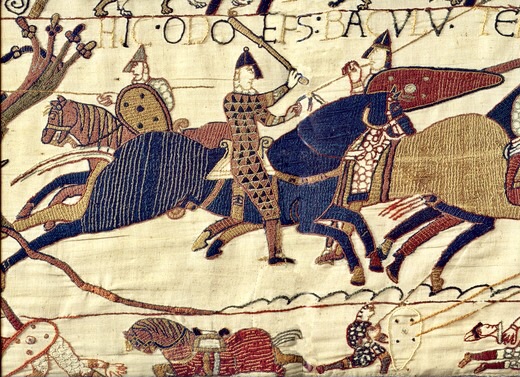
Bishop Odo Spreading the Love
The general scholarly consensus is that the “tapestry” was commissioned by William’s half-brother Odo, bishop of Bayeux (and proud new owner of massive parts of England, courtesy of brother Billy) in the 1070’s. Possibly created in southern England, it is thought to have been hung in Bayeux Cathedral (definitely worth a visit) after completion. The entire length (68.38 meters, or slightly over 224 feet) of the tapestry is displayed in a darkened room (to protect against damage from light) behind glass. We were happy to discover that one can get very close to the textile and see it in great detail. Absolutely brilliant to think that one is looking at an embroidery which is nearly a thousand years old.
Taking a Wander Through the Streets of Bayeux
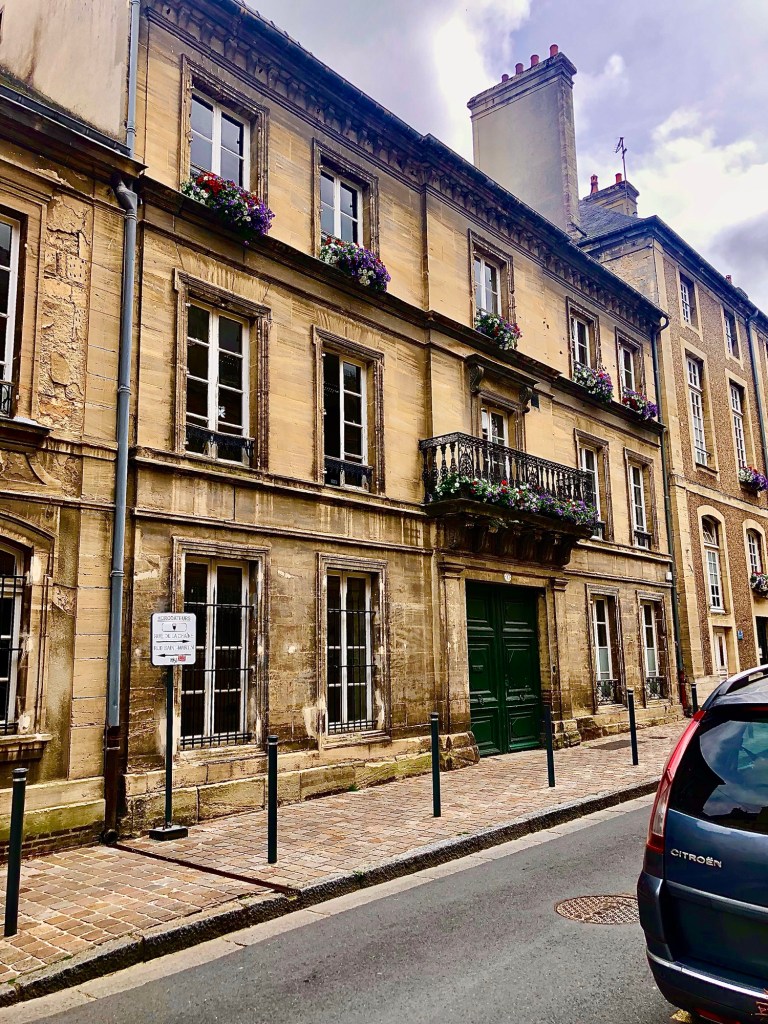
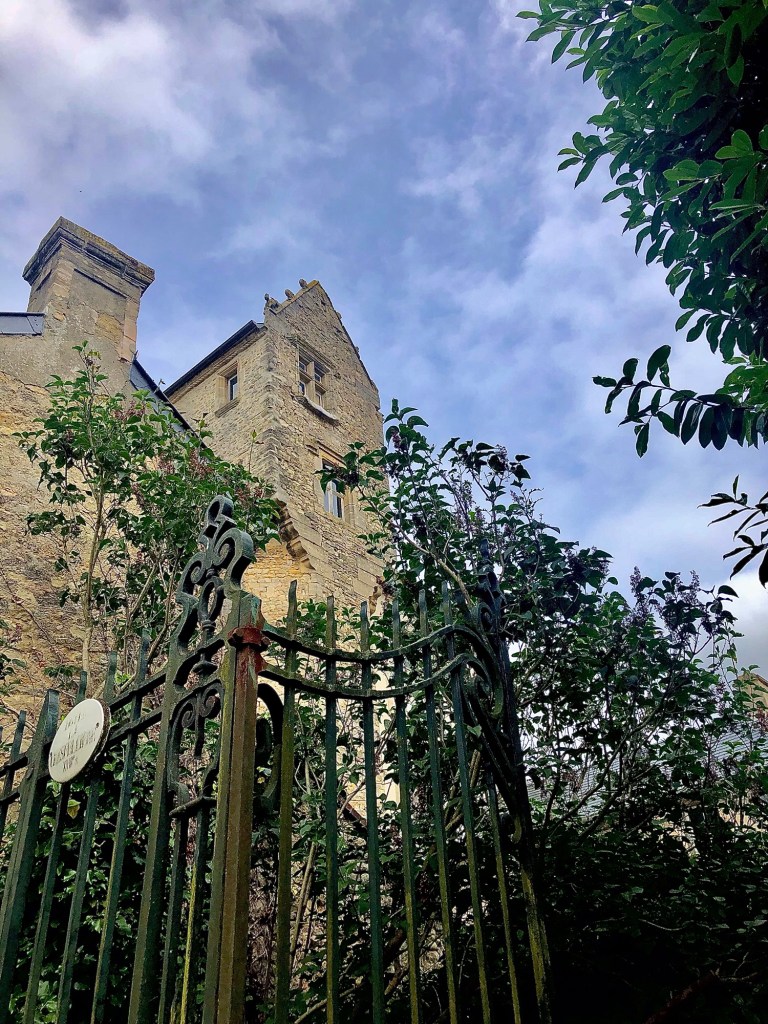
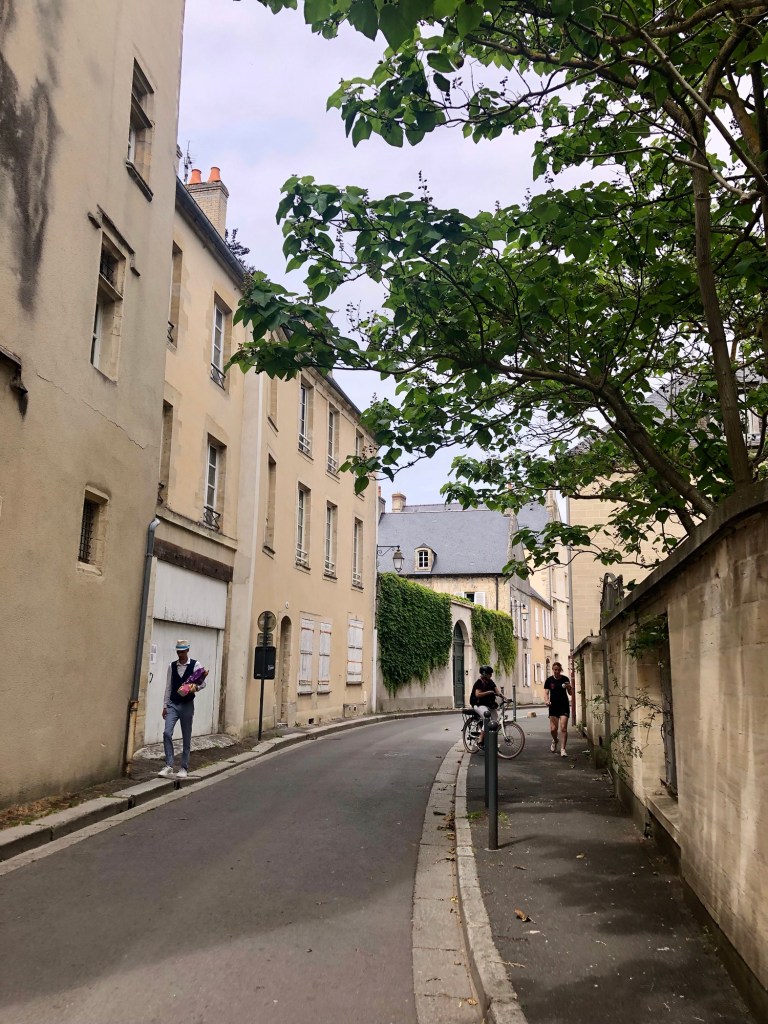
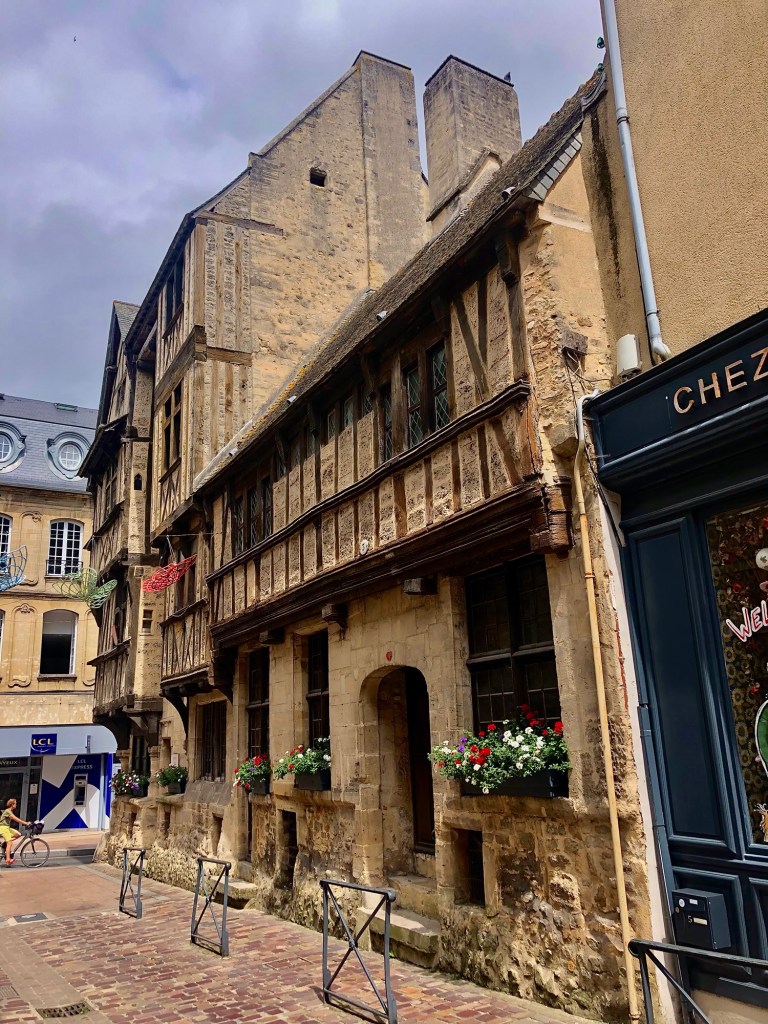
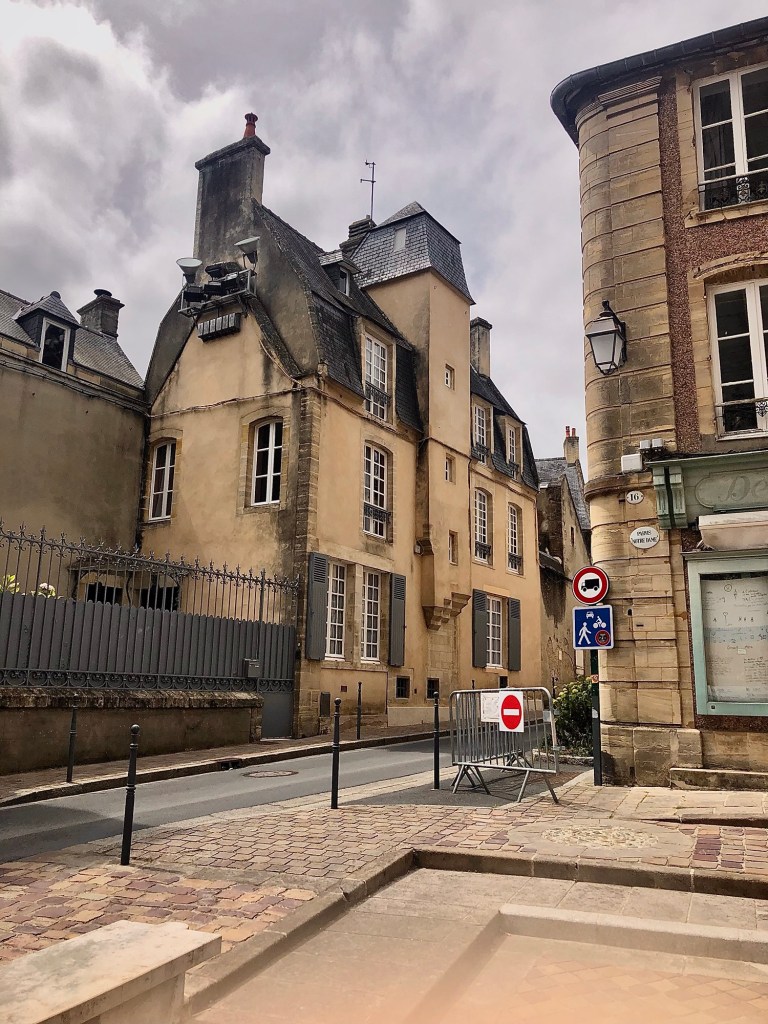
Though relatively small, the center of town has a bustling high street. We were there in late June on a weekday and it was completely rammed with tourists – a good deal of them American or British. But, as is usually the case, the side streets are where few tourists dare to tread. And it’s there where we not only found a more peaceful version of Bayeux, but also some beautiful scenic gems. The narrow medieval streets of the old town are hedged in by lovely old buildings, many of which display interesting architectural facets which seem to be unique to the area. We spent an enchanting afternoon wandering aimlessly, willingly following the timeless cobblestones whither they wished to lead us.
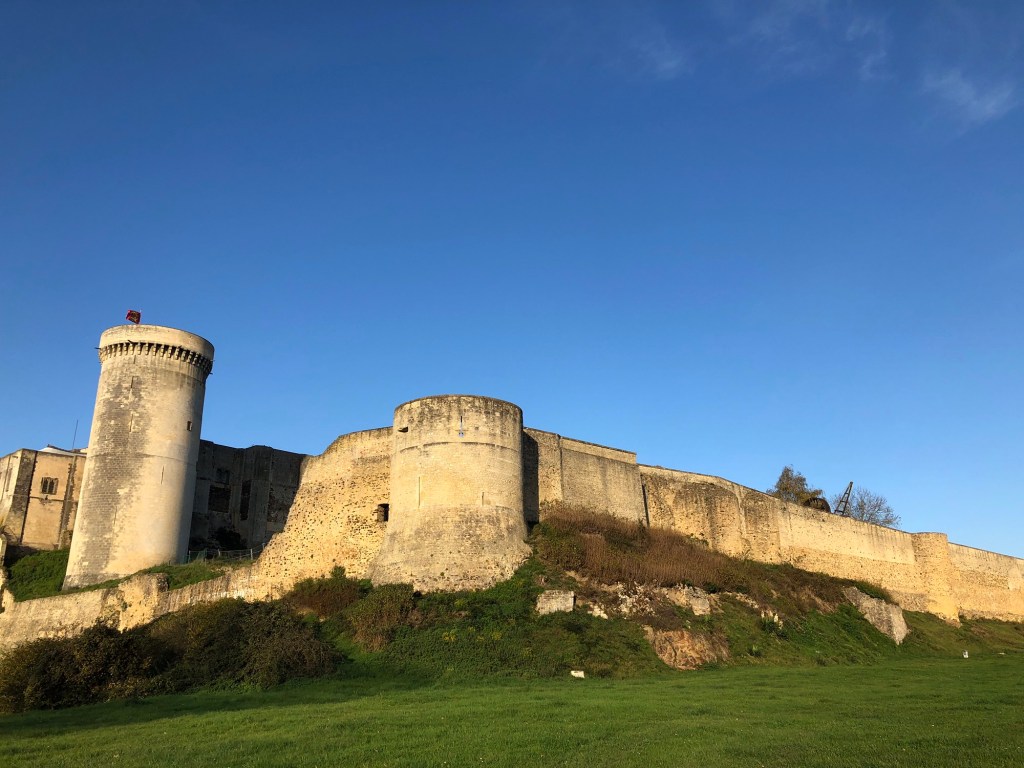
Le Château-Fort de Falaise
We continued our Conqueror’s Trail – he was also called “the Bastard”, but Bastard’s Trail doesn’t quite have the same ring to it – by pulling into the even smaller town of Falaise. It was mid-November by now so there were almost no other visitors apart from us. I imagine, though, that the place can be thronging in the high season. I mean, one look at the magnificent, chalky ramparts, towers and donjon of the château standing watch over its town is more than enough to get your tourist juices flowing.
Odd Camouflage – WWII Sherman Tank on Display Near the Centre-Ville Car Park
But first things first. As per usual, we arrived in town at lunchtime. We were hungry. And those tourist juices don’t just create themselves. So we nipped into a brasserie just opposite the castle and grabbed a bite to eat, stuffed in like sardines with locals who, I think, found us to be a curious diversion while they loudly bantered with each other over their meals. We all seemed to have a nice lunch and, by the time we walked out the door, they were laughing with us instead of at us. It was fun. And that little spark of connection between two cultures is always a rewarding feeling. So, we’ll take that as a win. Off to the château!
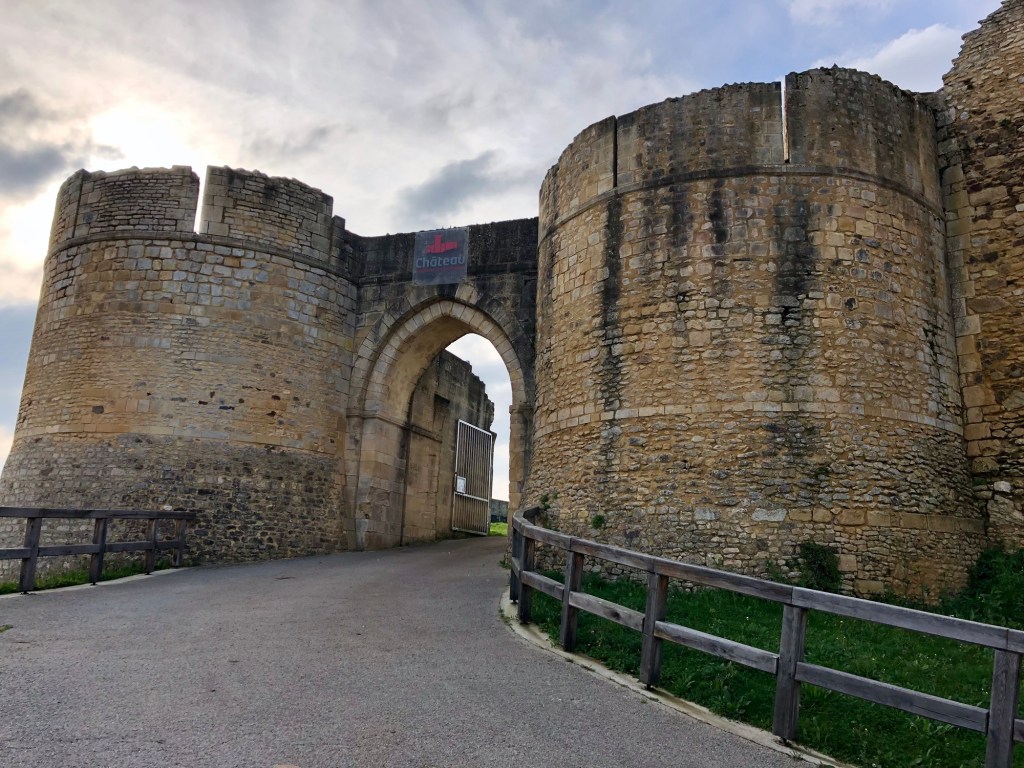
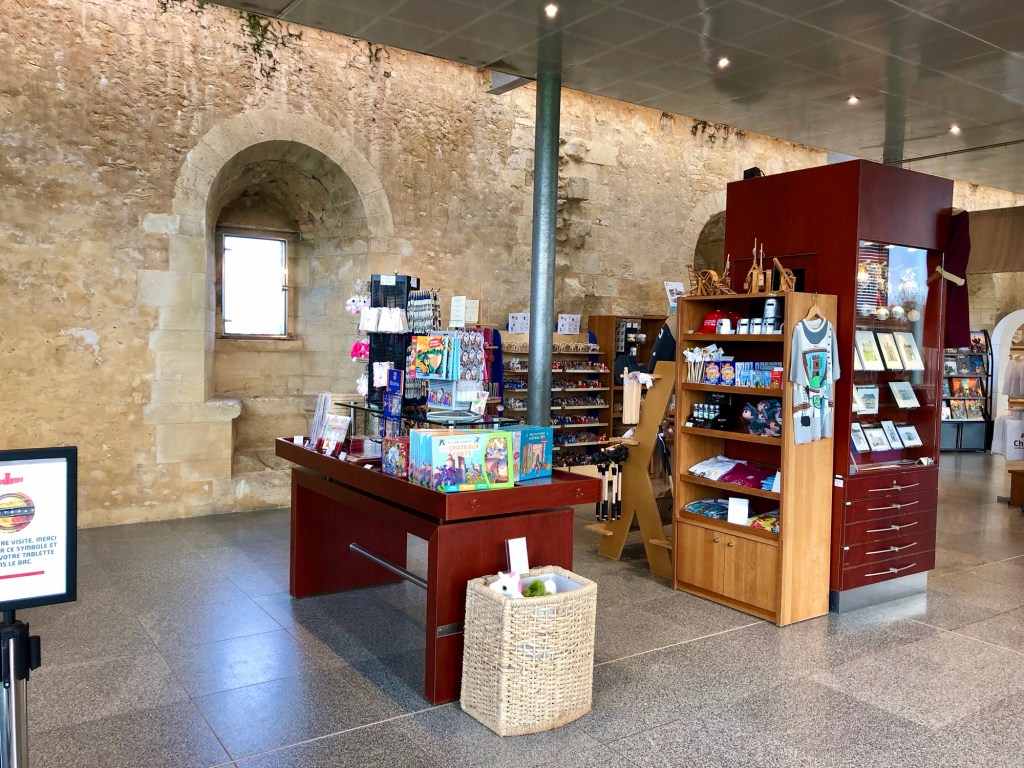
Entrée LibreA Handsome Gift ShopConcrete and Steel Mask Over the Donjon
The illegitimate offspring of a duke and a local tanner’s daughter, William spent much of his early years in Falaise. In the very castle which we were privileged to visit that day. There has been a stone fortification of some kind on this rocky mound since circa 960. You can wander freely around the outer ramparts but there is a fee charged to enter the hub of the château-fort: the donjon. The square, imposing form of the principal surviving stone structure inside the walls has been restored – in some areas quite heavily. For some reason, the restorers erected a gargantuan concrete and steel-beam structure in front, apparently in an attempt to reference the original entrance but in a very post-modern, brutalist manner. We both found it to be a bewildering choice.
In the Rooms Where it Happened – Inside William’s Childhood Home
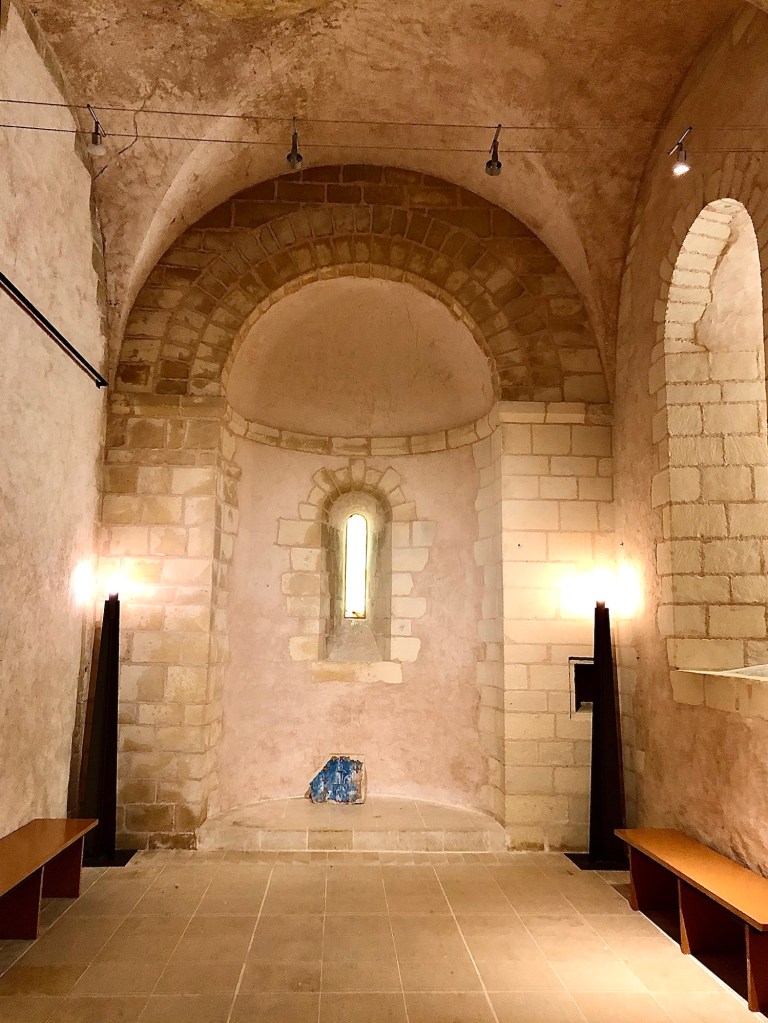
Once inside, we discovered that the main hall of the Norman keep has also been handled in a very strange way. The best way we could think to describe it is “early 2000’s exhibition hall chic”. But the good news is that the rest of the donjon has been much more sympathetically restored. There are several levels to see, even up to the rooftop for some nice views of the town and surrounding countryside. Overall, it’s a rewarding place to visit and worth the price of the ticket.
La Trinité
We are always keen to visit a nice church and there are two within easy walking distance from the castle. Our favorite was the most ancient and interesting L’Église de la Trinité. The current edifice stands facing the lovely Hôtel de Ville and the château beyond. It originates from the 13th century and after, but there has been a church on the spot since at least the 9th century. So, yeah, kinda old. La Trinité was heavily damaged during World War II but lovingly and expertly rebuilt. Of special note are the substantial portions built in the French Renaissance style (porch, various chapels). Quite special and beautiful. But the whole church is a gem and definitely a must-see.
Châtelet of Our Dreams – La Porte dés Cordeliers
Falaise has retained many vestiges of its 12th century town defenses. One special point along this circuit is the Porte dés Cordeliers. A picture-perfect châtelet guarding one entrance into the medieval town, this charming remnant completely entranced us both. It is sadly empty and seemingly abandoned, but so incredibly beautiful to our eyes. As we took our many photos, we madly schemed with each other as to how one could purchase it and make it the perfect home. This poor, neglected piece of history is crying out for help. We really hope it receives some attention soon.
Falaise War Devastation
We liked Falaise. Though small, and having suffered horribly during the last war, it is bursting with history. We ran out of time so we were unable to visit the museum dedicated to the experiences of the citizens of Falaise during the war (Les Civils dans la Guerre) but we hope to return to see it someday soon. A thriving commercial district lines the axis of the town too. So there are plenty of shops to browse. It was a fun time. And our only regret was that we didn’t have more time to spend there.
Bayeux and Falaise. You should visit them. We’re certainly glad that we did.
It was the middle of the week. We had finished yet another changeover for our holiday rental the previous day. Feeling a little tired, we decided that a quick exploration would be just the ticket to revive our spirits. The other day I had seen a short video online about a town which looked kind of interesting. Winding streets. Centuries-old architecture. A history reaching back for centuries. Definitely our kind of place. The ville of Moncontour has attained the coveted designations of being a Petite Cité de Caractère, as well as one of Les Plus Beaux Villages de France. Not bad, we thought.
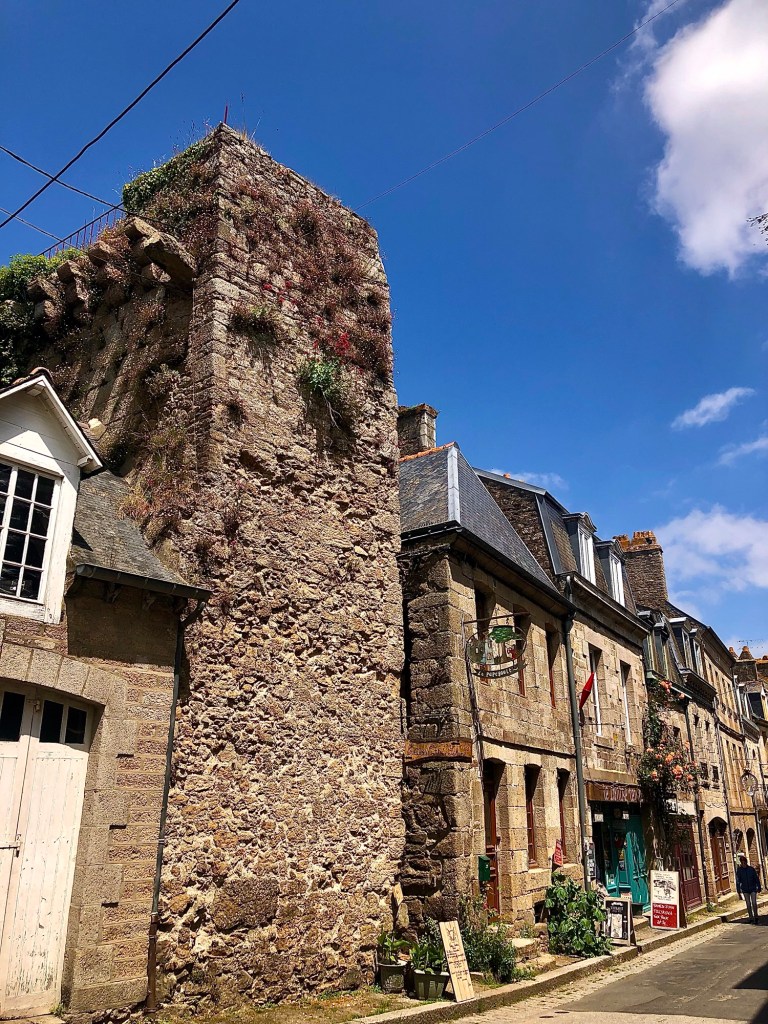
The Old Town Defences
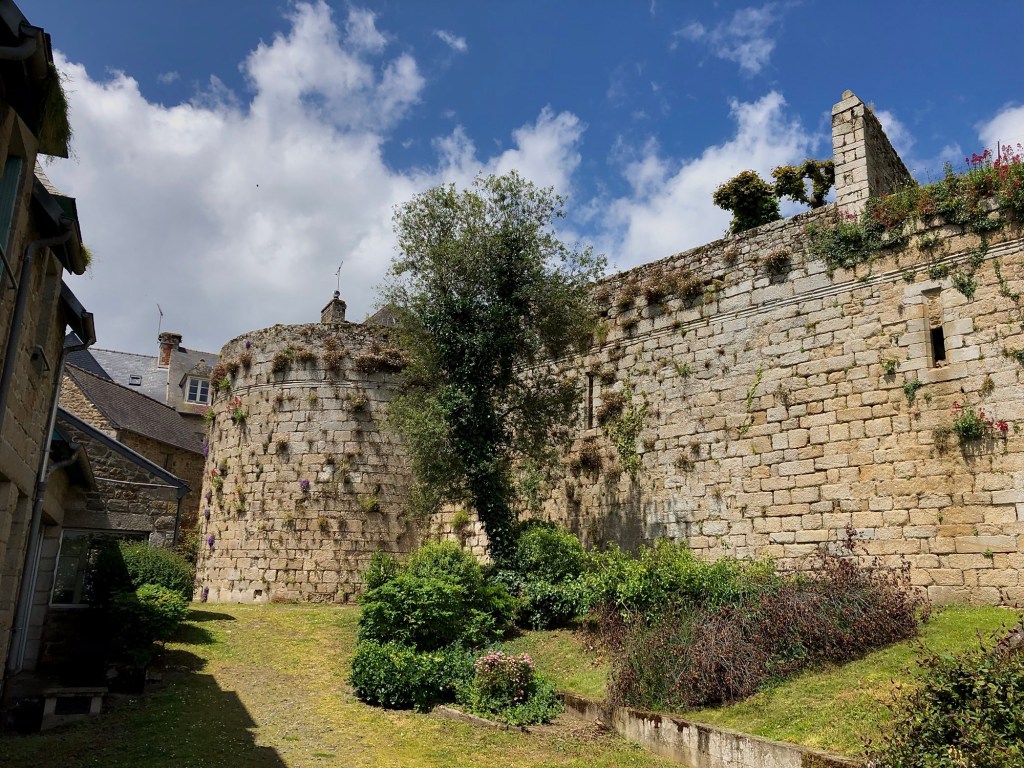
It seems that there was a settlement at Moncontour as early as the 7th century. The later medieval town developed on top of a narrow, rocky escarpment situated at the confluence of two small rivers. Its purpose was to guard the western approaches to Lamballe, then the capital of the area known as Penthièvre. The ville was encircled with strong stone ramparts and round towers, clinging to the steep slopes that tumble down to the waters below.
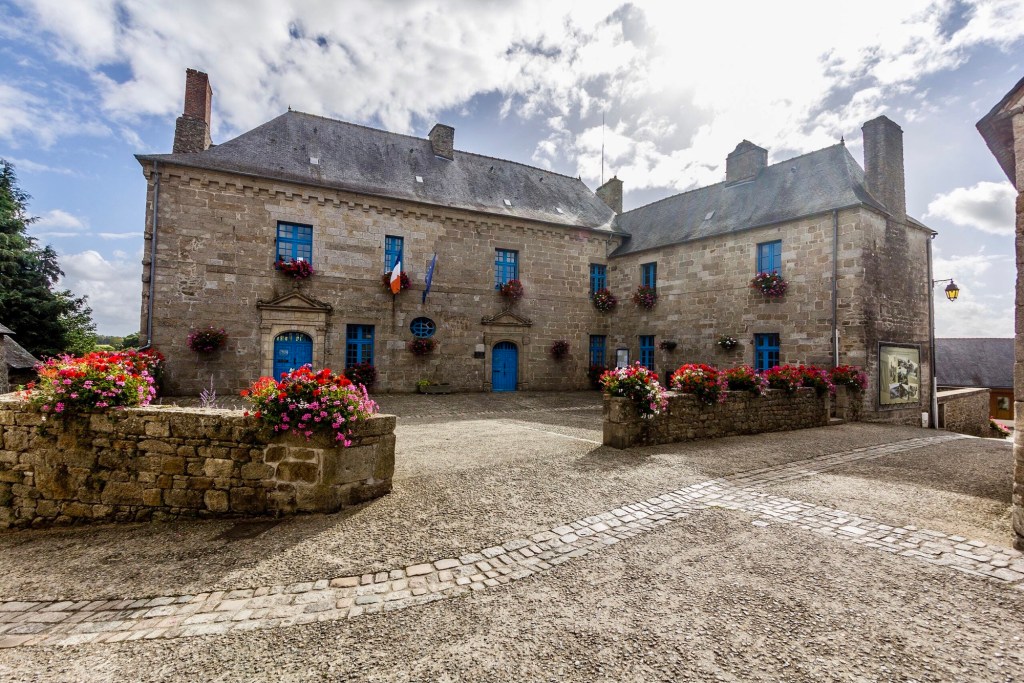
L’Hôtel Kerjégu (now the Mairie) – a 17th c. Testament to Moncontour’s Past Grandeur
Although the town expanded through the centuries, it appears to have changed little since the 17th and 18th centuries. In the past, it thrived on the weaving of linen and hemp cloth, exporting these goods through the ports of St. Malo and Lorient to Spain and the Indies. By the 1790’s, the town boasted more than 2,000 inhabitants. But a slow decline over the ensuing two centuries reduced the population significantly. By 2021, only 745 people made Moncontour their home.
Once We Were Giants
From Fougères, we drove an hour-and-a-half westward to Moncontour. It sits about 24 kilometers south of Saint-Brieuc in pretty countryside, surrounded by rocky hills and steep-sided vales. One enters by climbing up the ramp-like approach that mounts the side of the escarpment. Once on top, you are surrounded by lovely old buildings. Once regal and proud to display their proprietor’s success, many of the ancient homes now bear a patina of diminished fortune and a want of population to support them. For the visitor, it presents a charming age and is pleasantly evocative of the past centuries. However, I am not so sure it is as reassuring to those who live there.
Commerce
Moncontour is not a town for shopping. There are precious few shops, though we did pass by a fine-looking bookshop. If you are looking for something sweet to take home (or eat in the street if you can’t wait), then the patisserie on Rue Notre Dame is quite good. We bought a rather delectable slice of chocolate torte there and, quite proud of our restraint, managed to wait until we got home to eat it.
Beauty is All Around You in Moncontour (click each photo to enlarge)
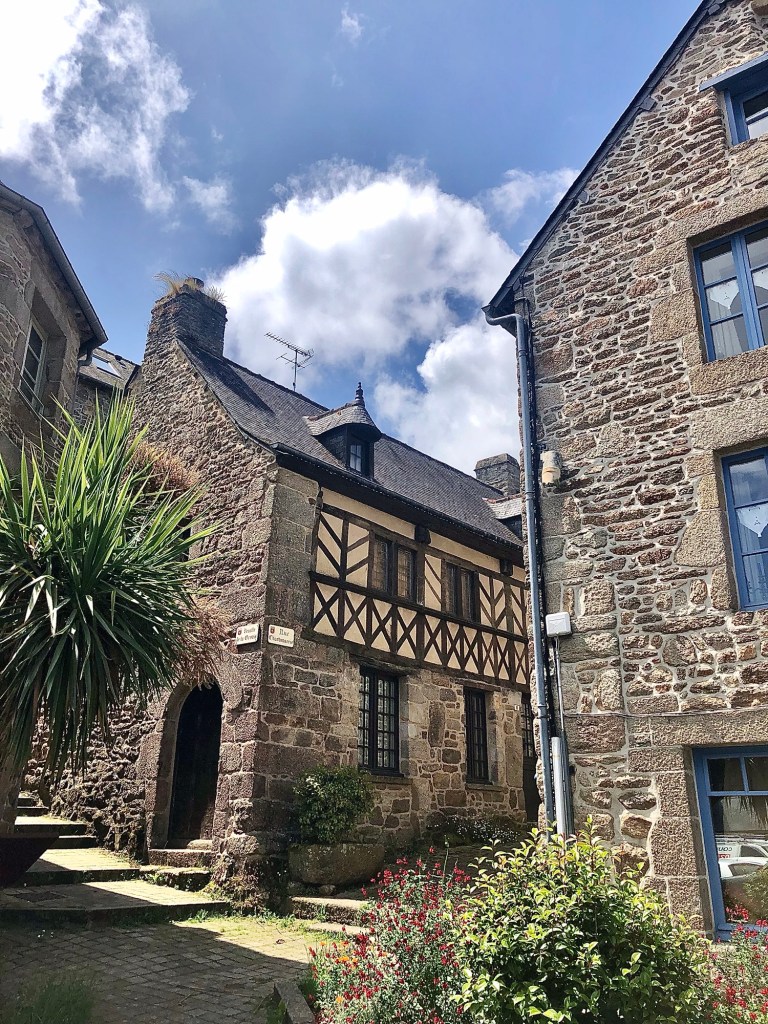
The real show in this lovely little town is the ambiance. We simply let ourselves wander down the quiet lanes, admiring the many stone and half-timbered buildings which line them. A good number of the homes and shops are well-kept, lovingly maintained and restored. But many others, sadly, stand empty, a bit worn down and sagging as the accumulating years threaten to melt them away. Fine examples ranging from the 14th through the 18th century await any lucky wanderer who cares to appreciate the art and skill of those past artisans.
Saint Mathurin’s Church (click each photo to enlarge)
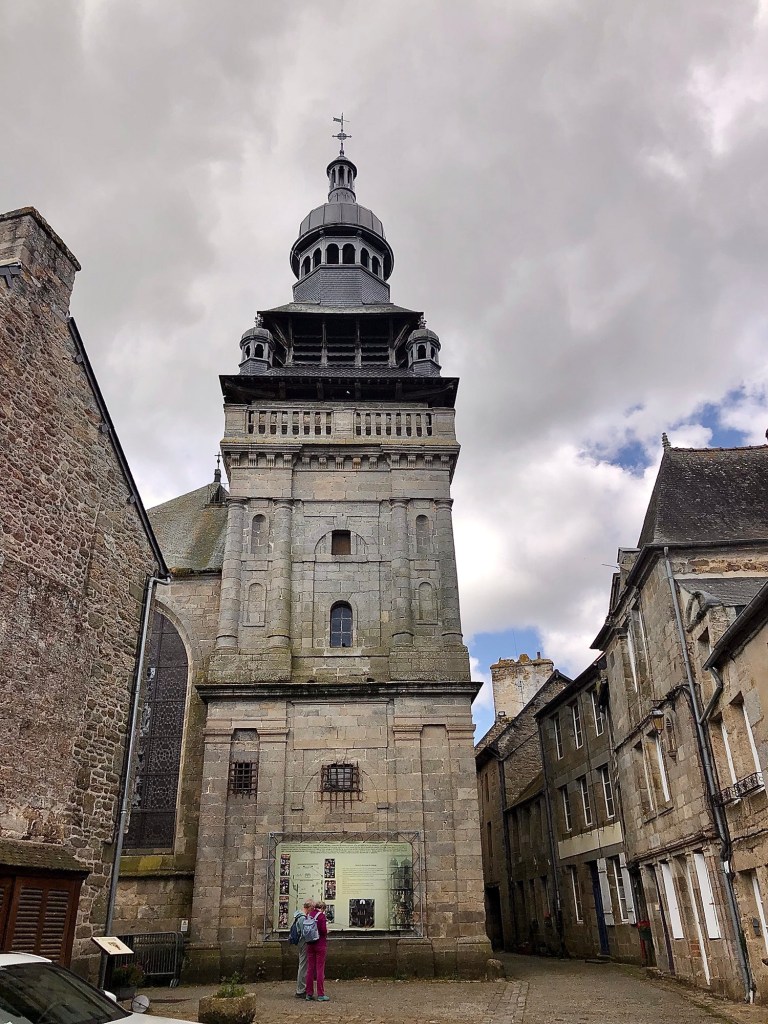
Possibly the star of the panoply is the church. L’Église St. Mathurin proudly anchors the center of town, a broad square affords a pleasing view of the church’s west front and its bell tower projecting skyward. The building’s constituent parts cover the early 16th to 18th centuries and somehow with age have combined into a harmonious assemblage. We were dazzled by the several 16th century stained glass windows still intact and seemingly as fresh as the day they were made.
By the time we arrived in Moncontour, we were feeling quite hungry. And, thankfully, it was right at the beginning of the sacred two-hour lunchtime which our fellow French citizens observe with meticulous regularity. In fact, lunchtime might just possibly be the only event about which they are so precise. Excepting, perhaps, the Tour de France.
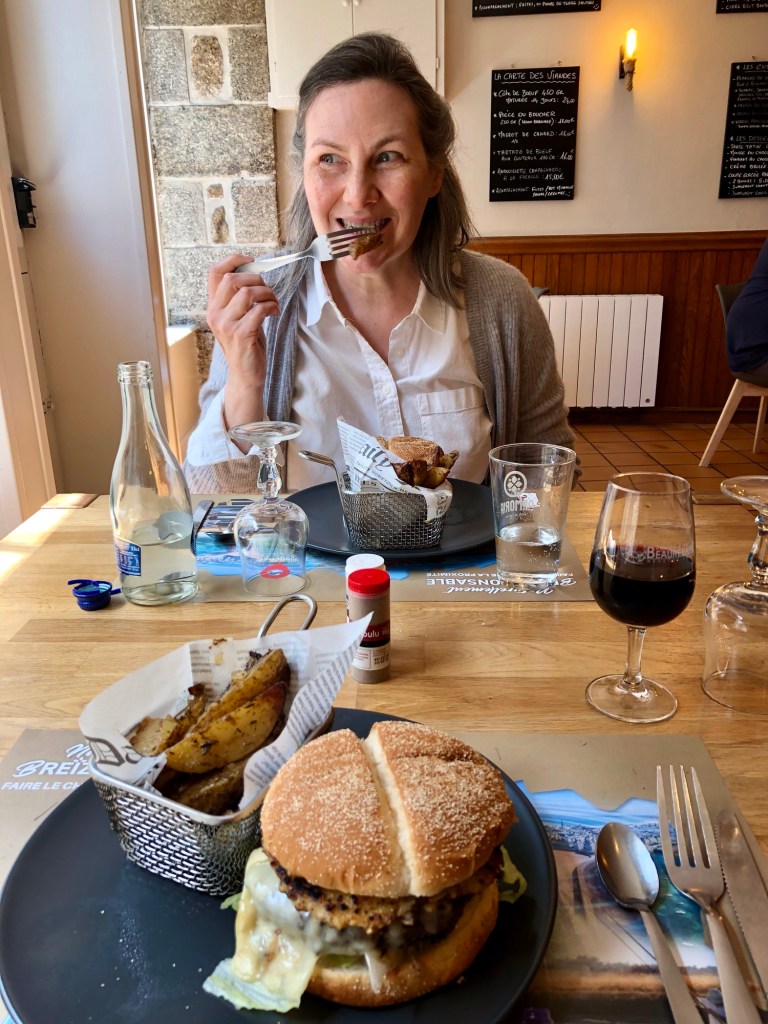
Really Good Burgers from the Wizard of Les Remparts
Not intending to miss out, the two of us cast our keen eyes about the town, searching for our next meal. As you might imagine might be the case in such a small town, the choice was limited. Luckily for us, Cherie thought we should try a little place just up the street on Rue de l’Union: les Remparts. Unassuming in the extreme, the place was almost entirely full. We were shown to one of the last open tables by what turned out to be the sole owner/chef/bartender/server/and dishwasher. This man did it all, and he was nothing short of a phenomenon. We counted 7 tables and 18 diners, six of whom were a group of hungry construction workers. Despite a surprisingly extensive menu plus daily specials, he took orders, poured drinks, cooked, served meals and took payment – all in the time you would expect of at least three or four normal human beings working flat out. Moreover, the food was quite good and well-presented. Needless to say we were well impressed. It was a performance worthy of a Nobel Prize. Do give this restaurant a try if you visit.
We had a fine time in Moncontour. Relaxed, eminently picturesque, it’s one of those many places in France where you feel really fortunate to be a traveler. We’re glad we came and thankful that towns like this exist.

















 Finding Our France