The Torch Bearer and His Olympic Enforcers Pacing Past Our Gate
Surprising things happen in our little town in France. No, it wasn’t the appearance of a rude-shaped turnip in the market; not the invention of a new baguette with frosting and sprinkles; nor even the sighting of a grown man peeing with joyous abandon onto a memorial in the main square in broad daylight. [Although we did witness the last one yesterday while taking Saxon for a walk.] Even though all of those stories would easily make it onto the front page of the local edition of the newspaper here, it was something much more unusual.
Crowds Begin to Gather Down Our Street
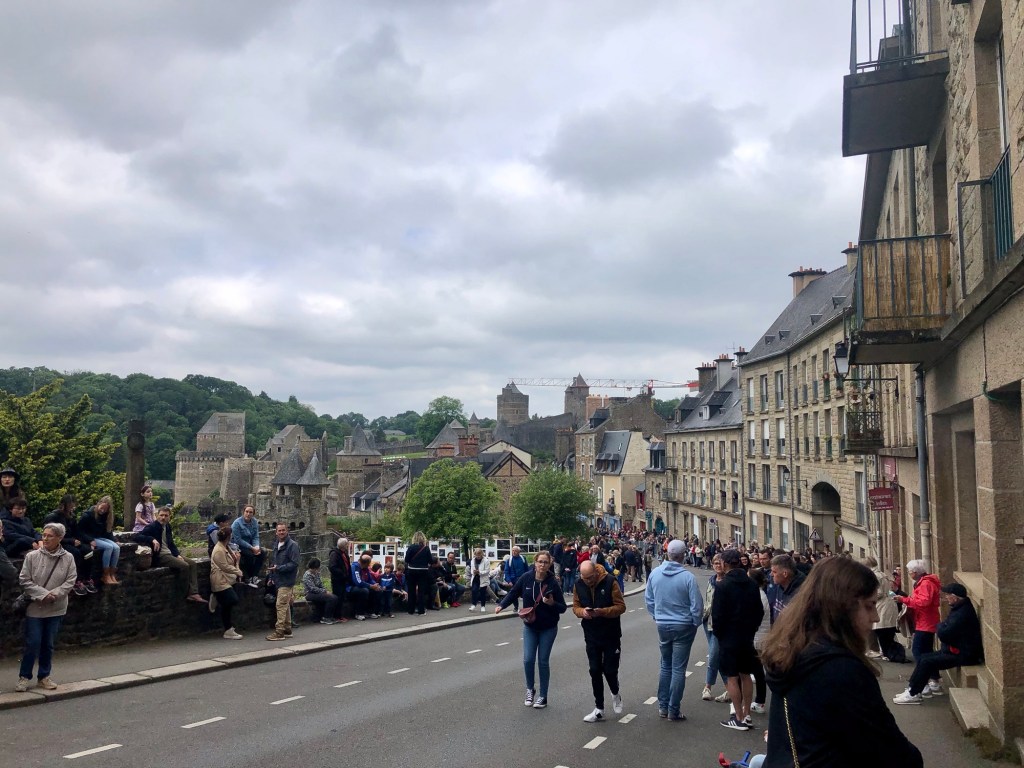
Saturday morning. Crowds began to gather throughout Fougères. There was a murmur of excitement building in front of our gates as people hurriedly laid claim to key viewing sites on the street in front of our house. The flame of the Olympic Games was coming to town.
The Procession Begins – Can You Spot the Torch?
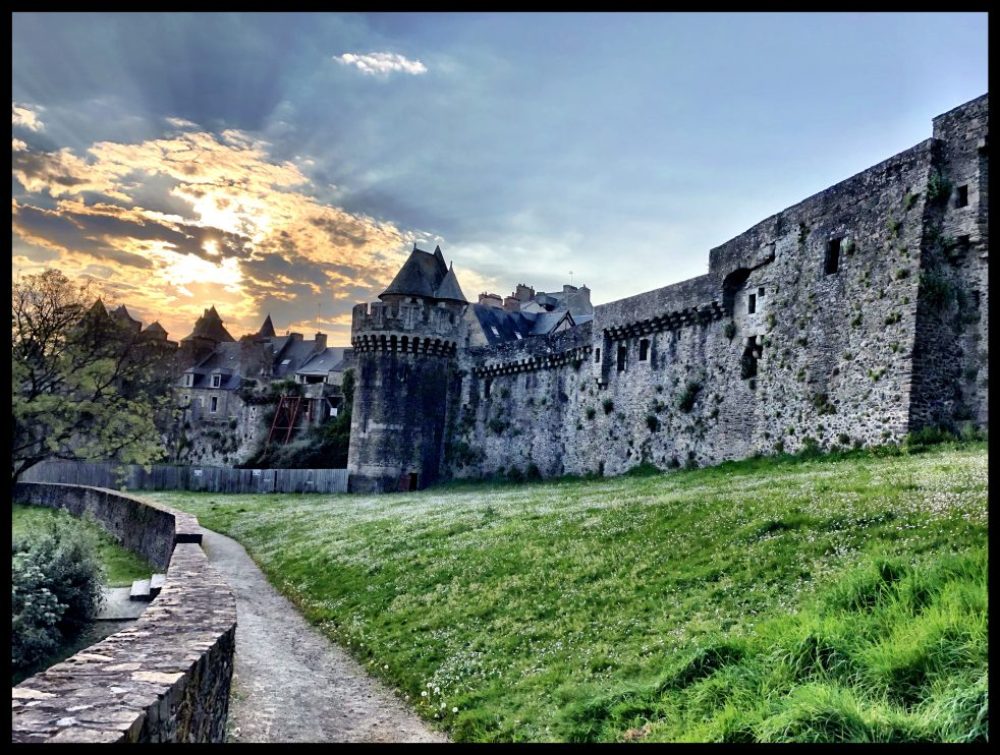
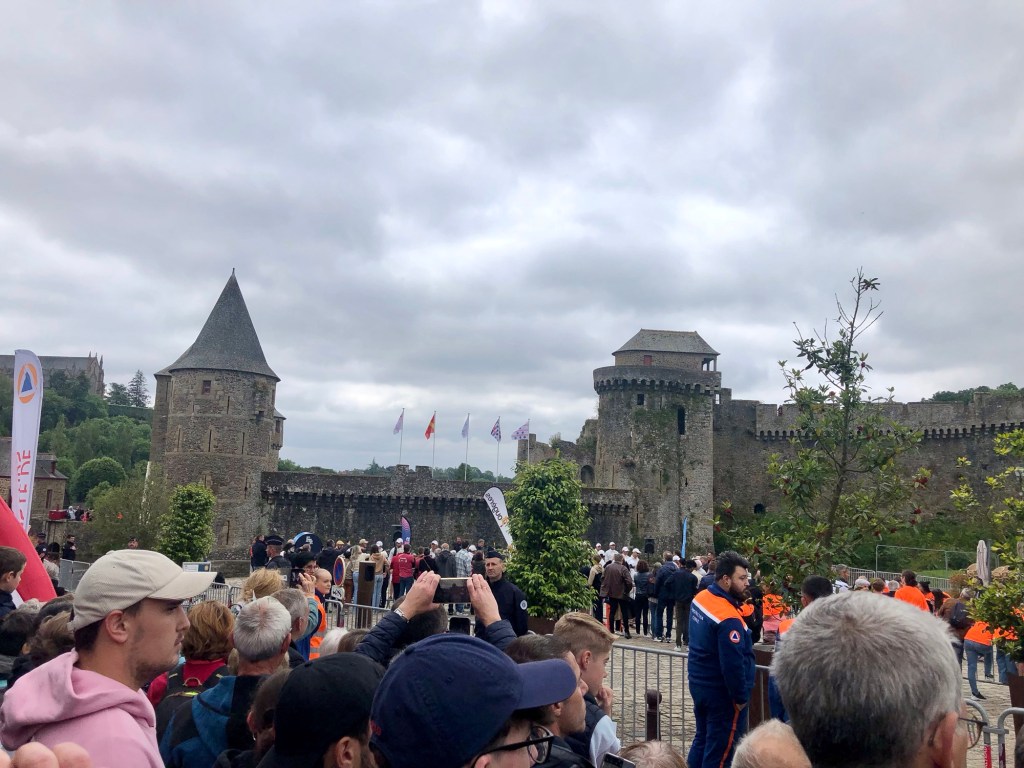
Joining the general hubbub filtering through our normally sedate neighborhood, Cherie and I walked down the hill to the square next to the castle. A sizable crowd had gathered to see the arrival of the olympic flame. After a surprisingly brief introduction, the first runner (more of a slow jog, really – the sort of thing you do when you see your bus pulling away, make a half-hearted show of quickening your pace for a few steps, and then stop in the acknowledgment that you never had a chance in hell of catching the damn thing in the first place) began the procession.
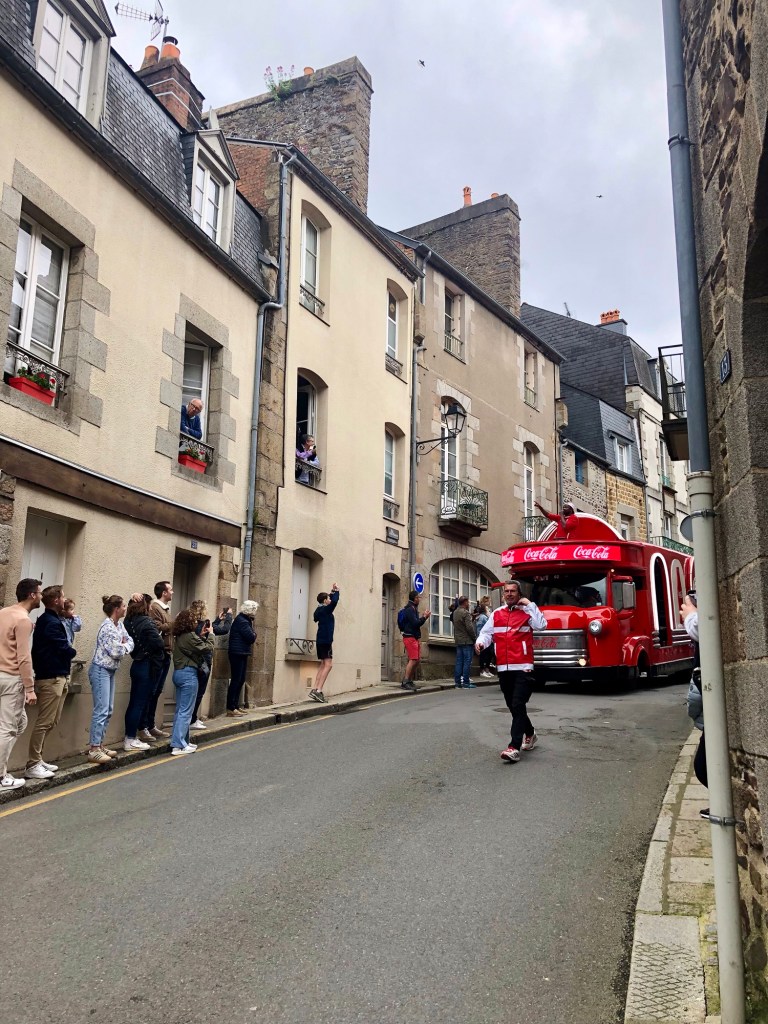
The Coca-Cola DJ, Bringin’ the Love (and tiny cans)
Everyone was very excited. This was the olympic flame, after all. Direct from Greece. As part of the buildup for the Summer Olympics in Paris, the flame has been making its way through several parts of France, including Bretagne. For some reason this included Fougères. And, for an hour or so, we played host to the sacred flame of Udûn, er, Olympia. Pretty cool!
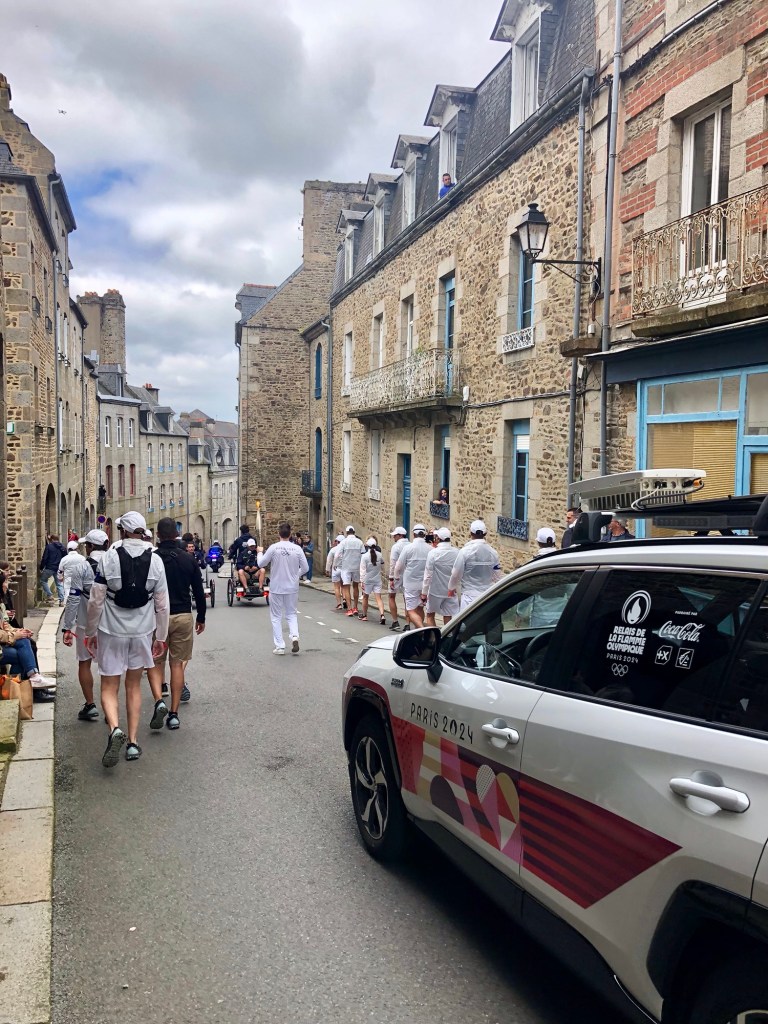
Old Flames – the Passing of the Olympic Torch
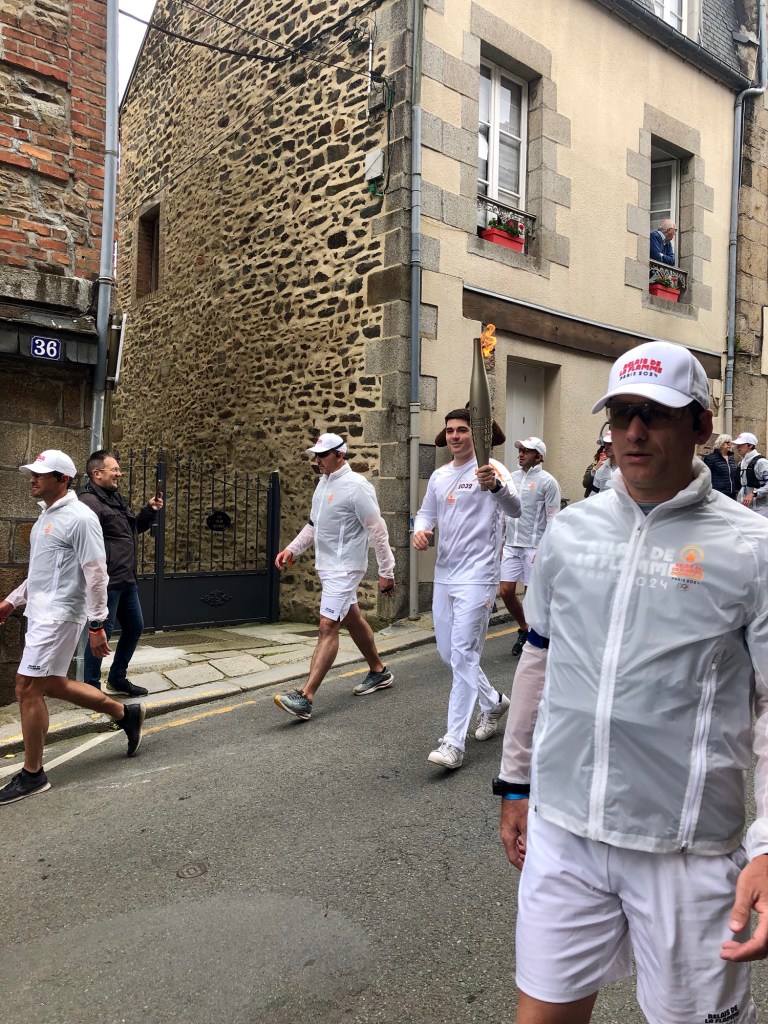
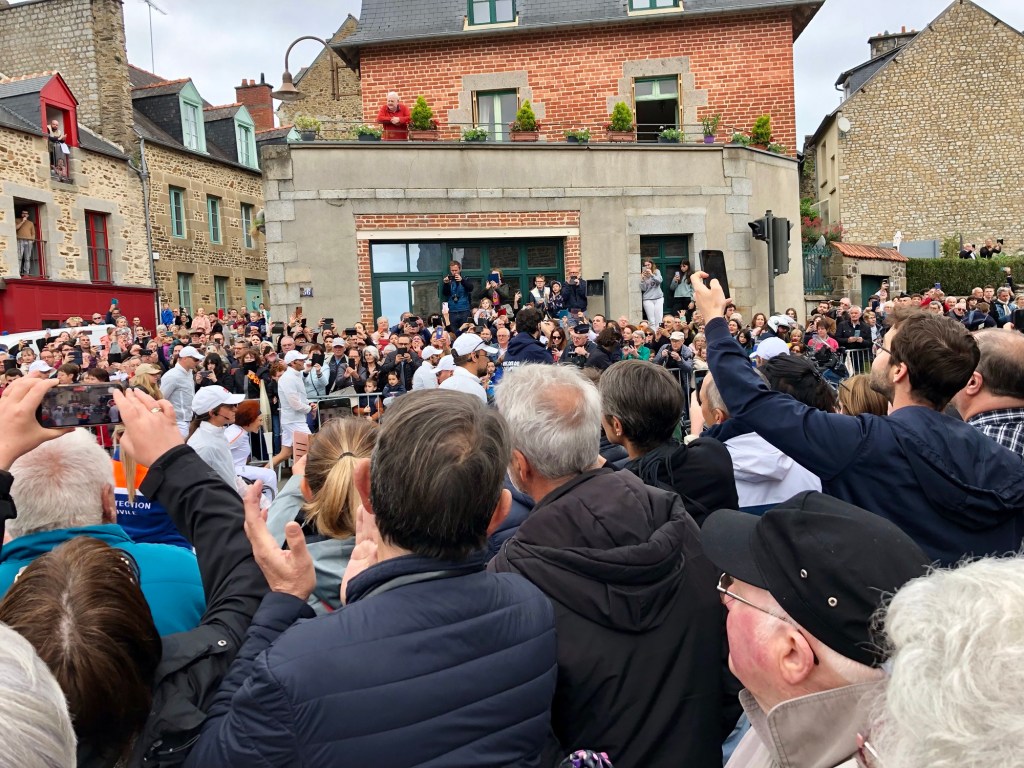
While the torch relay wound its way through the center of town, the two of us climbed back up our street and grabbed some sidewalk turf in front our gate. Like seasoned paparazzi, we skulked on either side of the pavement, Cherie in an archway, and me perched atop a stepping stool – my parents forgot to check the box for a statuesque build when they ordered me, so I needed the extra height. After a cavalcade of trucks sent by corporate sponsors to blare music and fling mini-cans of sugary drinks at unsuspecting bystanders, the torch bearer came loping down towards us. She passed the holy fire to the next bearer, they posed for a few photos, and then the new bearer let gravity take hold as he ambled with solemnity down the slope.
Opening Ceremonies in Front of the Château
And that was it. For a few moments, we were swept up in the planet’s gravitational pull towards the 2024 Olympics. It was an intoxicating moment. Pretty big stuff for our small piece of France.
Our Fifteen Minutes of Flame Trundles Away Down Our Street
[Just a quick one today. I had begun this post last September but then got sidetracked and eventually put it aside. But I think I did this subject a disservice in passing it over. So, I’ve dusted it off, nipped and tucked it in a few places, and nudged the poor neglected thing out in to the world for your consideration. As always, you be the judge.]
Having read this blog for a while now, you’ve probably noticed that France is a nation rich in historical monuments. Sadly, the country has not developed very good mechanisms for protecting and restoring these amazing places. There is no equivalent to English Heritage or National Trust to acquire historic properties, protect them, restore them and manage them. It’s a shame, really.
Nevertheless, a great deal of this important historic preservation work still manages to get done here, most of it conducted by passionate individuals and families, struggling to overcome considerable obstacles. I don’t know how they do it, but I greatly admire their efforts. We all owe them a debt of gratitude for preserving such beautiful and enduring chronicles of the past.
Carriage Rides and Market Stalls During Journées du Patrimoine (click the arrow to play video)
Despite the organizational challenges, one thing which France is particularly good at in this regard is honoring and promoting their heritage, their patrimoine. And every September the nation joins with the rest of the EU to celebrate the Journées Européennes du Patrimoine (European Heritage Days). During this weekend-long festival, many historic sites which are normally closed open their doors to the public for viewing and special events. We look forward to it every year.
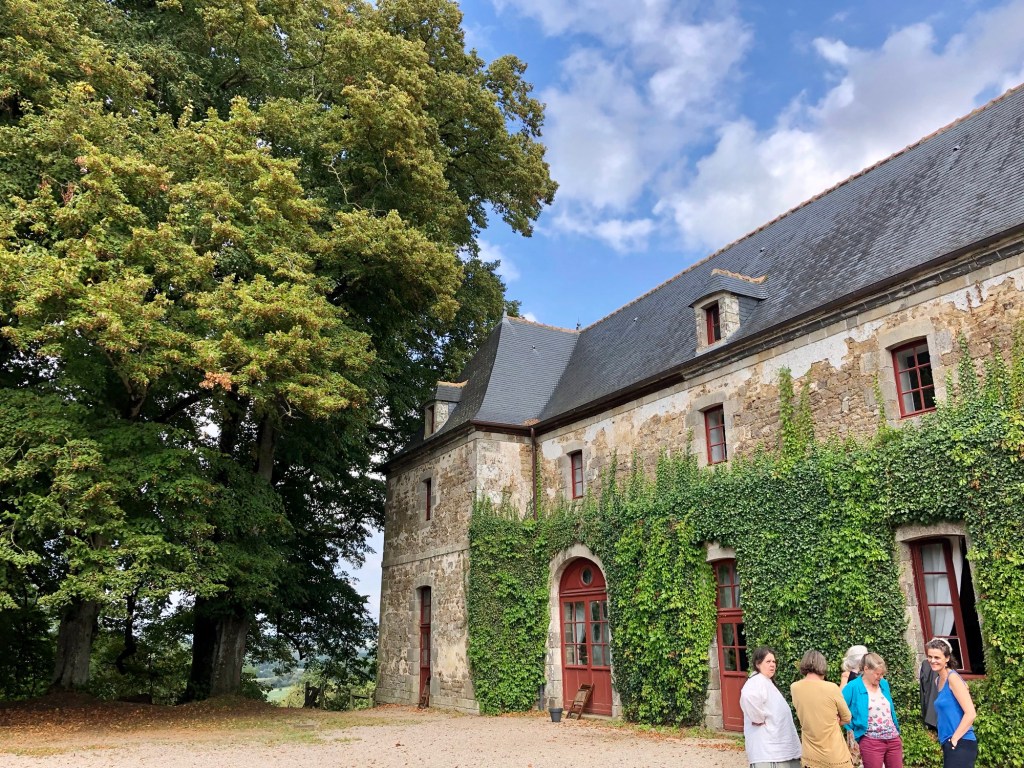
One of the Beautiful Outbuildings at Montmuran
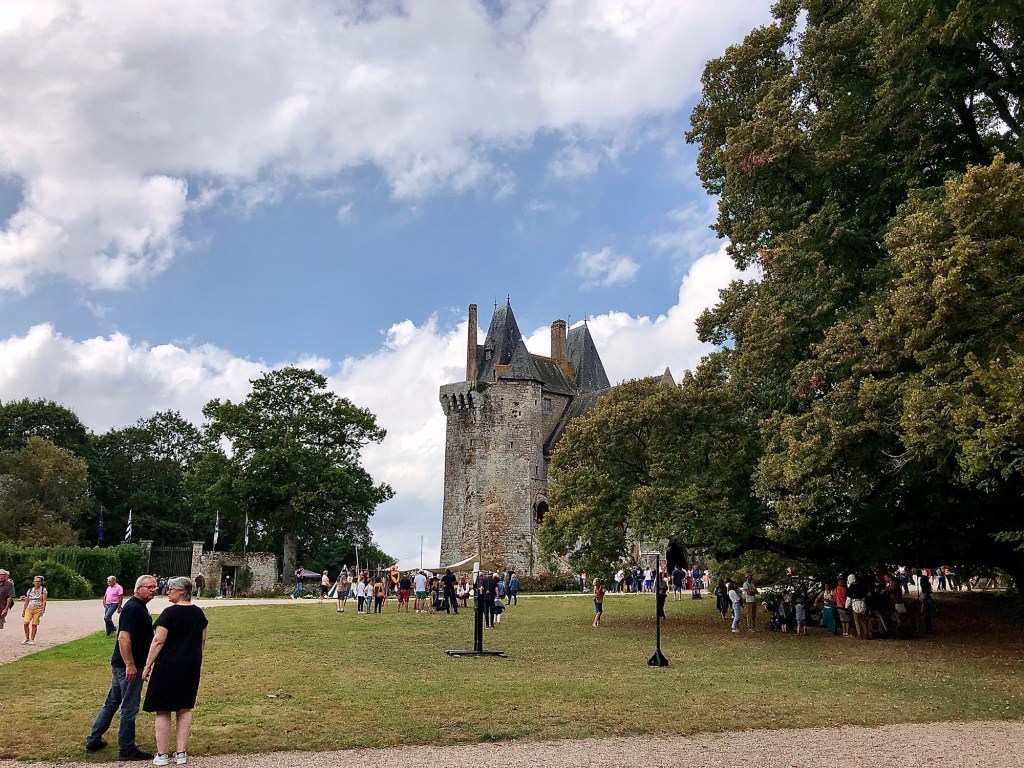
This last September we set our sights on Château de Montmuran. This beautiful castle sits in an elevated position just a few minutes walk away from the village of Les Iffs, and only a 30-minute drive north of Rennes. Currently undergoing major restoration, Montmuran is normally closed to the public. But we and a few hundred other admirers had the good fortune to gain admittance on a lovely, sunny Saturday.
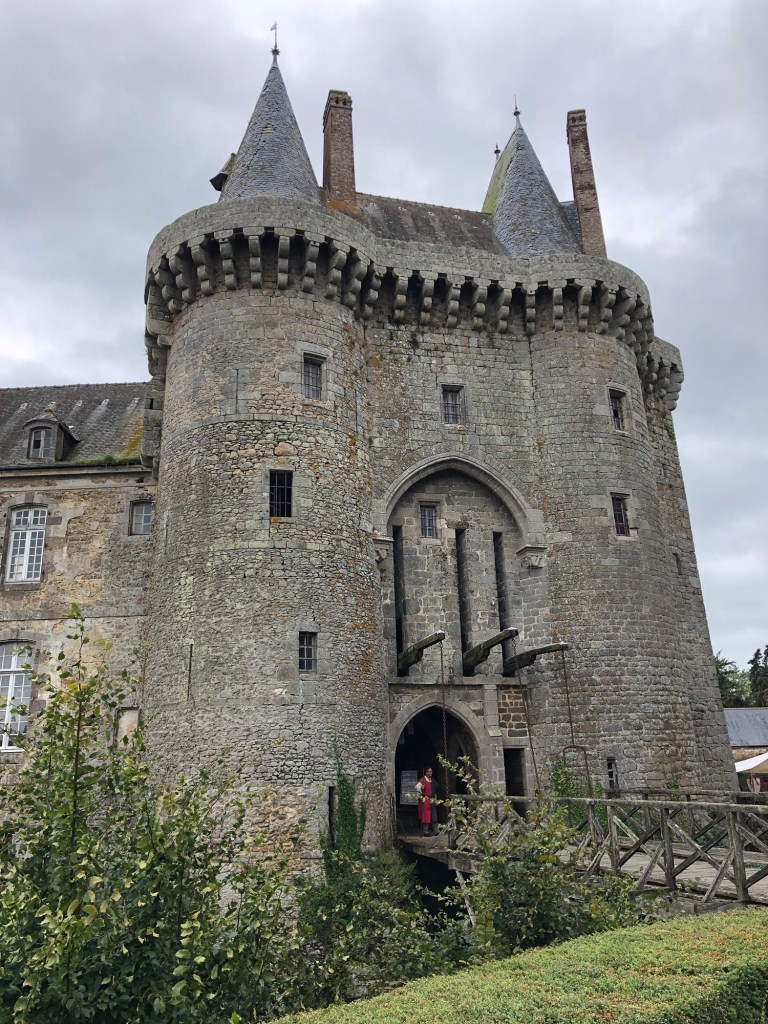
The châtelet
The château-fort visible today displays elements ranging from the 12th through 18th centuries. Most impressive is the 14th century châtelet (a sort of mini-castle at the entrance) composed of two magnificently soaring towers framing a gate with a moat and drawbridge. It is striking. For a castle enthusiast, Montmuran is worth seeing for that alone.
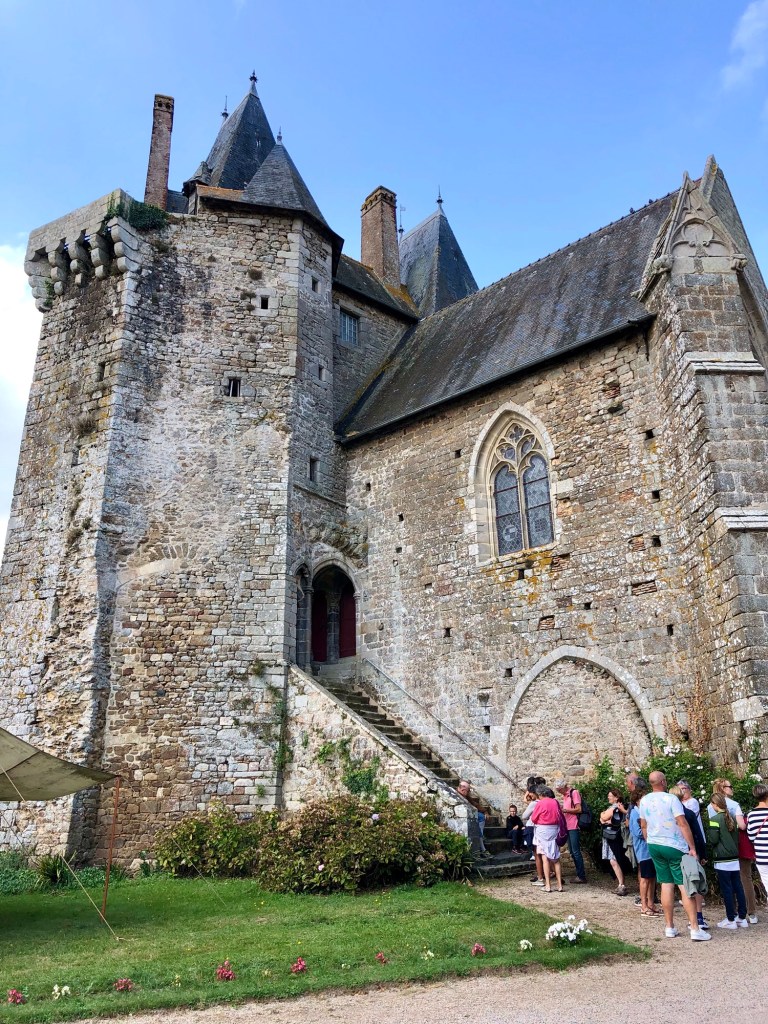
Queuing up to View the Chapel
But, wait, there’s more! A lovely elevated gothic chapel extends from the rear of the châtelet. It is said that the famed Bertrand du Guesclin, later Constable of France, was knighted in this chapel in 1354. In addition, the primary residential block consists of a series of 17th and 18th century chambers. And there are several outbuildings of notable character as well.
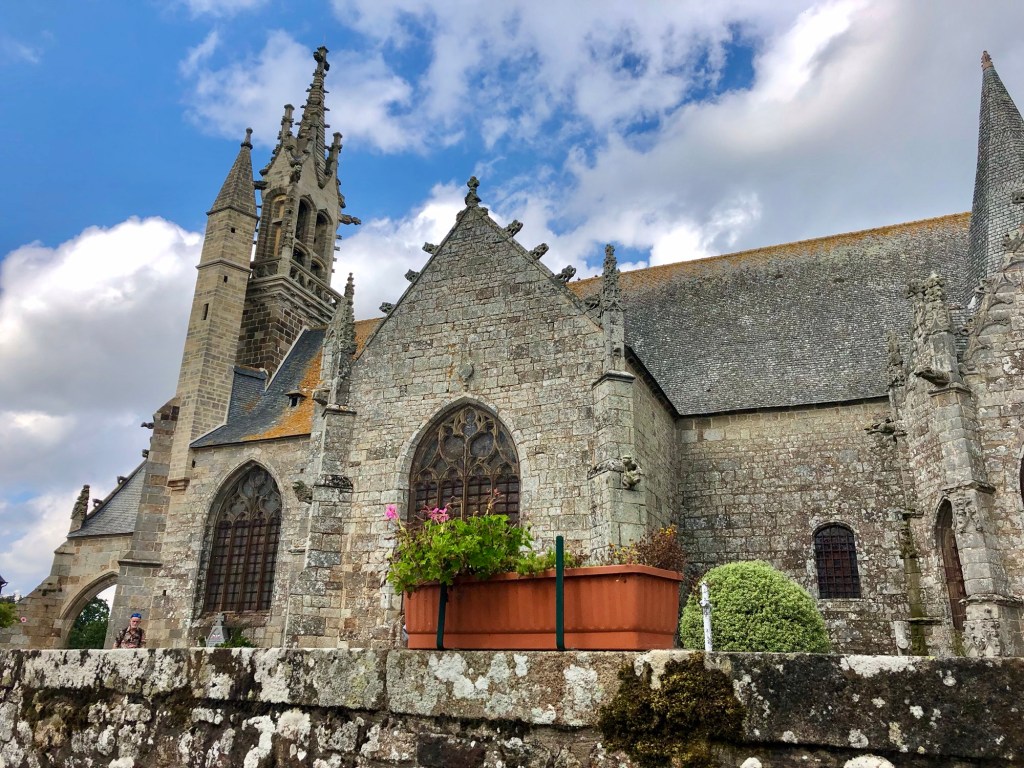
Saint-Ouen des Iffs
We also had a walk around the nice village of Les Iffs. The whole village seemed to be engaged in celebrating the heritage days with games, food stalls and decorations. Honorable mention goes to the church. L’Église Saint-Ouen des Iffs was built in the 15th century. It is justly famed for its 16th century stained glass windows. A beautiful and unique parish church, it is worth a detour all by itself.
Holy Hares!: Baptismal Font in Église Saint-Ouen
I promised a quick one, didn’t I? Well, so much for that. But I did try. I will simply leave you with this bit of advice. If you live here, or will be visiting around the end of September, it’s worth the extra effort to seek out those special historic sites which only open their doors to the public during this very unique holiday. Sites like Montmuran.
[Editor’s note: we have since learned that Château Montmuran is now open on a more regular schedule. The writer responsible for this blog has therefore been sacked.]
[Editor’s post-note note: due to lack of applicant interest, the previous writer has been rehired. We apologize in advance for any future misinformation which may leak from his brain.]
Faded Grandeur Adorning the Verdant Landscape of Mayenne (photo courtesy of the du Fresne website)
Cherie happened to be knocking around the interwebs the other day and somehow chanced upon a site for an obscure château we hadn’t heard of before: Château du Fresne. Little more than a half-hour’s drive away, this monument historique looked intriguing. So, Cherie made a quick phone call in order to arrange a tour of the place and off we went the next day.
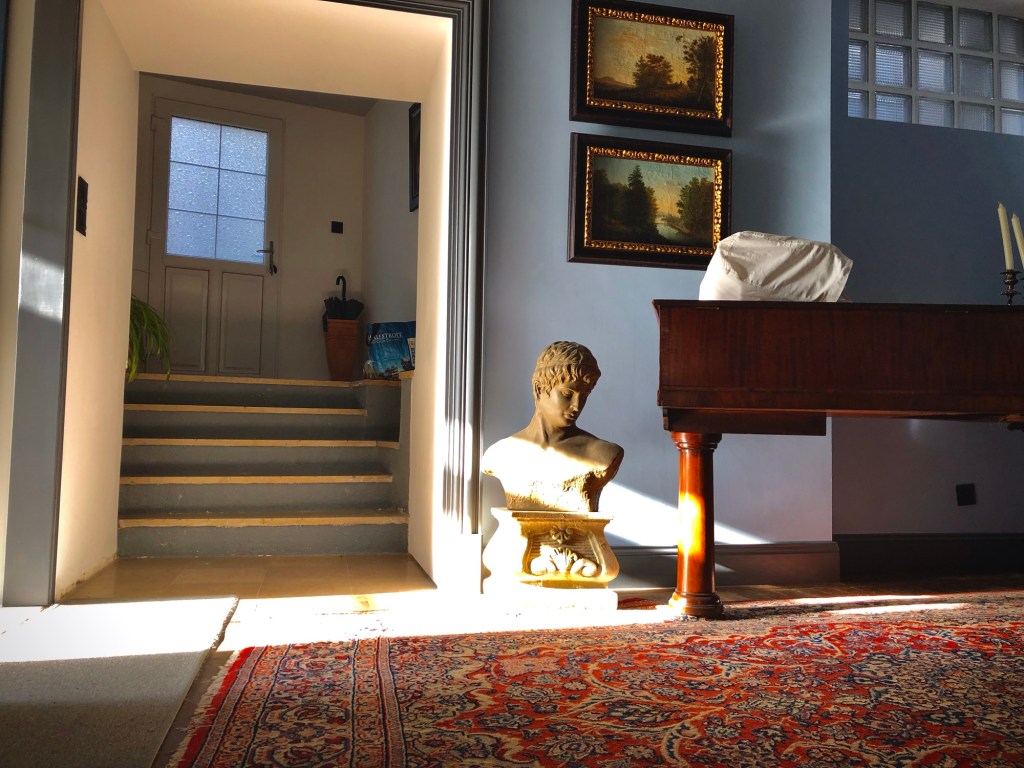
Morning Light Streaming into our Petit Salon as We Awake for Another Day of Discovery
Château du Fresne (https://chateaudufresne.org/) reposes quietly in a green valley just a few kilometers northeast of the town of Mayenne. A small, picturesque village bearing the pleasingly proud name of Champéon perches at a respectful distance just a couple of fields away. Finding the château is a bit of a challenge. As is often the case with more obscure rural destinations, Google Maps directed us down a country lane which quickly became a dirt track. We were later informed that this was the long-disused drive from the 17th century which now requires an off-road vehicle to navigate. Don’t go that way. Luckily, we have had the experience of these kinds of Google follies before and wisely turned around to seek an alternate route. We found it a few minutes later – minus the off-roading.
The Rear of the House, Protected by its Moat (photo courtesy of the du Fresne website)
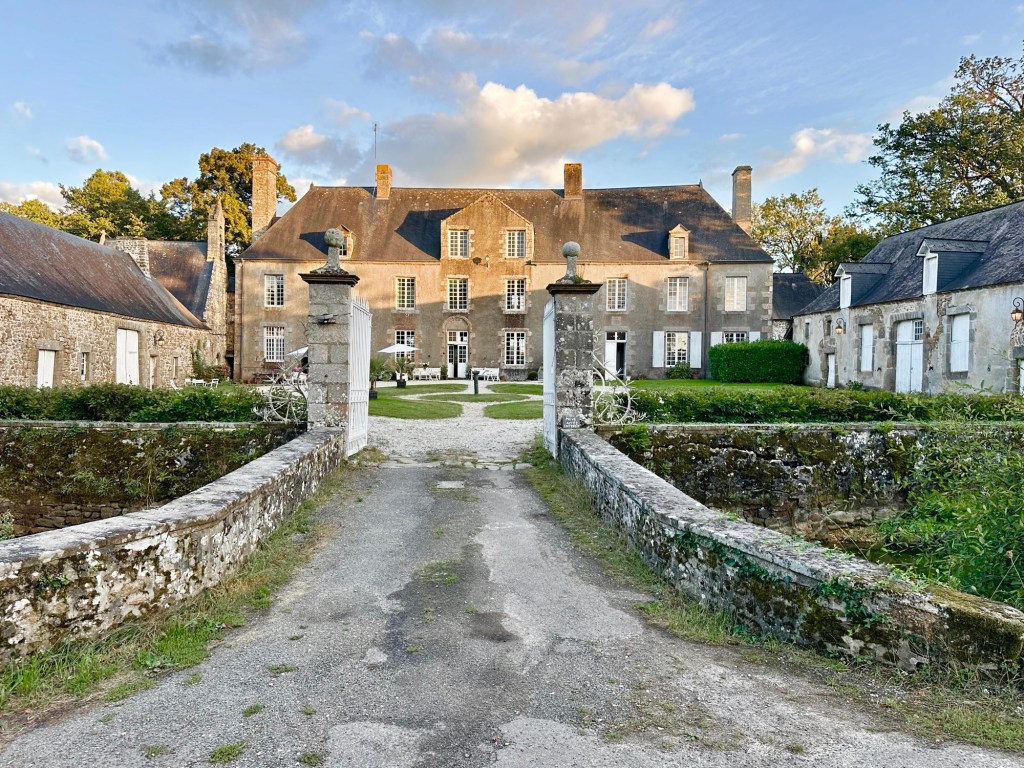
The residence and its principal outbuildings are arranged in a classic U-shape, the whole set amongst a pleasant natural setting of green fields and woods. The compound is surrounded by a substantial water moat, crossed by a stone bridge at the gates, opposite the house’s entrance. As it stands today, the house presents a restrained 18th century façade in the French country manner. It is pleasingly faded, wearing its age like a badge of honor. But the occupation of this site is said to reach back to at least the 12th century, if not earlier. Whatever the case may be, the place exudes a feeling of great age – in the best sense.
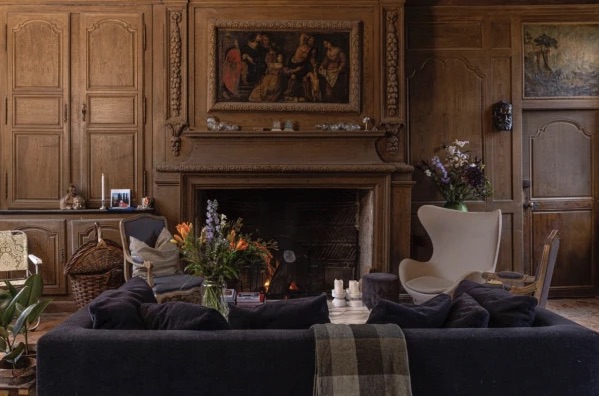
Le Grand Salon with Its Very Early Copy of Rubens’ Judgement of Solomon The Rear of the House, Protected by its Moat (photo courtesy of the du Fresne website)
Casual visitors are welcome to view the exterior and the grounds. However, if you’ve arranged for a tour (for a minimal fee) you are shown the main residential rooms in the ground floor, the chapel and the outbuildings on either side of the house. Well worth the minimal effort. The owner, Angelo, is Dutch and he splits his time between du Fresne and Amsterdam where he is occupied with the art business.
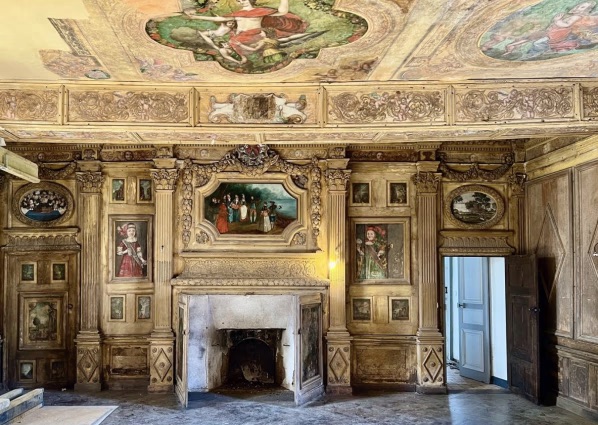
Le Chambre du Roi – The King’s Chamber (photo courtesy of the du Fresne website)An 18th Century Addition with Its Beautiful Parquet Flooring (photo courtesy of the du Fresne website)
We liked Angelo. He greeted us in a relaxed, casual manner which immediately put us at ease. And he proceeded to give the two of us a nice tour full of interesting history and anecdotes concerning past owners. Having a shared interest in architecture, restoration and decorative arts, we discussed in detail the many historical features still prominent in the residence and the challenges they face in preserving them. It’s a daunting task, to be sure, but well worth the effort. The house possesses some exceptional architectural woodwork, with elaborate carvings and rare painted decoration in abundance.
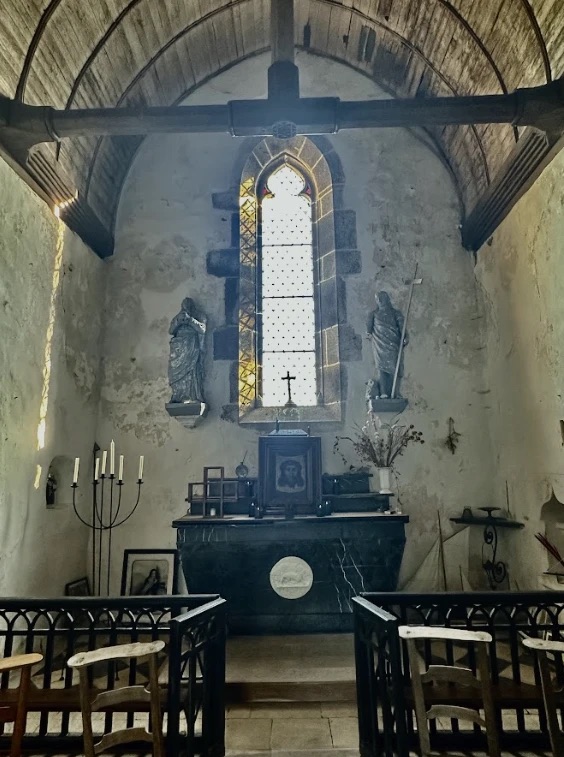
A Heavenly Space – Chapelle de Sainte Marie Madeleine (photo courtesy of the du Fresne website)
Standing at the house’s shoulder like an ancient spiritual advisor is the 12th century chapel of Sainte Marie Madeleine. It is a fine example of a medieval manorial household chapel. The chapel is intimate, comprised of a single bay with a narrow elevated gallery in the back, the whole perhaps able to seat twenty souls. Typically, the gallery is accessed by a separate doorway, probably leading to the lord’s private chambers. I could have happily lingered there for an hour or more, exploring all of the fascinating clues such buildings reveal. There remain faint hints of original painted wall decoration and structural alterations. Enough to incite the imagination to endless musings. It’s a real gem.
We also ducked in to the outbuildings which originally comprised a bakery, stables and barns. Though there is little to see in them today, these buildings demonstrate the ways in which manorial estates functioned as largely self-sufficient entities, producing, processing and consuming their own produce as well as the goods and implements needed to sustain them. The owners currently use the buildings for collaborative contemporary art exhibitions and other events. They also support an artist-in-residence program. Honestly, I can’t think of a better place to inspire the development of great art.
The Pigeonnier with the Chapel and House in the Background (photo courtesy of the du Fresne website)
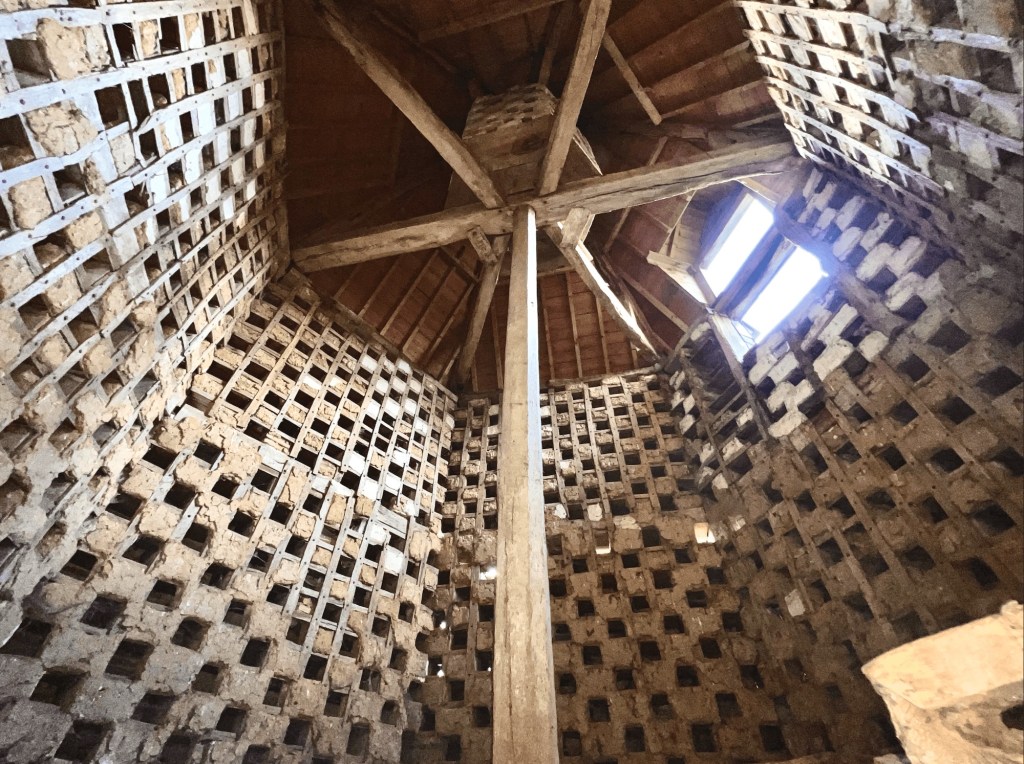
Perhaps the most unique aspect of Château du Fresne is its pigeonnier. Standing upon a small artificial motte in the middle of the broad moat, this dovecote was built in 1539 to celebrate the marriage of the lord at that time, Jean d’Athenaise. The dovecote is octagonal, with timber framing and brick infill, and perched upon granite pillars. It contains enough holes to accommodate 700 nests. The right to build a pigeonnier was held only by nobility. So, this seemingly humble and functional structure was in actuality a conspicuous status symbol at the time it was built. It also produced a steady supply of eggs and meat for the household. The dovecote at du Fresne is especially picturesque, being so quintessentially French. Its graceful aging and commanding presence quietly remind us all of an age obscured by the mists of time.
As we wound up the tour, our host invited us down into the cozy old stone kitchen, a remnant of the previous medieval hall which was replaced by the current house. There we chatted with him and a few guests which had been staying in the residence. We were served some flan and lemonade while an older cousin of his relaxed in the courtyard outside with her friend. It felt as though we had been invited to a relaxing weekend gathering at a private manor. I suppose that, in a manner of speaking, we were.
We very much enjoyed our visit to Château du Fresne. It was interesting, enriching and quite friendly – a pleasant way to pass an afternoon. If you’re in or near the area, it is decidedly worth paying a call into this charming example of France’s past country life. Under the guidance of its new owners, du Fresne also appears to have gained the promise of a bright and vivacious future. It certainly deserves it. And to that end, we wish them the best of luck in their endeavors.
High-Rise Living for the Birds – Inside the Pigeonnier (photo courtesy of the du Fresne website)




 Finding Our France