Cabin fever had finally gotten the best of us last weekend. Trying our utmost to stay at home, isolate as much as possible, wear our masks, and do our part to keep ourselves, our neighbors and the country safe from Covid-19, we had not really traveled anywhere to sight-see since the pandemic began. But working on the house non-stop had been getting monotonous. Our retirement plan had always been to intersperse home projects with travel. So, finally, we forced ourselves to put down the tools and hit the road.
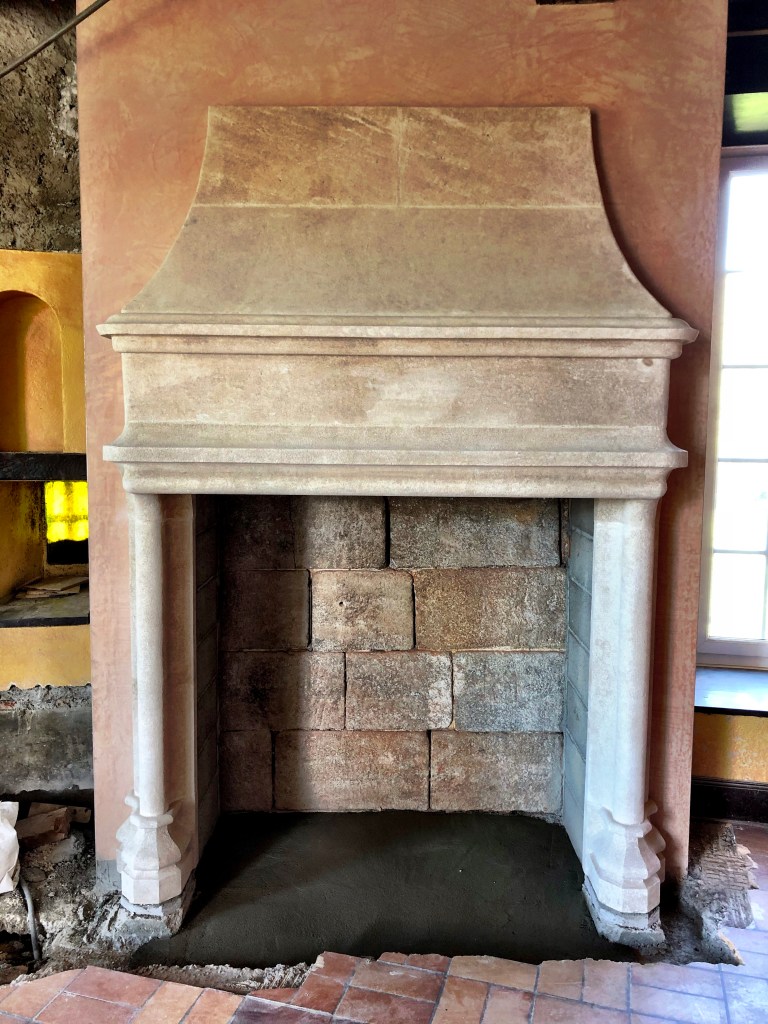
Our New Stone Fireplace is Finally In
We only had an afternoon and we didn’t want to go far. Somewhat at random, we spotted a town named Mayenne on the map. It’s a medium-sized town to the east, about 44 kilometers from Fougères. Google told us that there is a château in the center of the ville which was all either of us needed to know. Mayenne it was!
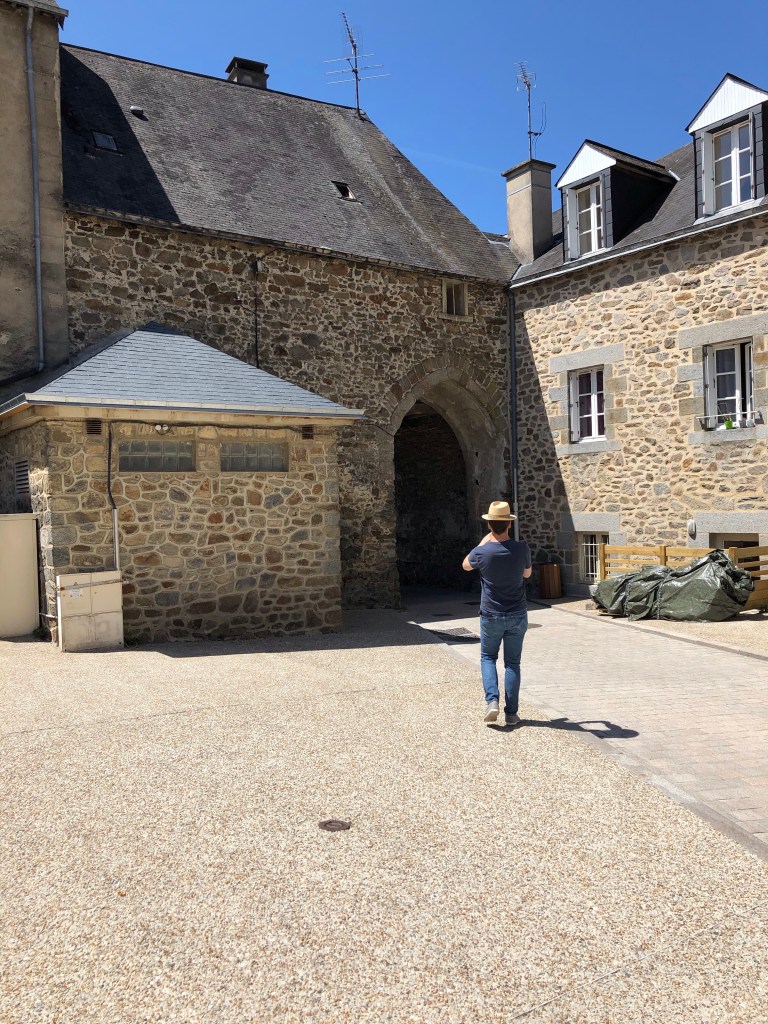
I Love a Good Archway
The day was lovely. Sunny. Blue skies. Winding country roads. Very french-y and just what the doctor ordered. We knew that we would be visiting a museum at the château so we left Saxon at home to guard our little tower. Besides, he doesn’t do well in warm weather so it was better for him to remain inside the cool of the stone walls.
Mayenne, the town, is situated alongside Mayenne, the river, which runs through Mayenne, the departement. They really like the way Mayenne sounds.
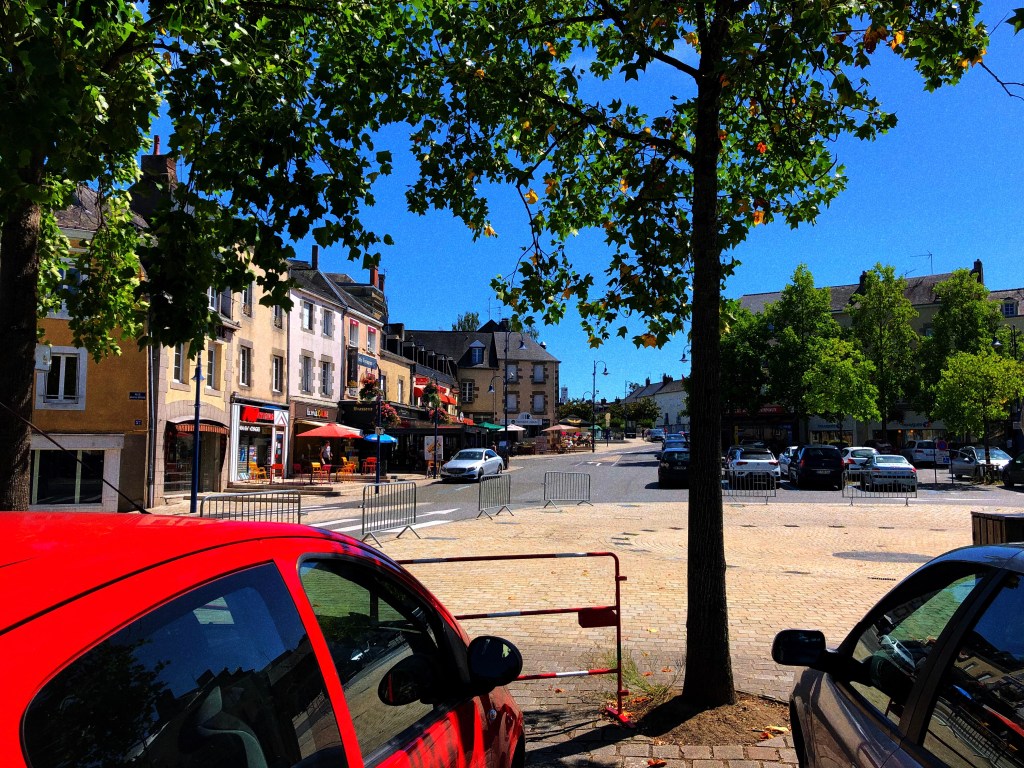
Blue Skies And Belle Façades
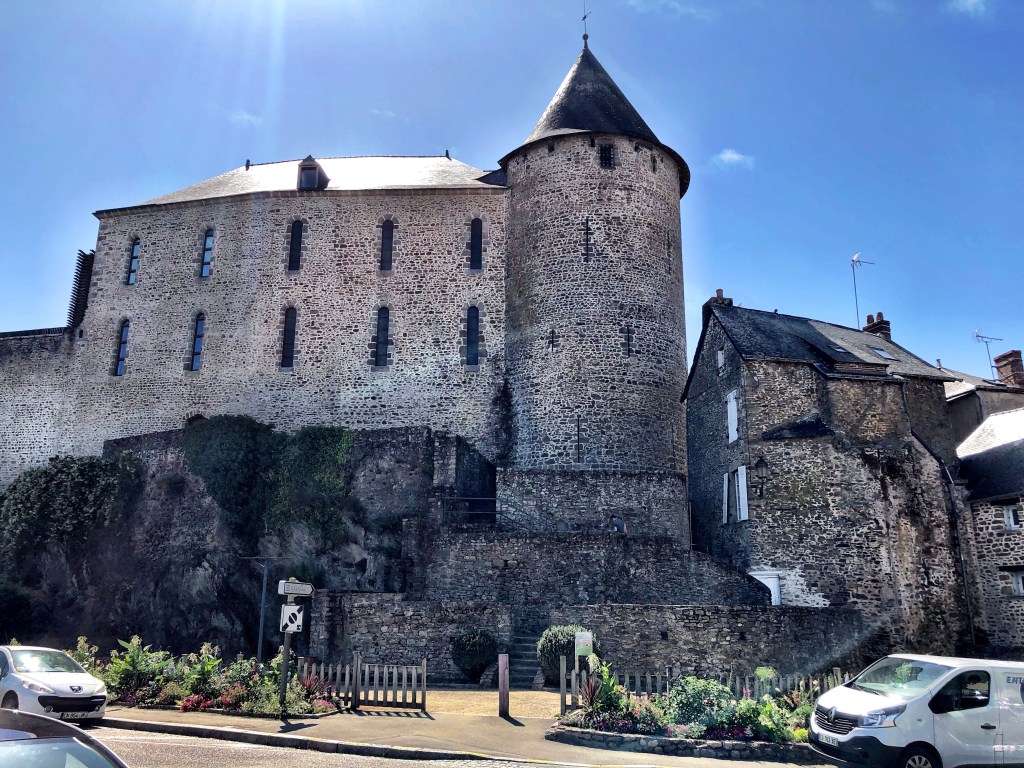
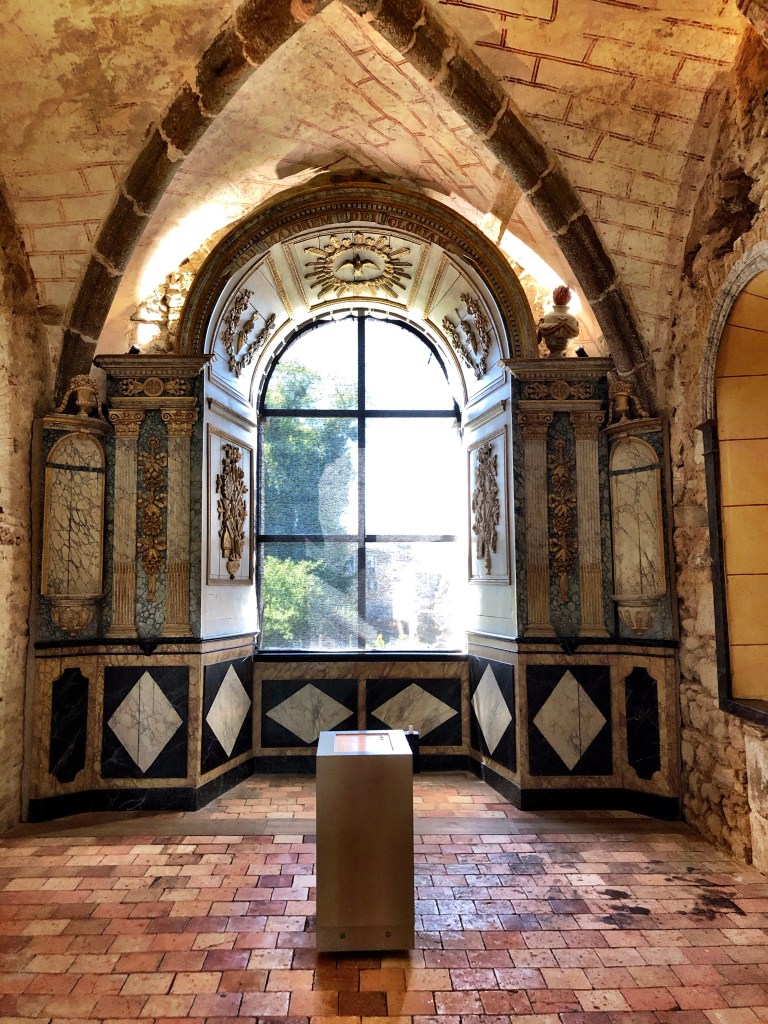
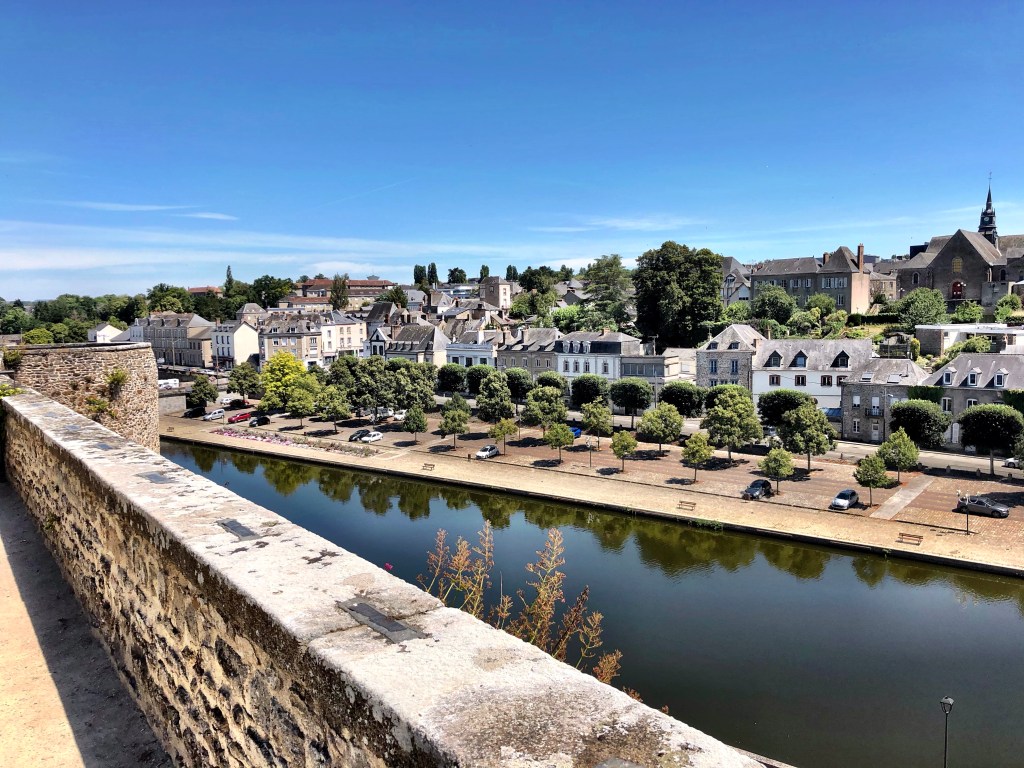
We maneuvered our way into the old town and found a shady spot to park the car. After getting our bearings, we made directly for the château. The château sits on a bluff running alongside the waterway which bisects the town as it makes its way south to eventually flow into the Maine and then Loire rivers. There has been a castle in this spot in Mayenne since at least the beginning of the 10th century. And before that there had been a Roman fort controlling the area. Remarkably, one can see elements from all of these periods in the remnants of the edifice which still stands today. The building houses a very good museum with a small but well-curated collection of artifacts on display representing the history of the local area. The architecture is varied and in good repair following recent restoration/preservation work. And we had the place virtually all to ourselves. Which is a shame, really. These museums rely heavily on the income they receive from tourist admissions in order to maintain the sites and carry out research. Like all museums and historical attractions, they will undoubtedly suffer a dramatic deficit in their funding due to the effects of the pandemic.
The ChâteauMedieval Hall19th Century Prison Chapel. Note the Remnants of Medieval Ceiling Decoration.
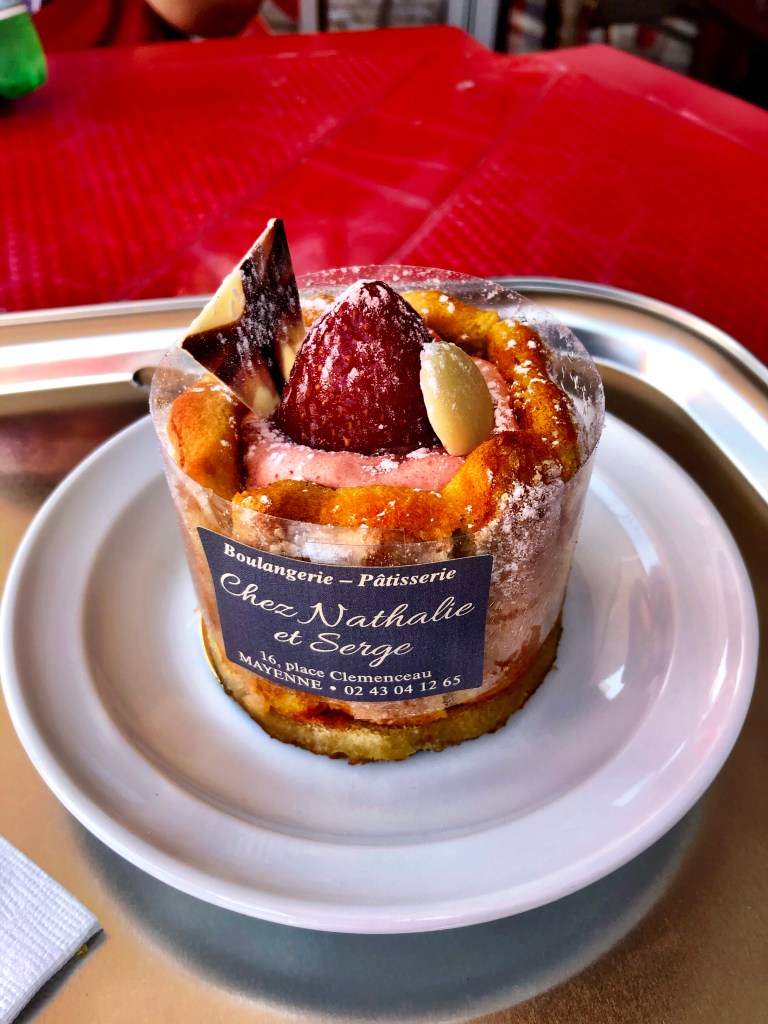
After the museum, we wandered around the streets of the old town. Then our stomachs reminded us that we hadn’t eaten lunch and demanded attention. We never argue with our appetites. So, we found a nice boulangerie, grabbed some quiches, drinks and dessert (duh!), and spend some quality french time in the square just watching the world go by. I highly recommend it.
No Lunch Without Dessert!
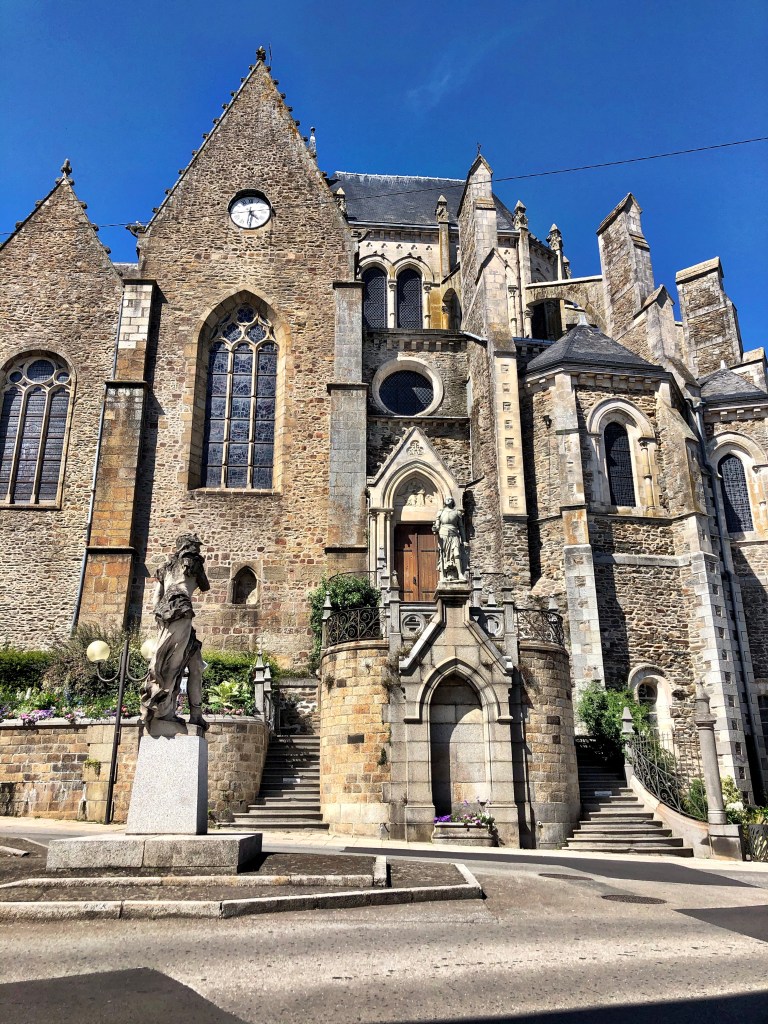
Our stomachs satiated, we strolled around a bit more, happening upon a church. The Basilica of Notre-Dame yields an impressive appearance on the exterior, boasting flying buttresses enfolding a large apsidal eastern end and an impressive stairway. However, we found the interior to be somewhat wanting. Only elements of the nave piers and some scant carving remain of the original 12th century building. The majority of the church appears to be a 19th century reconstruction. Still nice, but a little disappointing. Are we getting too picky now that we’ve been in Europe for almost two years? Perhaps. But I would say that it is rather a case of becoming more discriminating.
Basilica Notre-Dame
Although we only allowed ourselves three or four hours in Mayenne, our visit was rewarding and relaxing. Just the thing we needed. It’s a pretty town with lots of shops and some lovely-looking restaurants that we will have to sample the next time we find ourselves in the area. It felt good to stretch our legs a bit and indulge in our craving for the history and beauty of France. This country never disappoints.
View From the Château Rampart Across the Mayenne River
As a certified Tolkien geek, I was bemused last year when Cherie and I first came across a road sign announcing that the next exit would lead one to Elven. How cool is that?, I thought. But we were on our way to Vannes down the road at the time so we didn’t stop to investigate. A couple of weeks later we discovered that there is a town called Rohan not too far away. Elves, Rohan. Surely we have discovered Middle Earth!
No elves!
After a few further drive-bys (we always seem to be on our way to Vannes for one thing or another) we finally decided to check out this magical-sounding town of Elven. Would there be houses of sinuous design as at Rivendell? Perhaps timeless glades of statuesque mallorn trees such as would be found in Lothlorien?
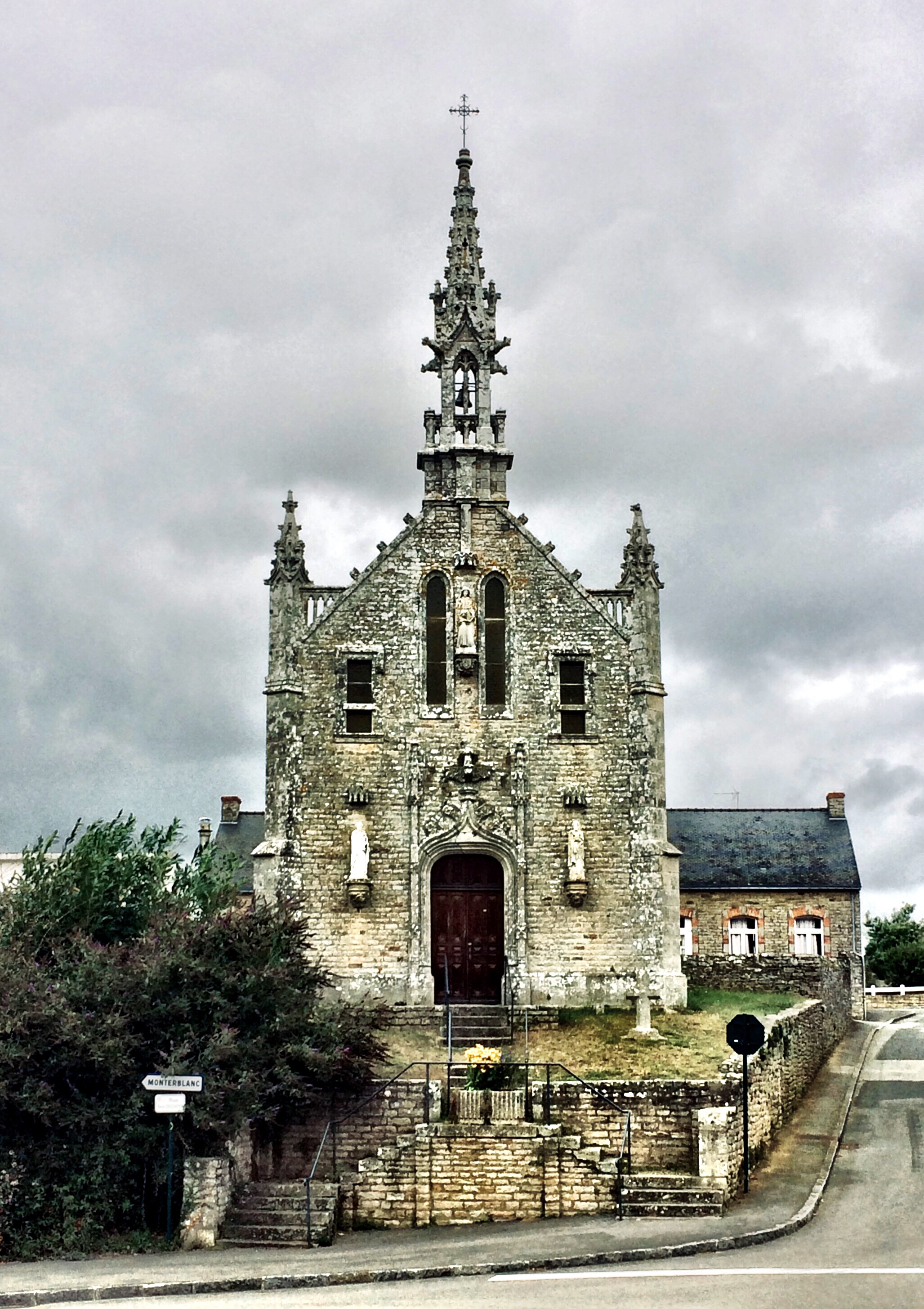
Nope. Elven is really just an average French town. We stopped and had a walk around its small center, grabbed a couple of sandwiches and pastries and noted that the town unfortunately appears a bit down on its luck. We discovered a nice little chapel on a knoll and the parish church was undergoing an extensive restoration. But apart from that, we found nothing of particular interest. And definitely no sign of elves. How disappointing.
But. We also saw signs for the Tours d’Elven, or the Forteresse de Largoët. [Tours is French for “towers”] Despite the different names, these appeared to refer to the same site. Intrigued, we attempted to find it. Or them. Or whatever “it” was. Following the signs will get you nowhere. Literally. But with the help of Google Maps we were able to track it down. Finally, we had found it. Unfortunately, we found it out of season. A long rural driveway brought us to a lovely gatehouse with a not-so-lovely paper sign suggesting we try again a few months later, in springtime. This place was proving harder to get into than the Black Gate of Mordor.
One thing led to another and we had many distractions (see previous posts) to keep us away from the mysterious towers in the forest and we had nearly forgotten about them. But last weekend we were wanting to take a walk somewhere new. Suddenly I recalled the mythical Tours d’Elven. Quick, we thought, we had better seek them out before they disappear for yet another off-season hiatus. So we launched the Audi southward from Malestroit, tingling with the anticipation that, at last, we might finally catch a glimpse of this legendary place, shrouded by ancient charms as it was in the misty forest.
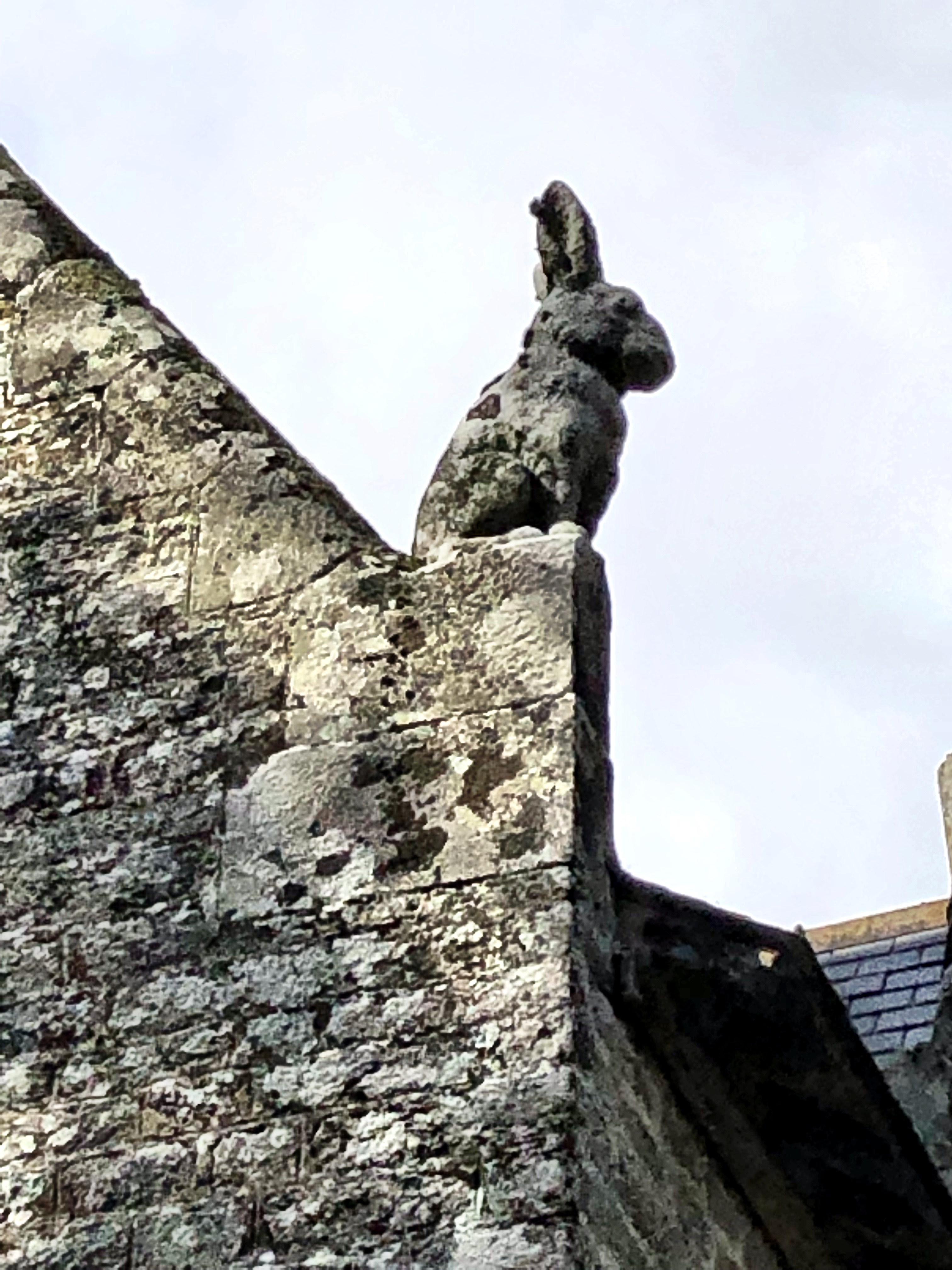
Just a Little GatehouseRabbit Sentinel
This time, Fortune favored us. We arrived to find the gates open and welcoming – as long as we plunked down our five euros each, that is. Tickets in hand, we discovered that this is a privately-owned monument. The gatehouse/ticket office was built in the beginning of the 20th century as part of a regeneration of the property. It’s a beautiful stone cottage with classic, stately lines mottled with lichens and well settled into the landscape. One peculiarity of the gatehouse are the several stone hares which decorate the gable ends and entrance stairway. They’re beautifully carved. A bit fanciful and, in one case, energetically straddling the bannister leading up the stairway to the front door in a way for which bunnies are well-known.
The Forest Way
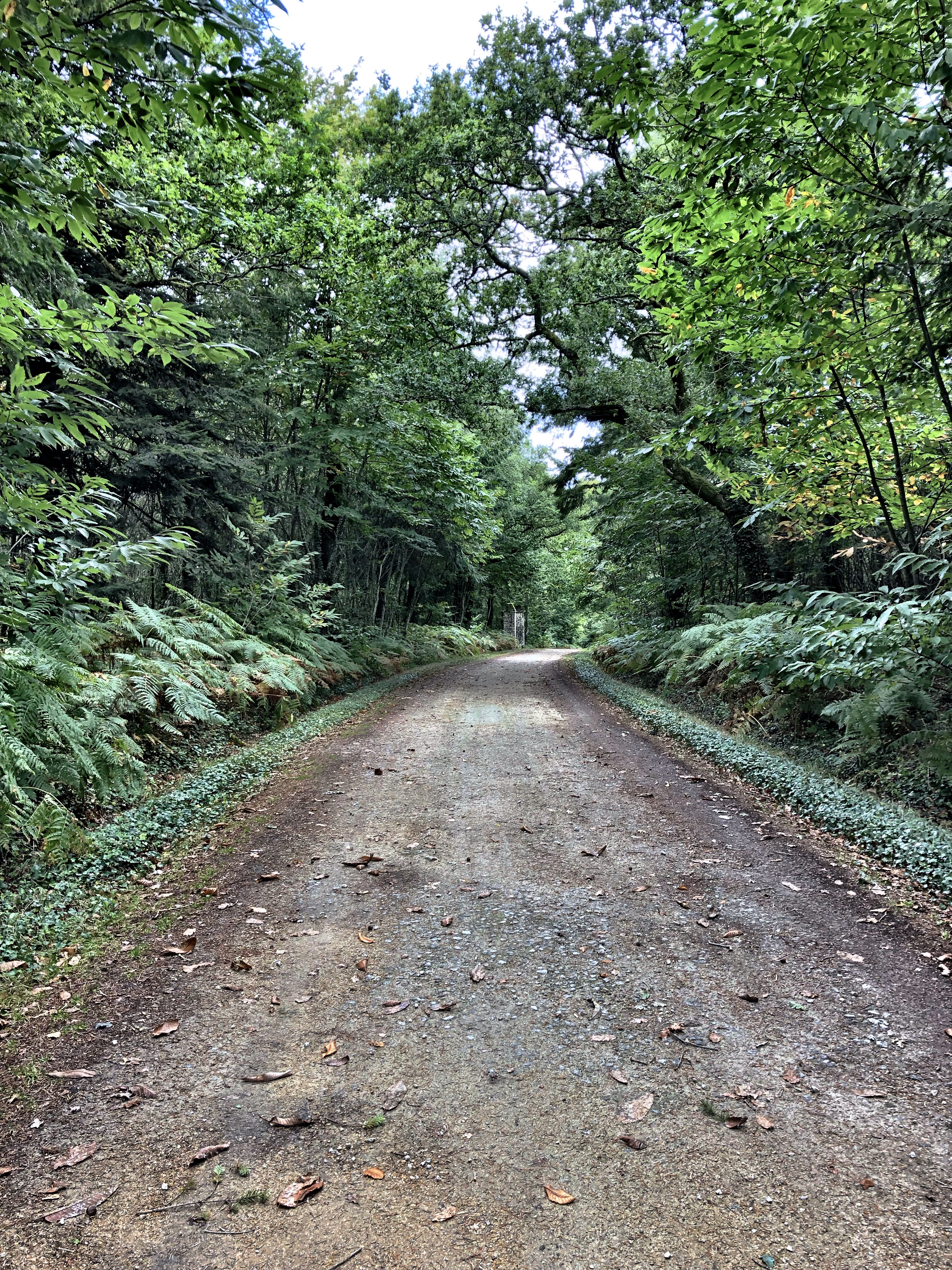
Past the gatehouse a gravel road led us on a tranquil stroll through woodland filled with chatter of songbirds. In the distance, we could hear the baying of hounds on the hunt. Not surprising this time of year. The French are mad about hunting (also fishing). It’s not uncommon to come across an organized hunting party while driving country roads. They usually place a couple of warning signs on the roadside to let people know that there are armed enthusiasts milling about in a nearby wood or field. Proceed at your own risk. The sound of gunshots is fairly common out here in the wilds of Bretagne. It makes hiking the trails a more piquant experience.
A Promise of Majestic Ruins
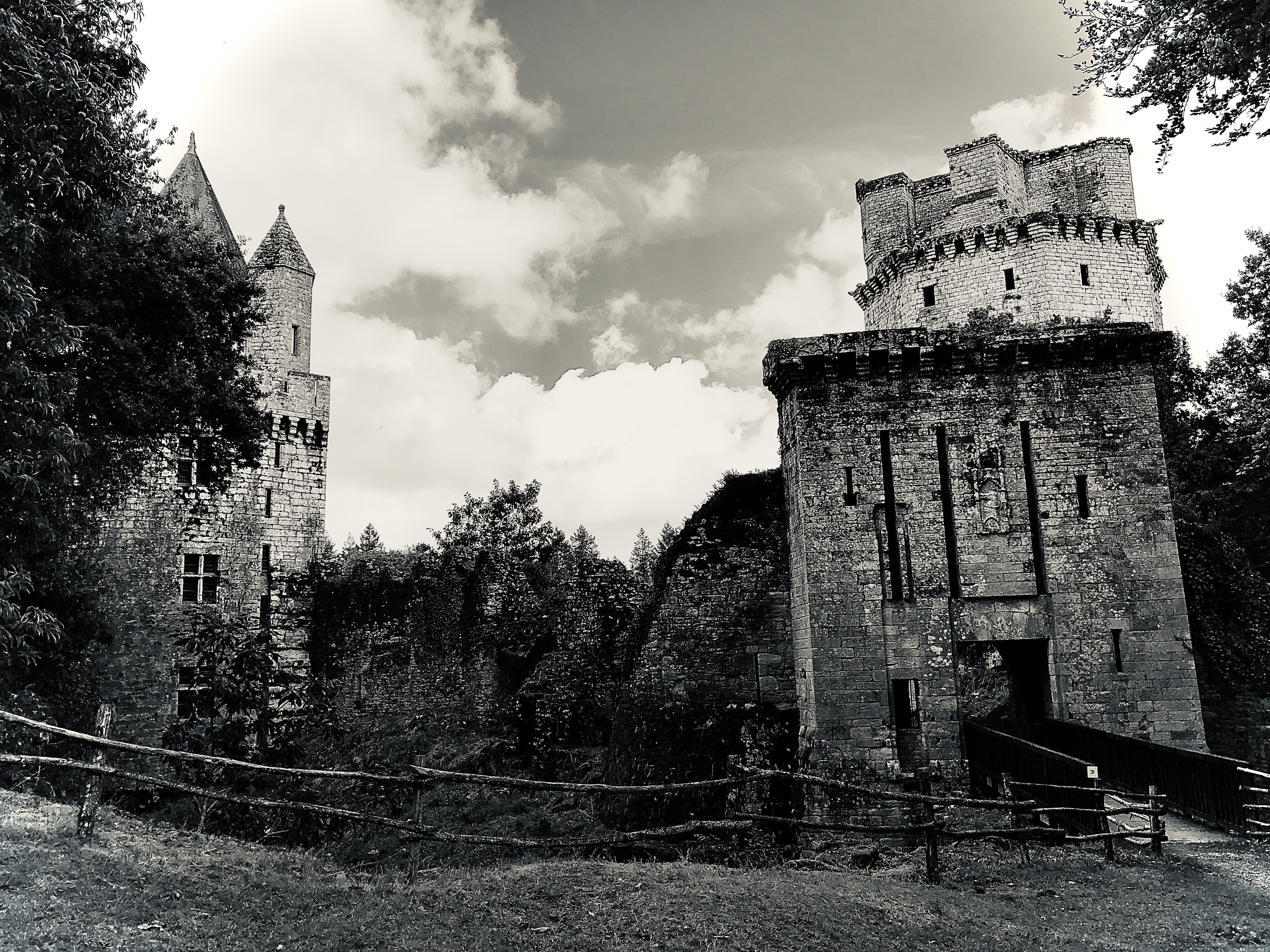
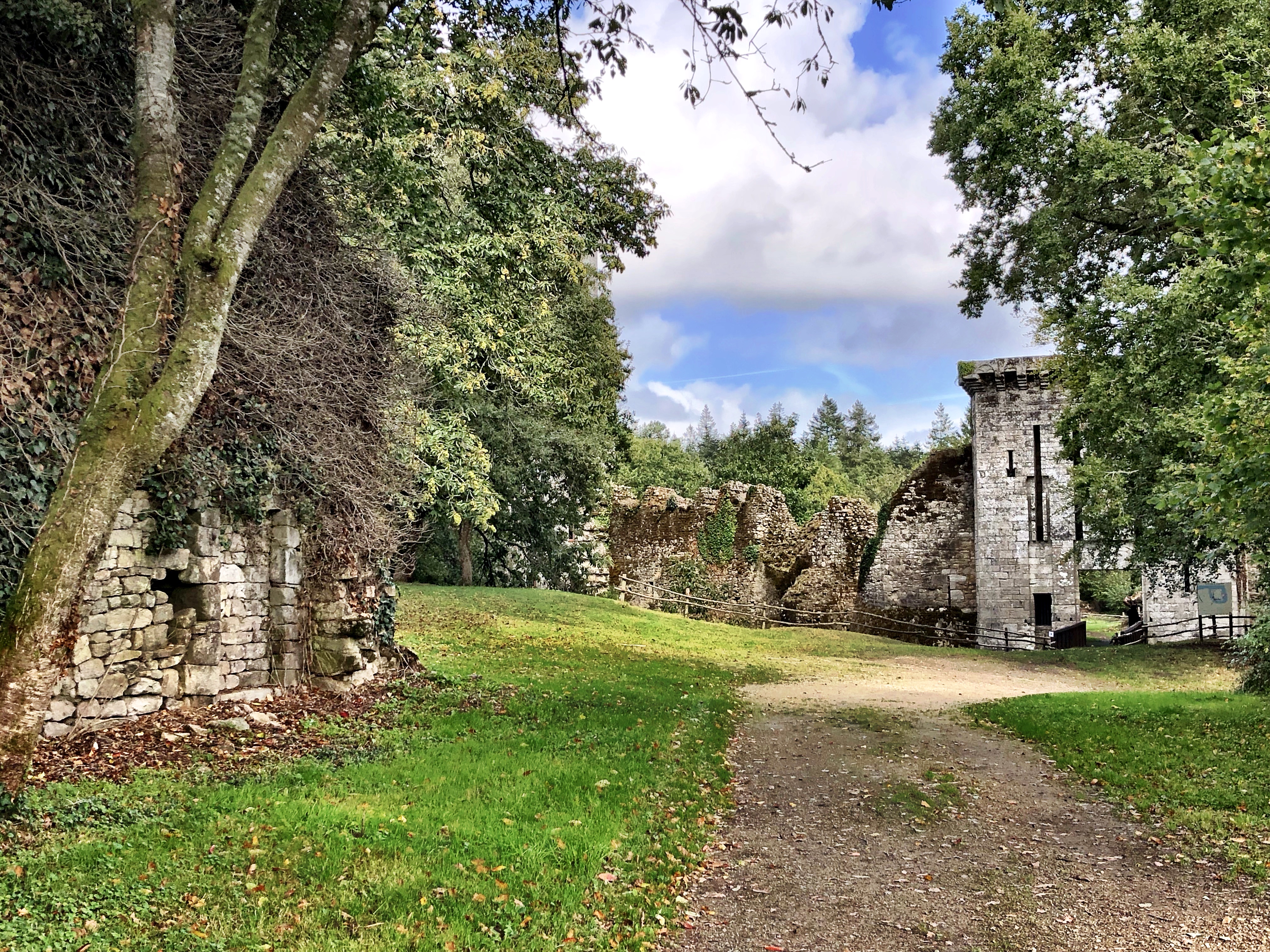
Suddenly we emerged into a clearing filled with majestic medieval ruins. We assumed there would be a few remnants of broken wall jutting out from a tumble of brambles. We were mistaken. Confronting us at the end of the road was a moat guarding a stone gatehouse, behind which rose two massive towers. “Quelle surprise!”
“None Shall Pass!” A Formidable Gate
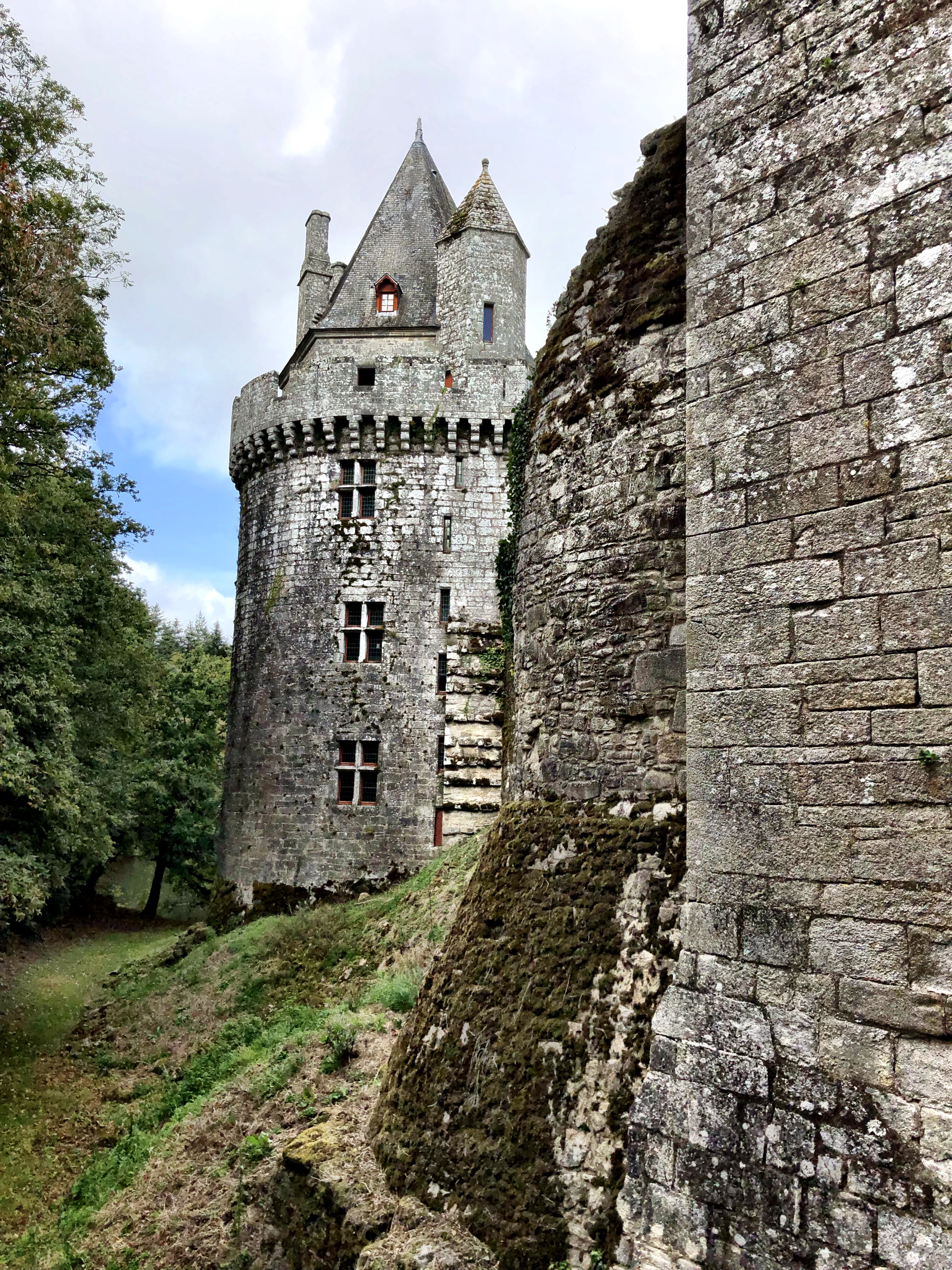
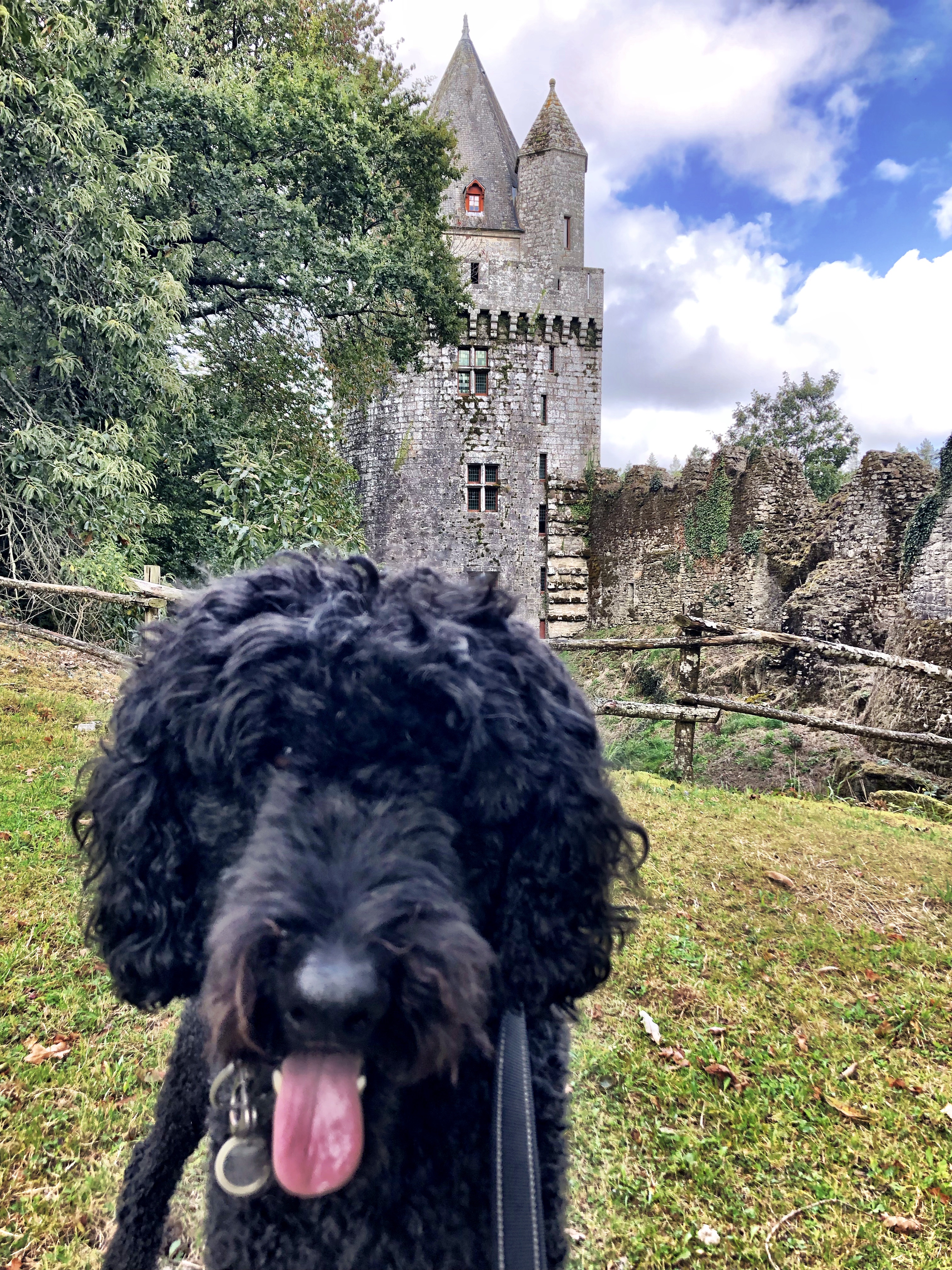
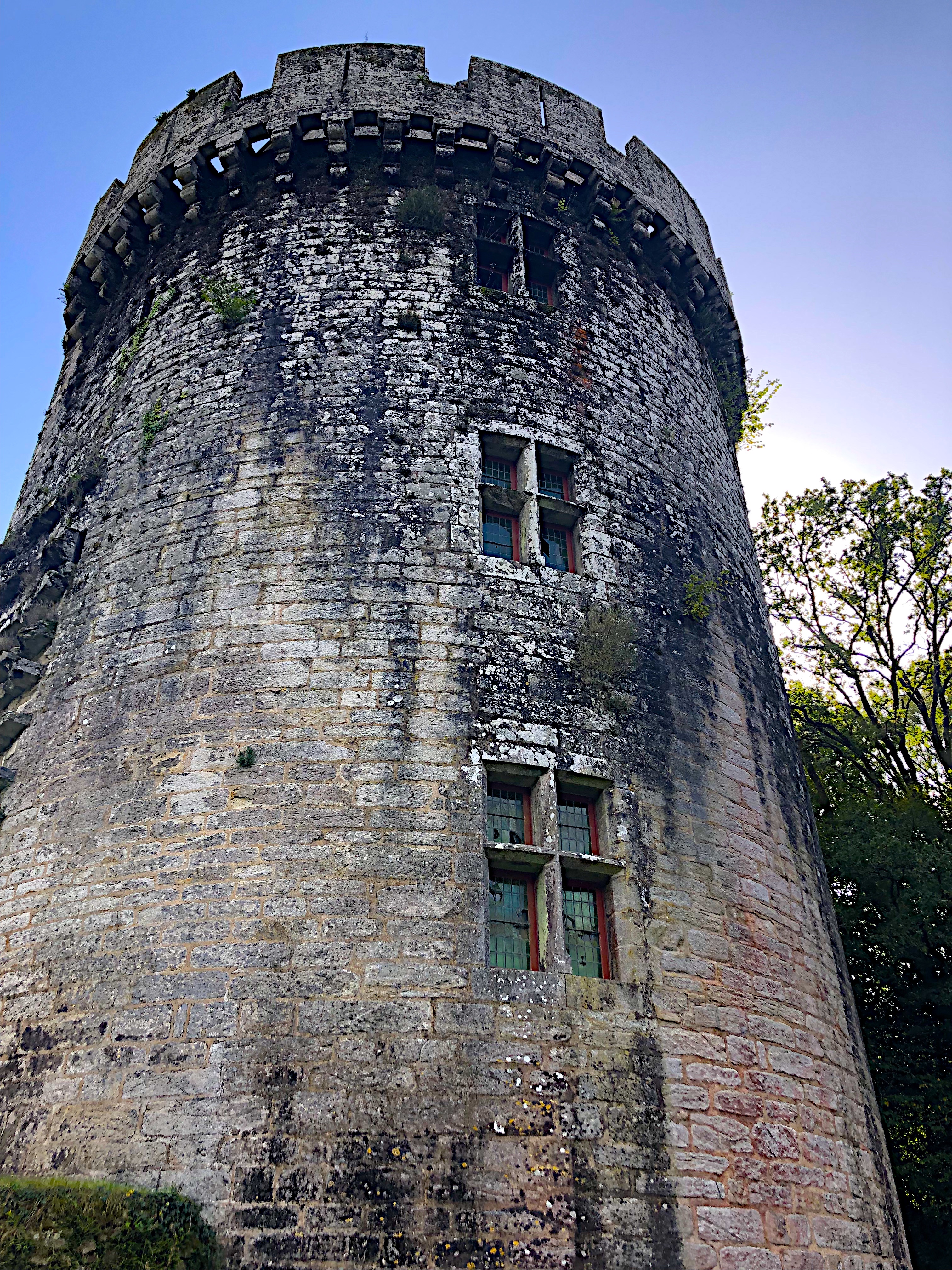
The Forteresse de Largoët is a compact site, much of it in ruins, but dominated by its two magnificent towers which still reach to their original heights. The castle was primarily built in the 15th century and, at one time, formed a small island surrounded by a water-filled moat on three sides and a small lake on the other. The rear elements of the gate (two flanking towers) date from the 13th century. It’s the only gate complex that I’ve ever seen which has arrow slits opening into the gate passage itself. Ingenious and, I imagine, quite effective if attackers ever managed to batter the gate down and get into the passage.
The Donjon
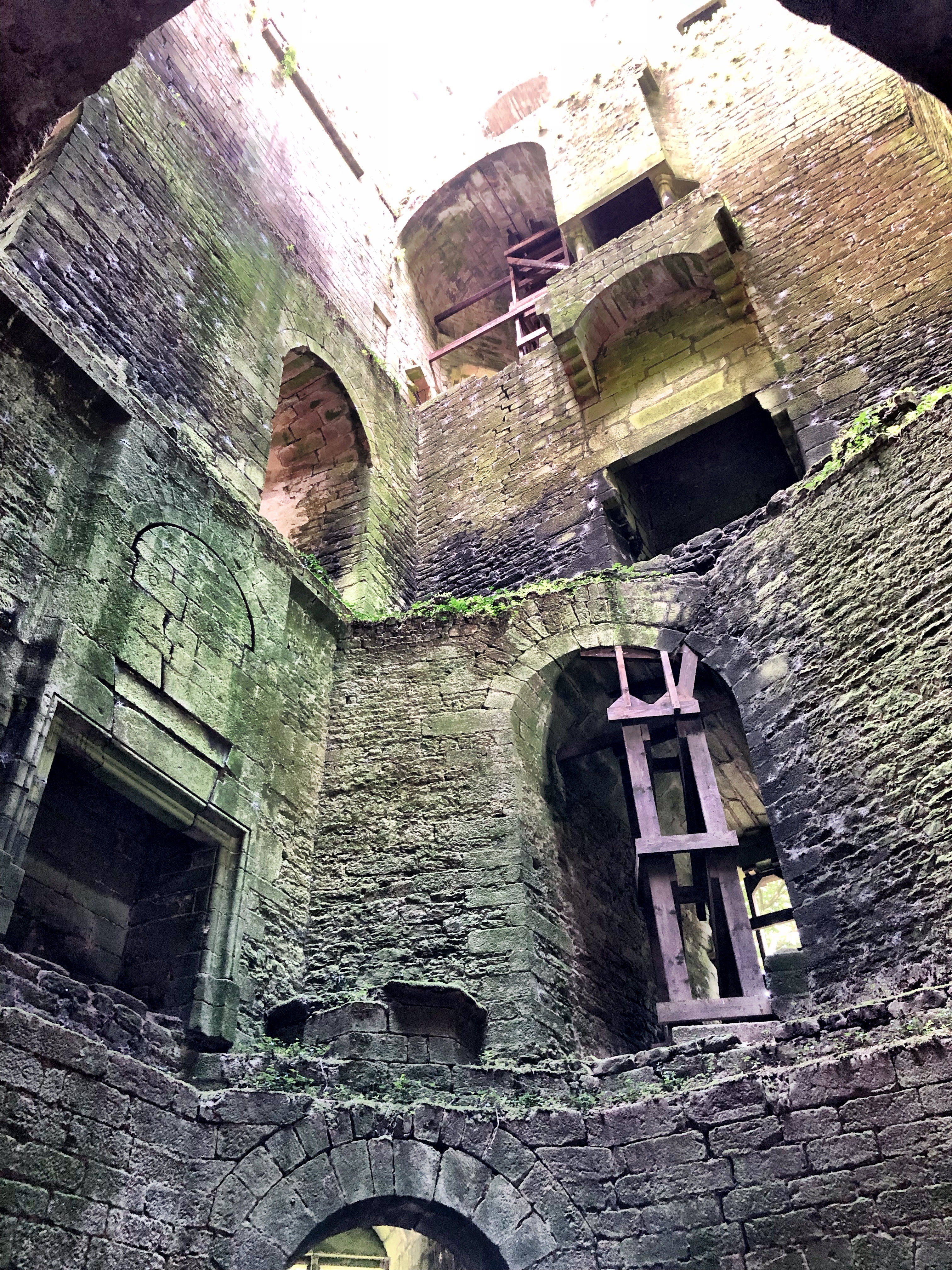
The main tower (the donjon) is open to the public. It’s also open to the rain, the snow, the wind, and pigeons – sadly, it has no roof. So it is somewhat of a shell. But one can still wander about, investigate its many alcoves. [“You use this word, alcoves?” – that’s for all of you In Bruges fans. If you are not a fan of this movie, well … it beggars belief.] There are also two winding stairways which climb nearly the full height of the tower. At each level you can gaze out over the beautiful forest and lake, or wander into empty spaces still containing fireplaces, window seats, garderobes (medieval toilets), arched ceilings and wonderfully carved doorways. The larger halls and chambers of the two central cores running vertically through the donjon apparently had wooden floors which long ago rotted away, leaving precipitous views of fireplaces and other elements now hanging in mid air.
Fireplaces in the Sky
Despite its partly ruinous nature, the donjon is really impressive. Seven floors. Forty-five meters tall! It’s huge. And it must have been mind-numbingly expensive. Elaborately decorated with gargoyles, stepped machiolations, molded edgings, the entirety of the exterior and interior is faced in fully-dressed stone. None of your cheap rubble construction at Largoët.
La Tour Ronde
The other tower, the Tour Ronde, is less statuesque than the donjon, but it, too, is beautiful and imposing. It was restored in 1905 when the top bits were reconstructed and used as a residence for some time. Unfortunately, this tower is closed to the public so we weren’t able to have a peek inside.
Dog & Castle
It’s easy to imagine how this castle in the woods must once have looked. In spite of the many ruins, the remains are substantial enough to allow one to form a full image of its walled might when the complex was complete and filled with the many inhabitants who must have lived and worked there. For the lords of Largoët it was surely a life lived in the height of fashionable architecture and security. Exciting as it is to explore such amazing sites, I am always left with a bit of sadness that a building of such beauty, so cleverly conceived, and having required such effort to complete, could be left to fall into ruin, largely forgotten or, at the least, discounted. A place no longer valued. To me, it’s a form of disrespect. Not just to the noble elites who conceived and enjoyed the many advantages of such a place, but also to the countless men and women whose names we will never know – those who toiled to build, maintain, and serve the Forteresse de Largoët. We could certainly do them more honor.
The Sun Sets on Largoët
As for the elves? Not a one. Nor dwarves, hobbits, orcs or goblins. Not even an ent in the woods did we see. We certainly found the two towers. But Middle Earth? Well, I guess my search continues. Nonetheless, we had a fine day and we were so happy we persevered in our quest to find this place. Should you ever find yourselves in this magical part of the world, you will not regret a visit to the Elven Towers.
[This post was originally an email sentin April, 2019 to friends and family before this blog was started.]
Last week I, Cherie and Jessica [Cherie’s niece] spent a few days in the south of France. This region is historically known as Languedoc and is culturally a very distinct region of the country. It’s an area influenced by several successive waves of peoples, including Gauls, Romans, Visigoths, and Ummayads (Narbonne was, for a time, the muslim capital of this part of their kingdom); it was later part of several northern Spanish kingdoms. Languedoc was also the scene of a devastating crusade (the Albigensian Crusade). It’s a fascinating place and so different from what we have seen in Brittany.
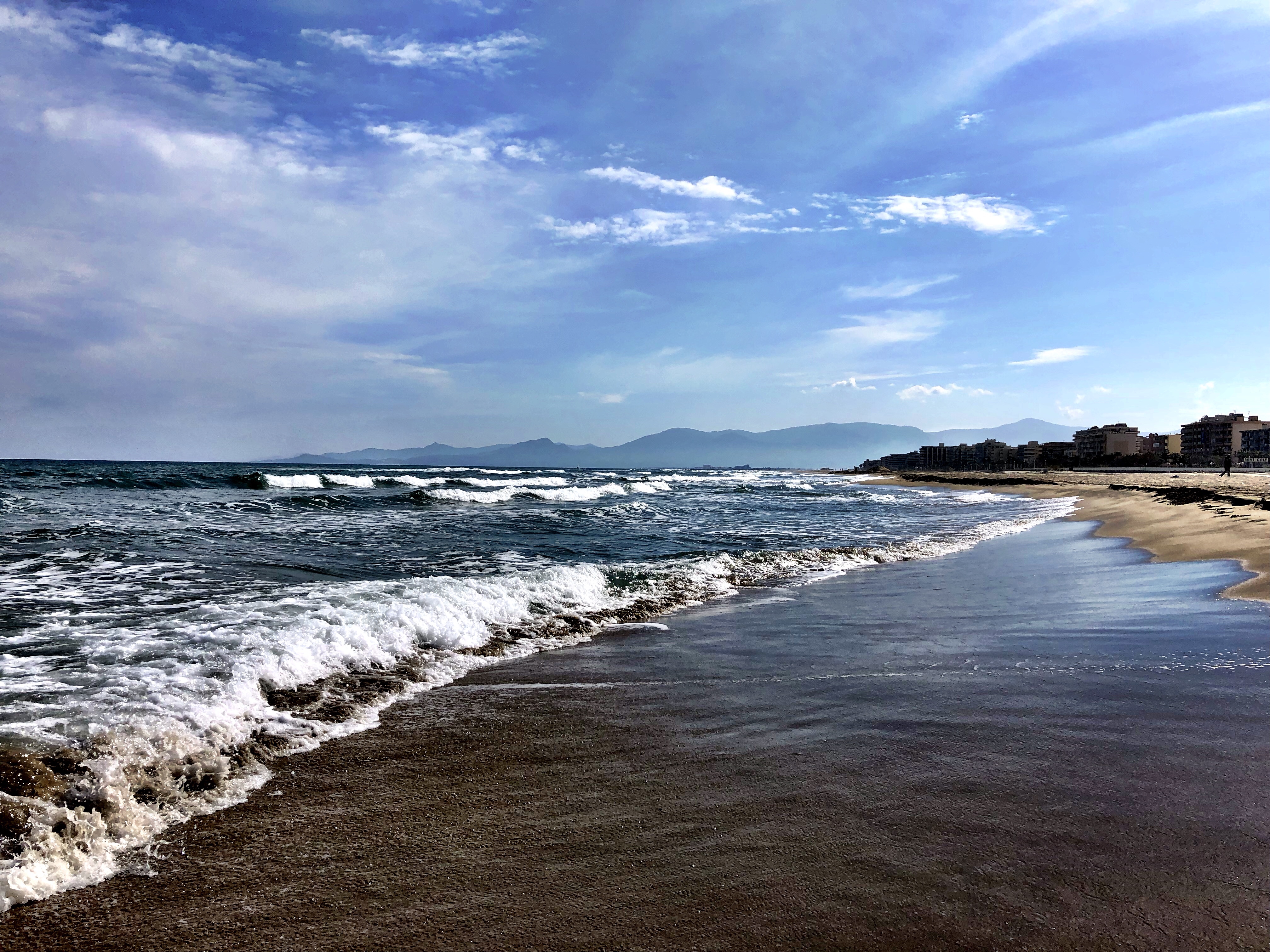
The Mediterranean Coast at Canet-en-Roussillon
It’s about a 9 hour drive to the area of Rousillon where we were based. Some of you may know this area for the excellent wine they produce. As you ply the many tollways southward through Nantes, Bordeaux, and Toulouse, the landscape becomes drier but remains verdant. Finally one arrives at the Mediterranean Sea. It was the first time for any of us to see the Mediterranean; I even convinced Cherie to at least dip her toes in the water. In her defense, it was surprisingly cold. But at least we can now declare that we have touched its waters.
We stayed in a bit of a dodgy resort called the Malibu situated on the coast in Canet, between Narbonne and Pepignan. It was not the greatest accommodation we have ever had, but it was passable. From there, we were able to visit lots of really interesting and beautiful places.
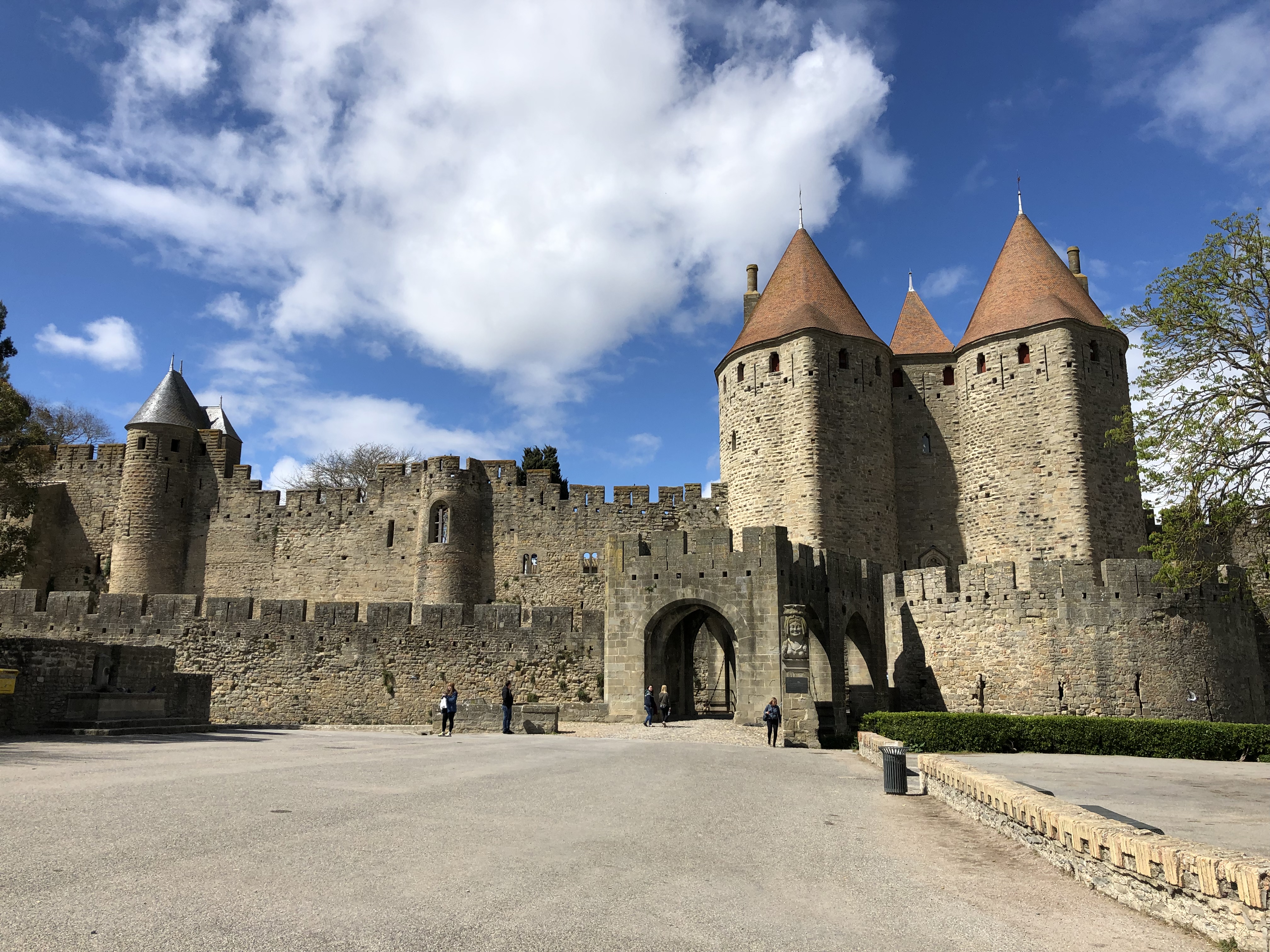
Keep Out! Porte Narbonnaise, Carcassonne
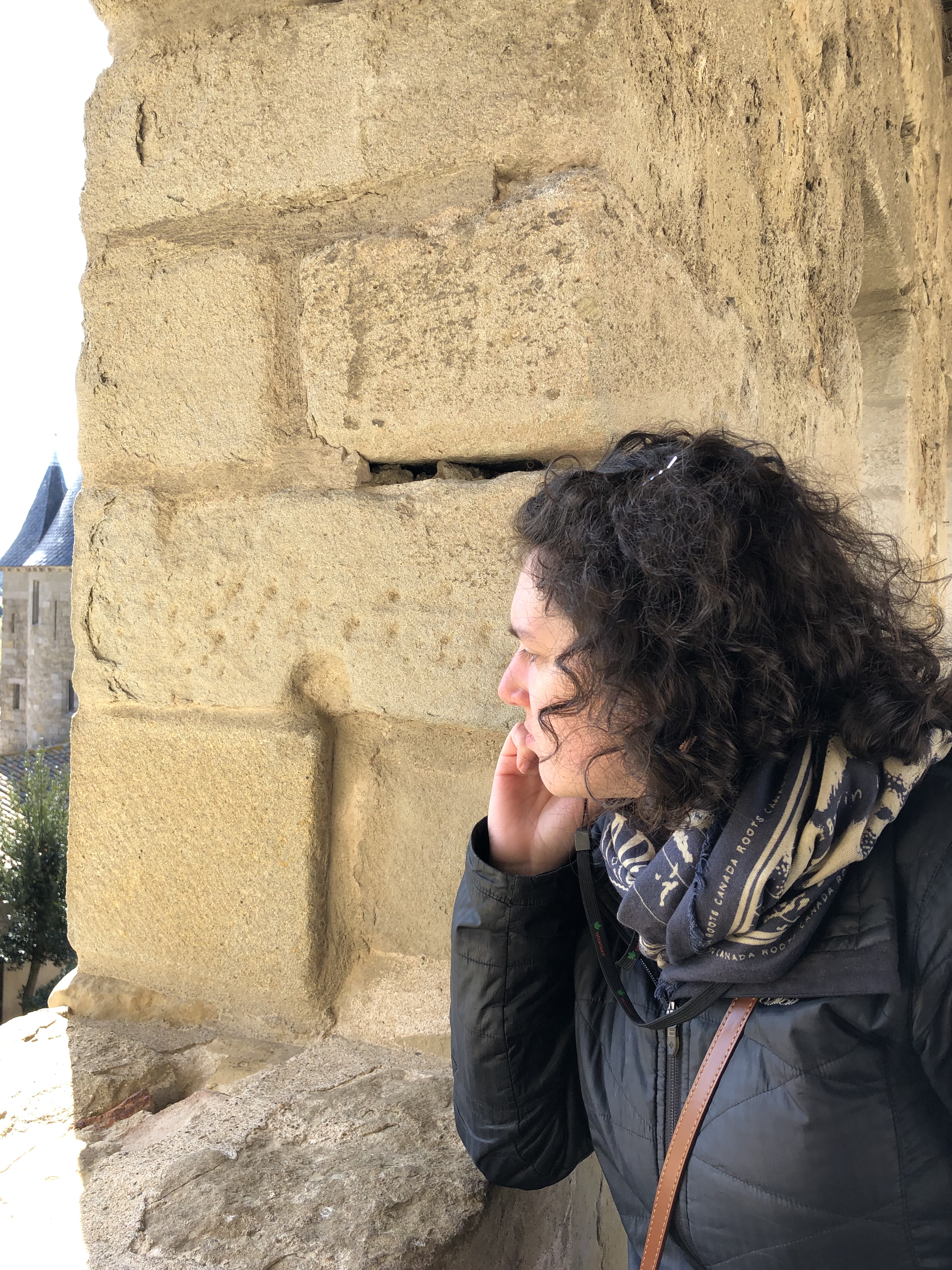
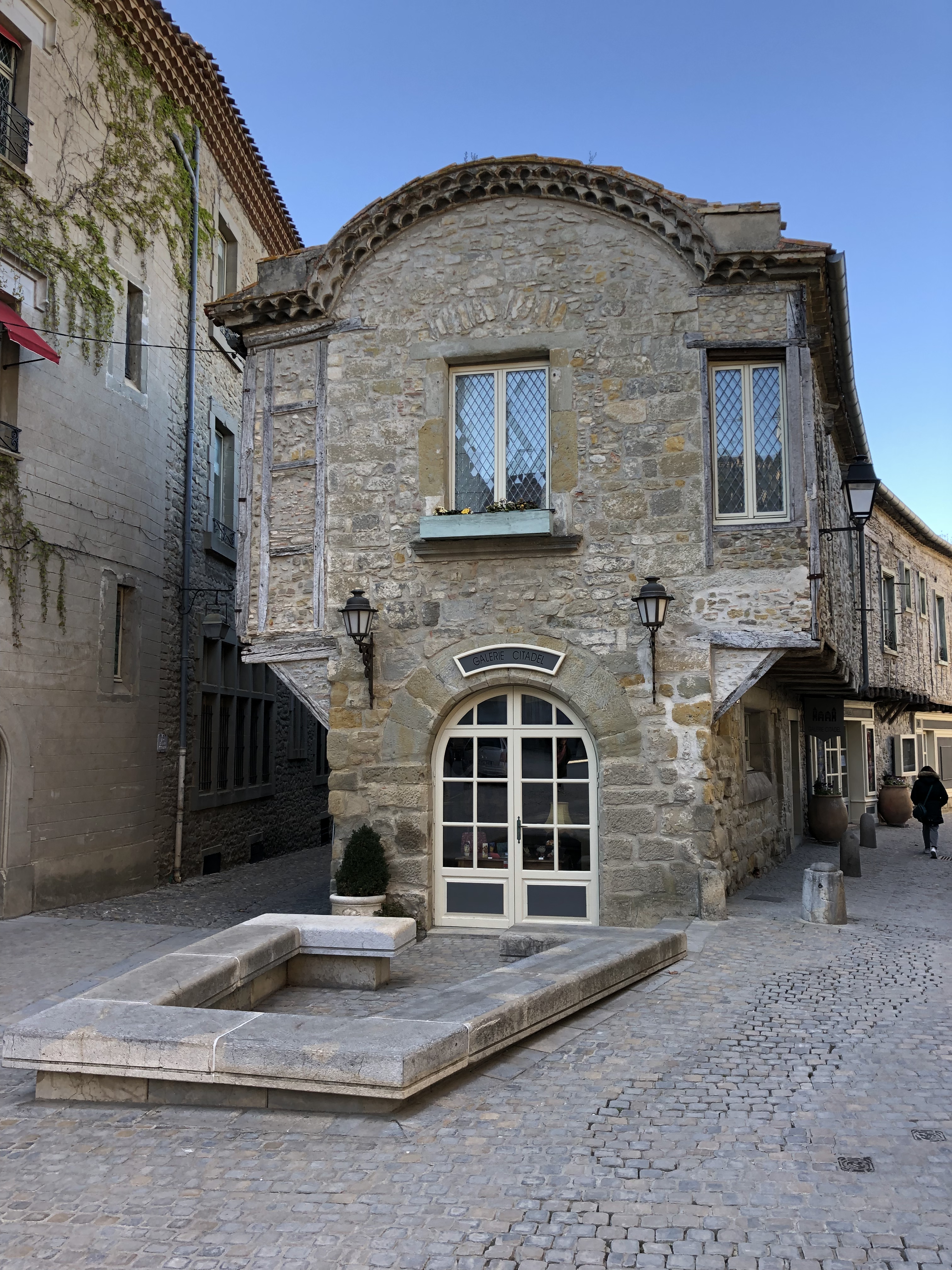
Amongst the extraordinary sites we visited was the medieval city of Carcassone. The first visible fortifications go back to at least Visigothic occupation and much of what remains is from the 12th and 13th century. The old town is surrounded by a double ring of defensive walls within which is a fortified castle. One can walk the ramparts of the inner curtain walls with its many towers and tour the castle itself. Even though it’s very touristy, the entire old town is a medievalist’s dream and we’re so glad we got to see it.
Jessica Pondering the View from the Ramparts, CarcassonneApproaching Dusk in the Cité, the Streets of CarcassonneCarcassonne Fortifications
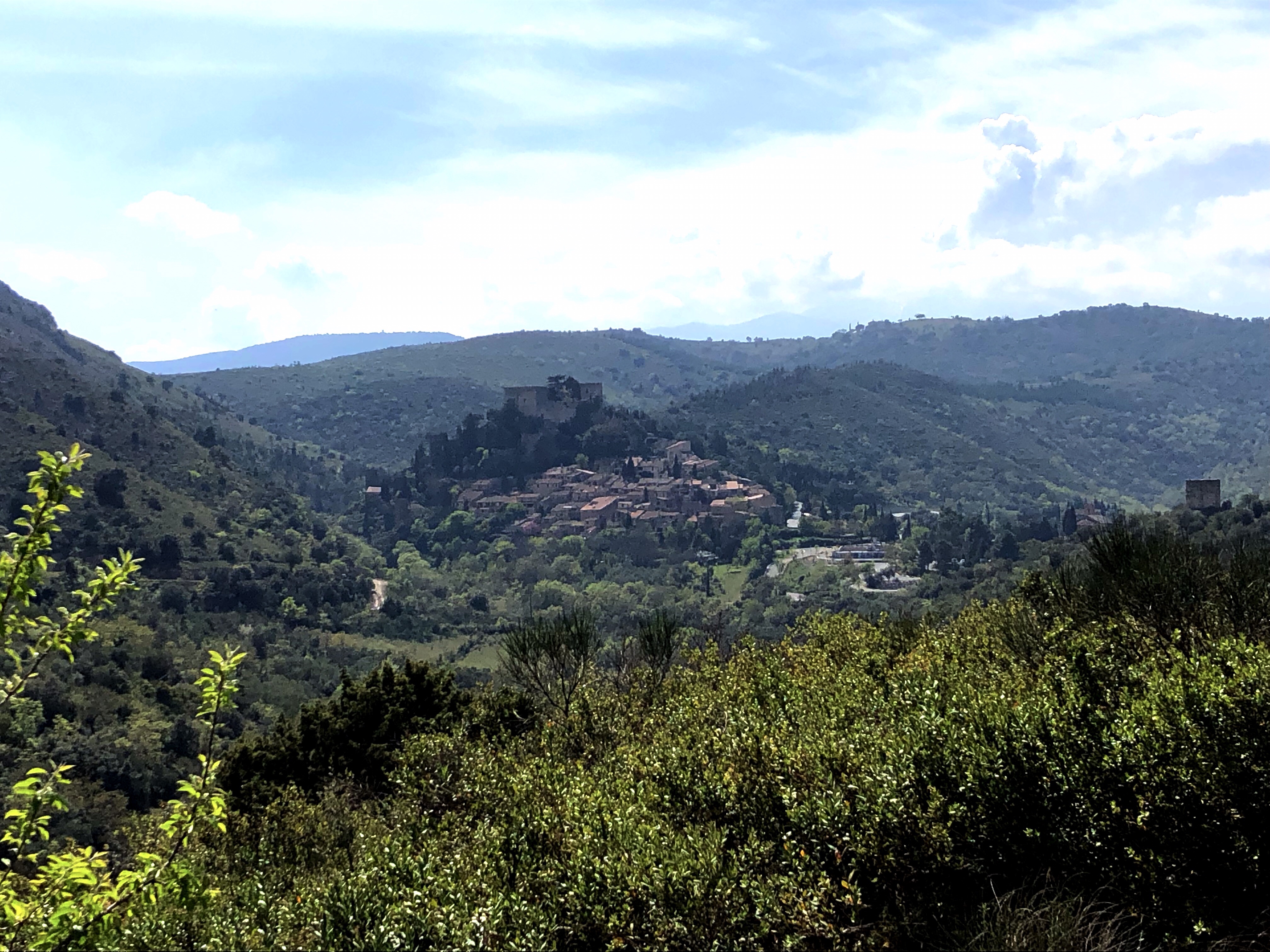
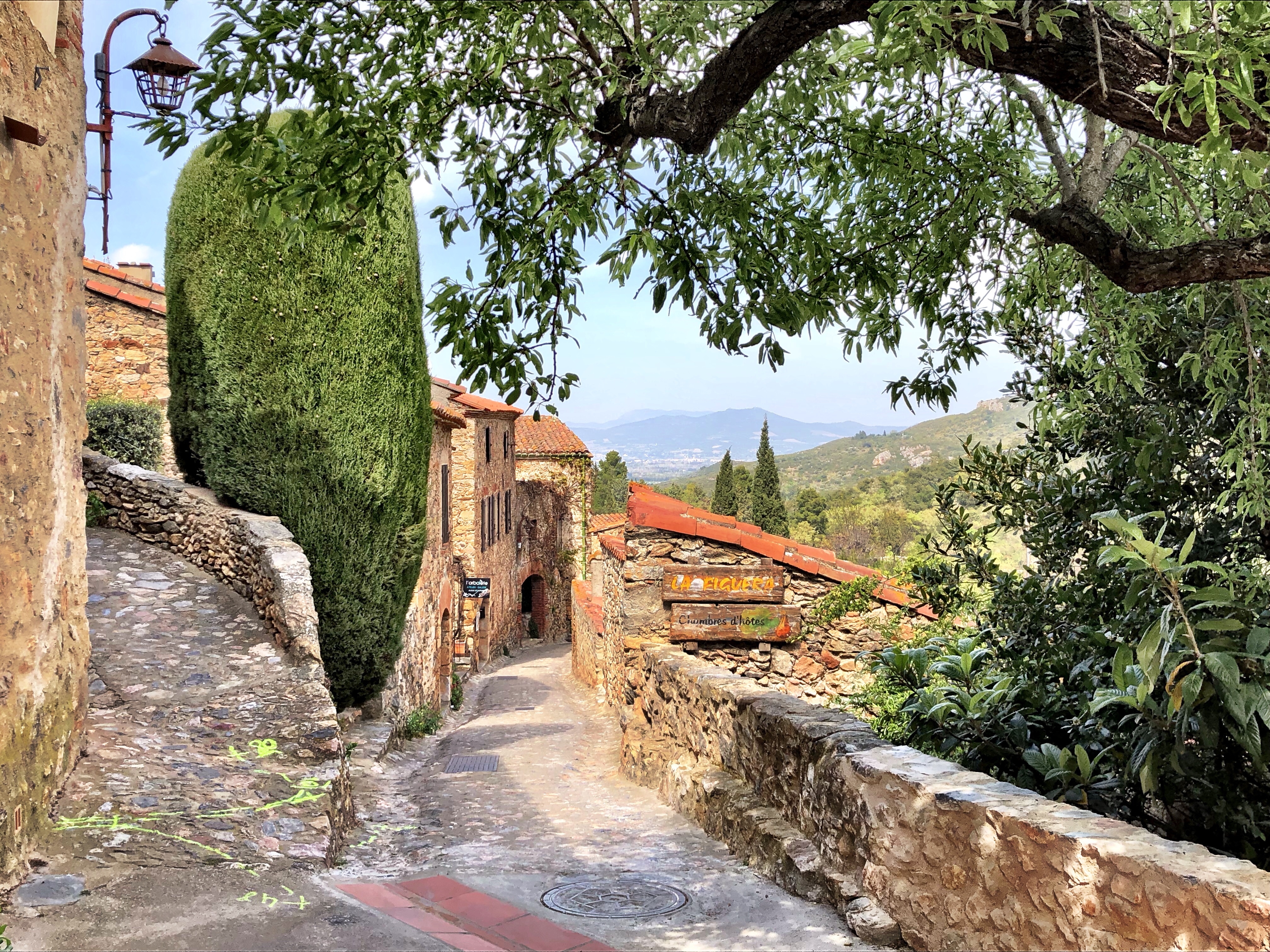
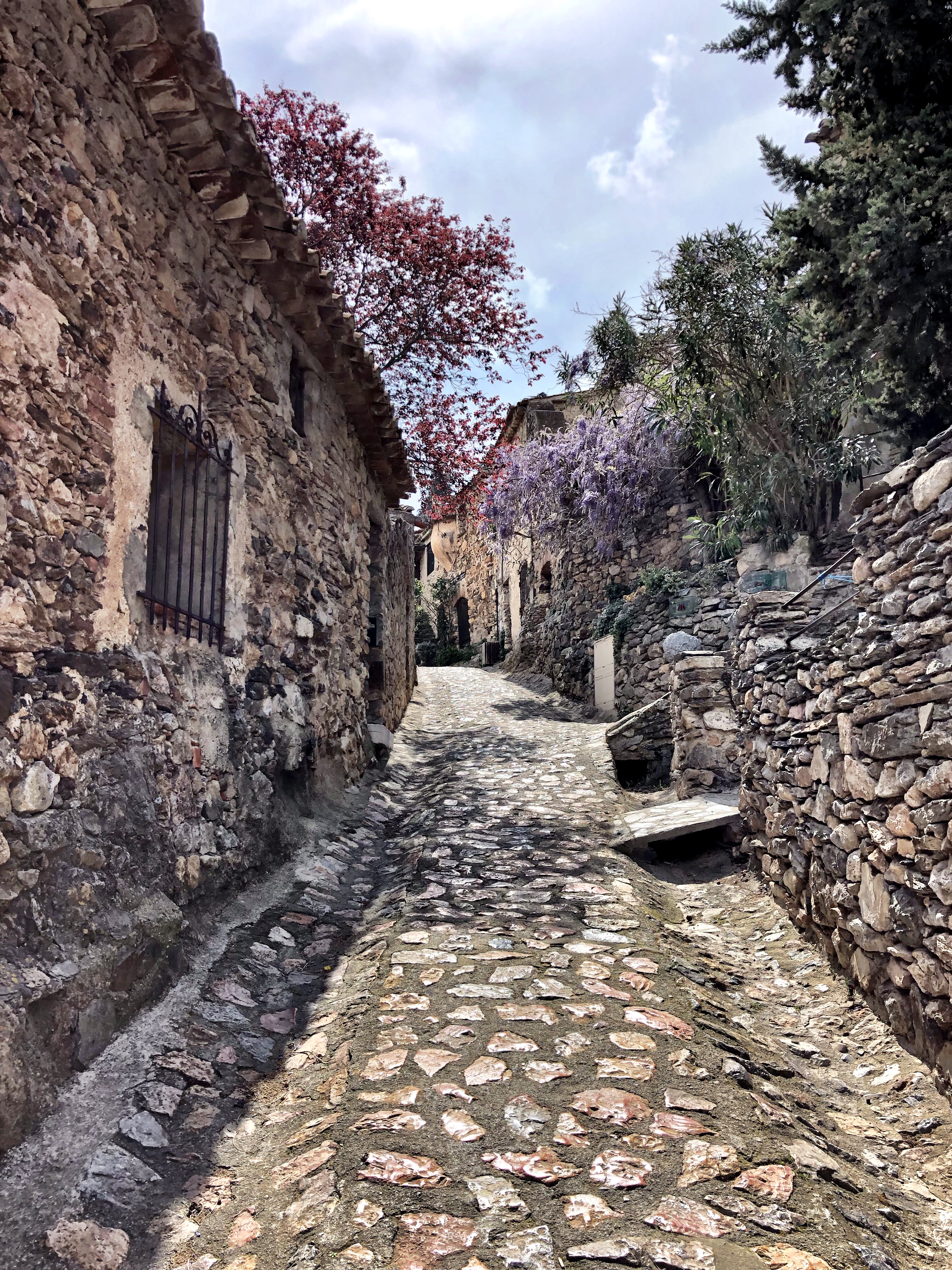
Far up in the hills of the Pyrenees lies the village of Castelnou. Perched on a rocky spur, the village’s houses cling to the steep slopes, huddled together around narrow cobbled streets below the medieval keep which still stands a sentinel watch over the rugged landscape. Almost on a whim we decided to visit Castelnou and we were richly rewarded. It was beautiful and we had the village almost to ourselves. A kind woman in her open-air café just before the fortified village gate chatted with us as we stopped for a brief rest and glasses of Moroccan tea. We were the first Americans she had ever met in Castelnou. Hopefully, we left her with a good impression! For our part, Castelnou left us with a lovely, lasting impression.
A Hill-Town in the Valley, CastelnouNo Cars AllowedWisteria in Bloom
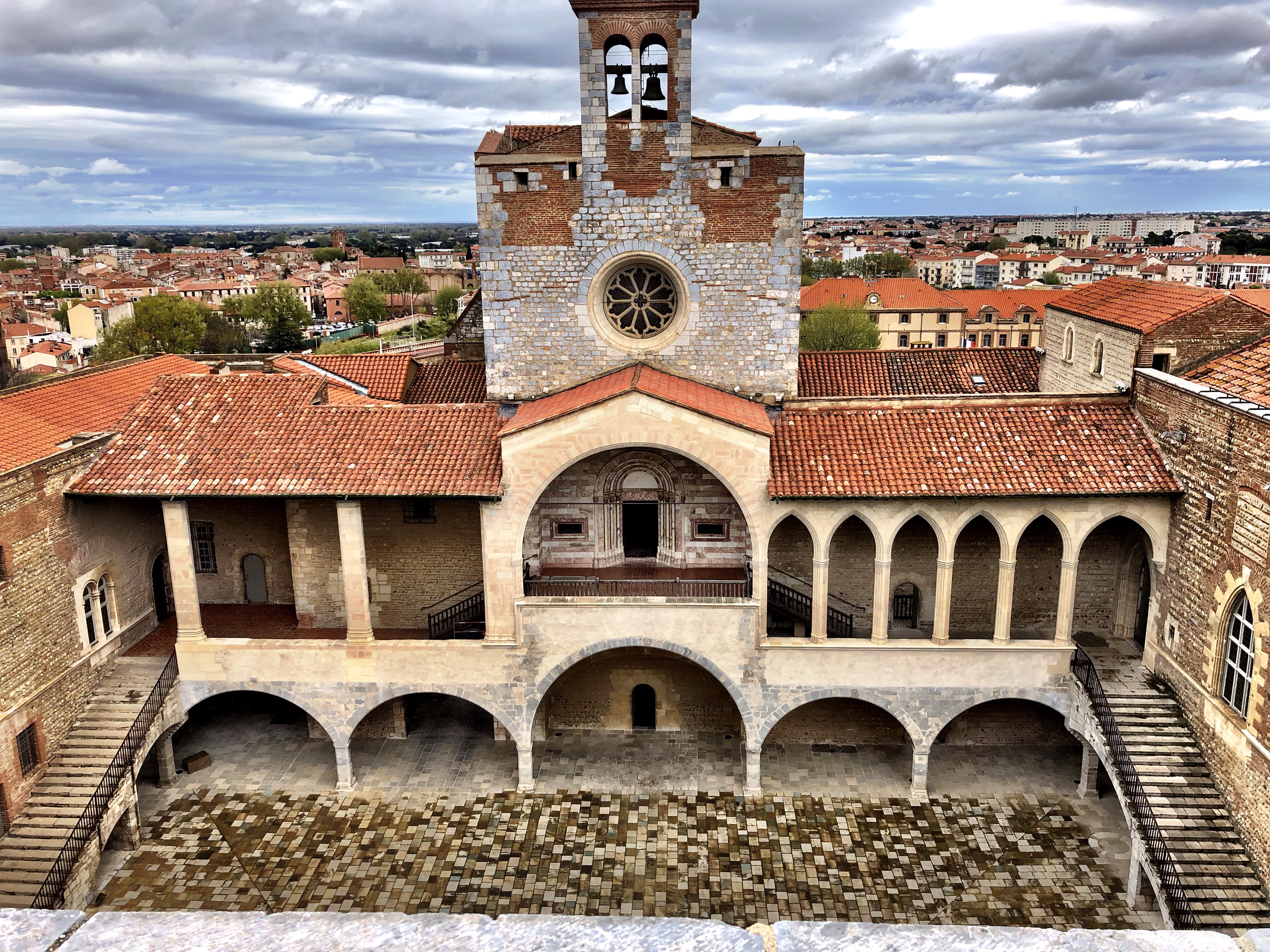
In the bustling city of Perpignan we saw many interesting sites, including the Palace of the Kings of Majorca. In the center of a large military fortification, the palace was built in the 13th century when Perpignan was part of the Kingdom of Majorca. It was so different from what any of us have ever seen. We spent a lovely afternoon investigating its many spaces, including a somewhat harrowing climb up an open spiral staircase in order to get this spectacular view of the palace’s courtyard from high above:
It’s Good to be the King: Palace in Perpignan
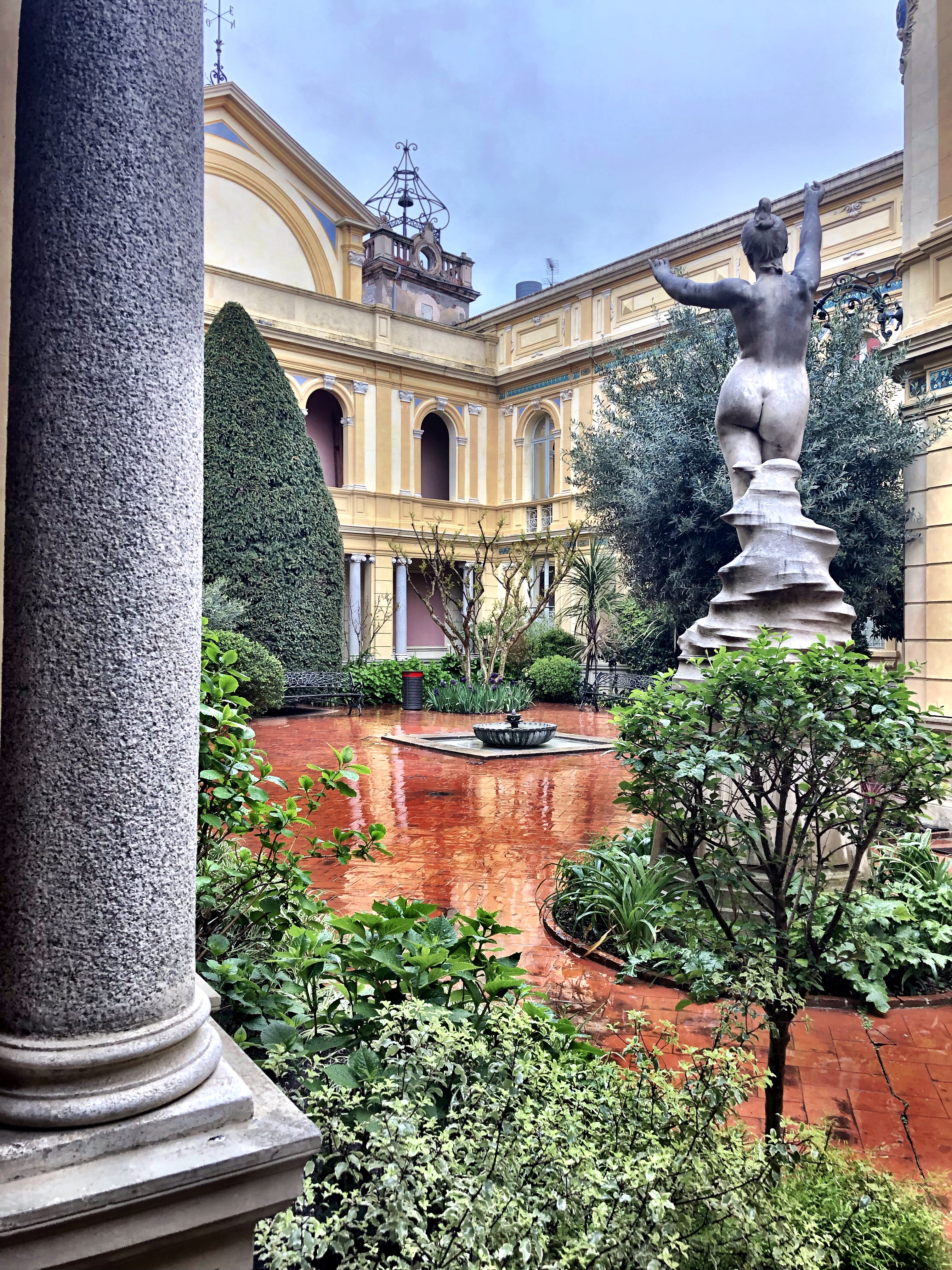
On a different note in Perpepignan was the Hotel Pams, the lovely Art Nouveau home of the Job cigarette rolling paper magnates. Jessica is very fond of this style of architecture and decorative arts so she particularly enjoyed our visit to this house.
Rain-washed Courtyard, Hôtel Pams
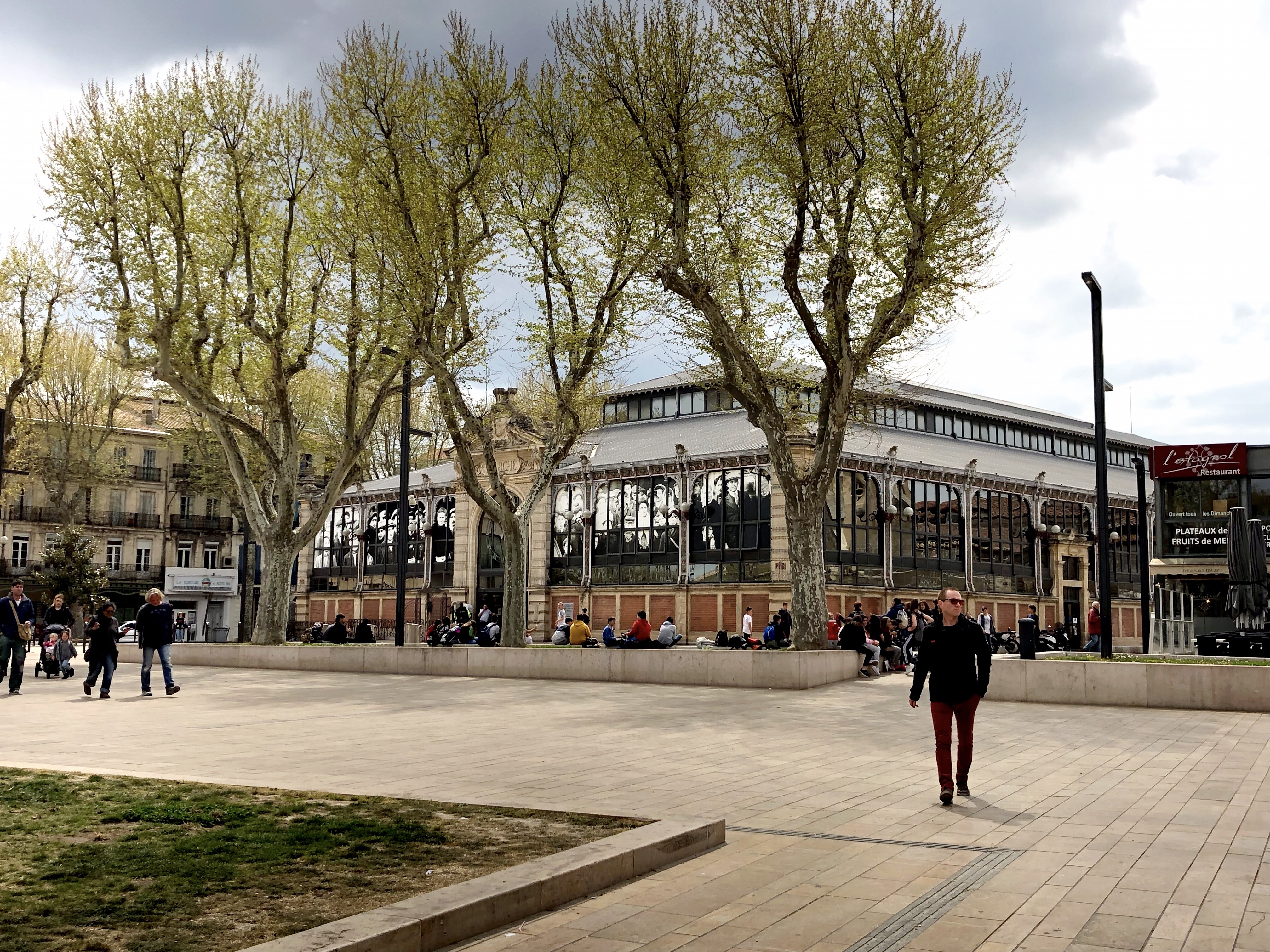
Narbonne: the Market Hall at Lunchtime
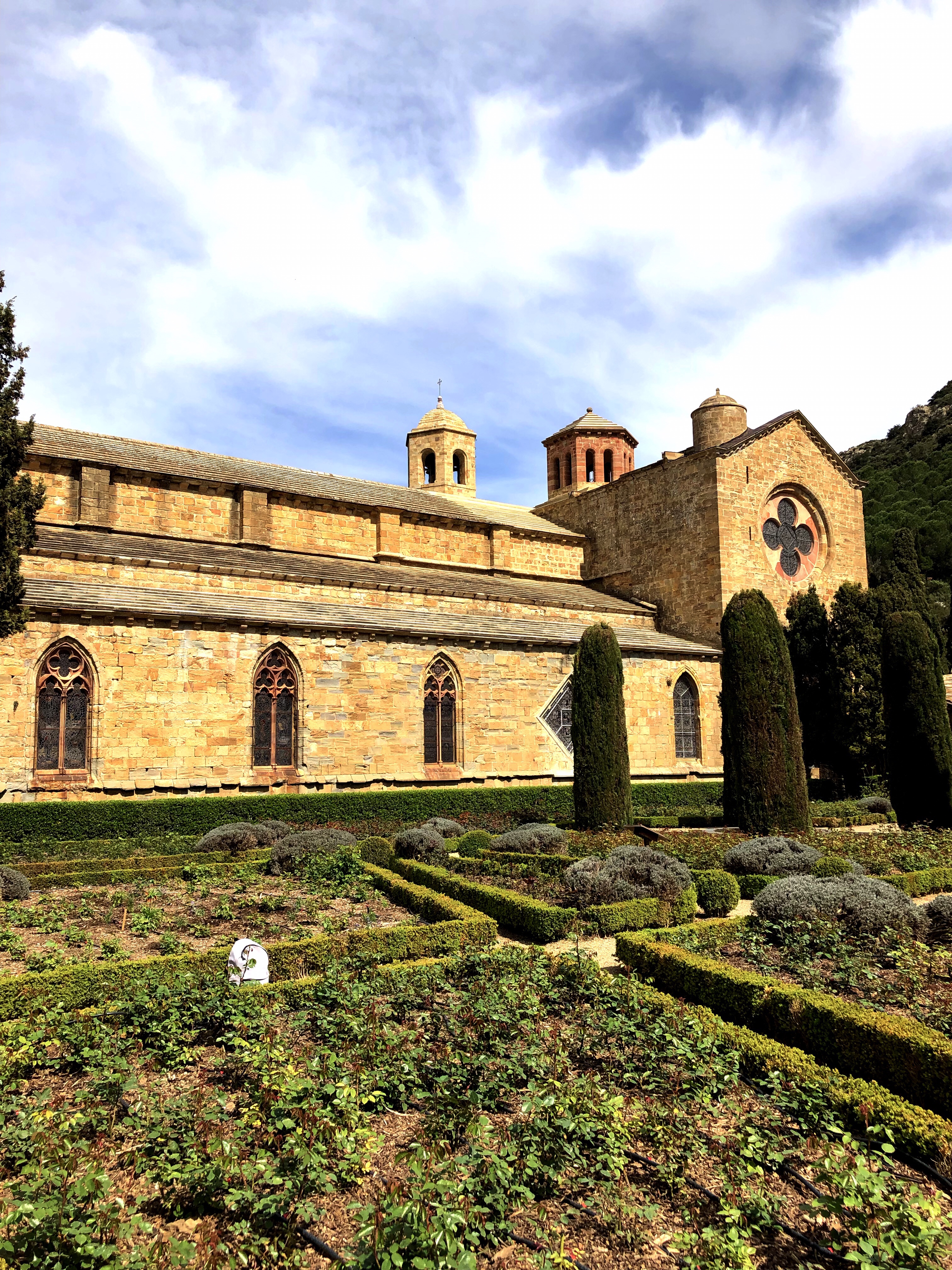
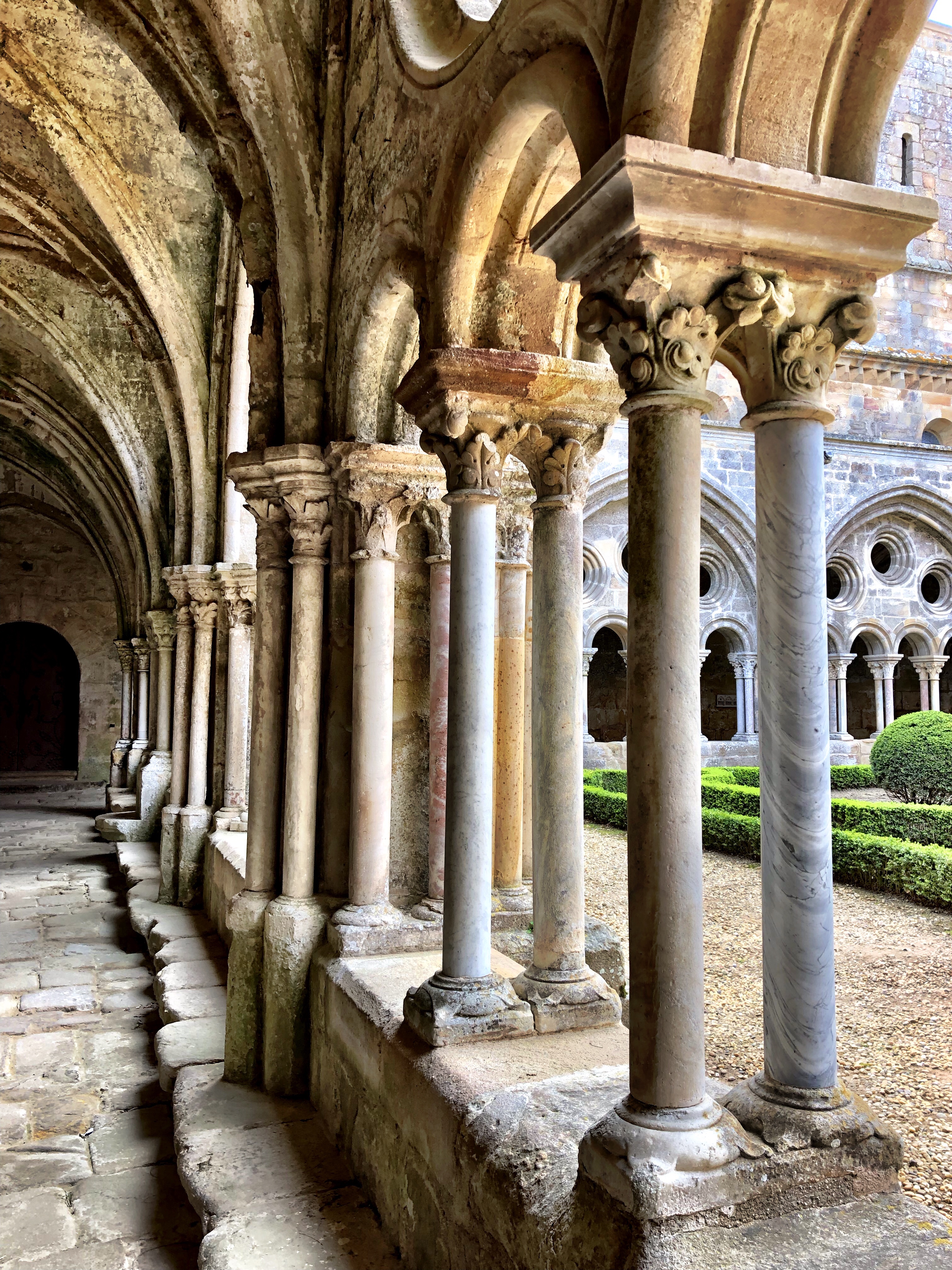
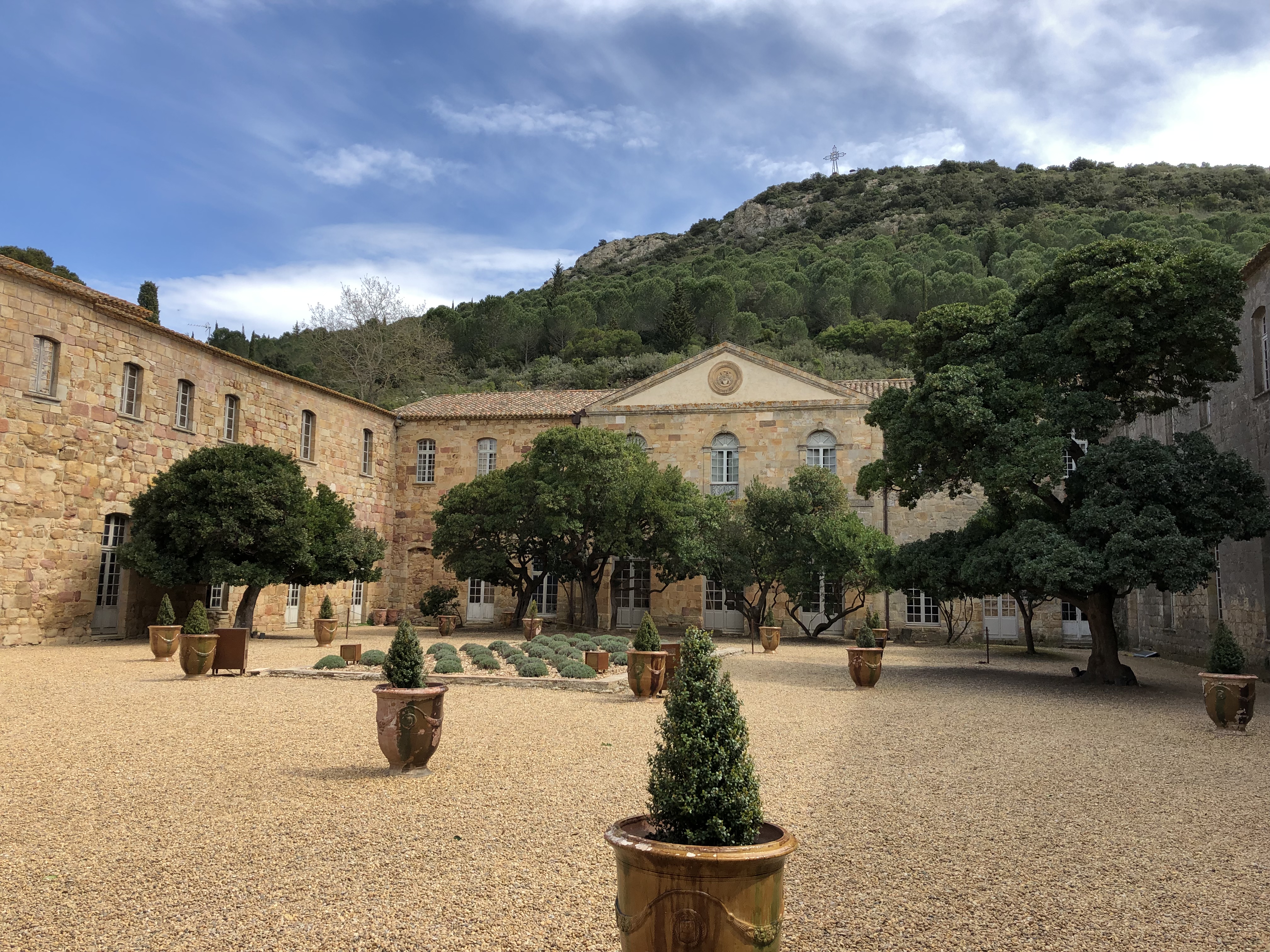
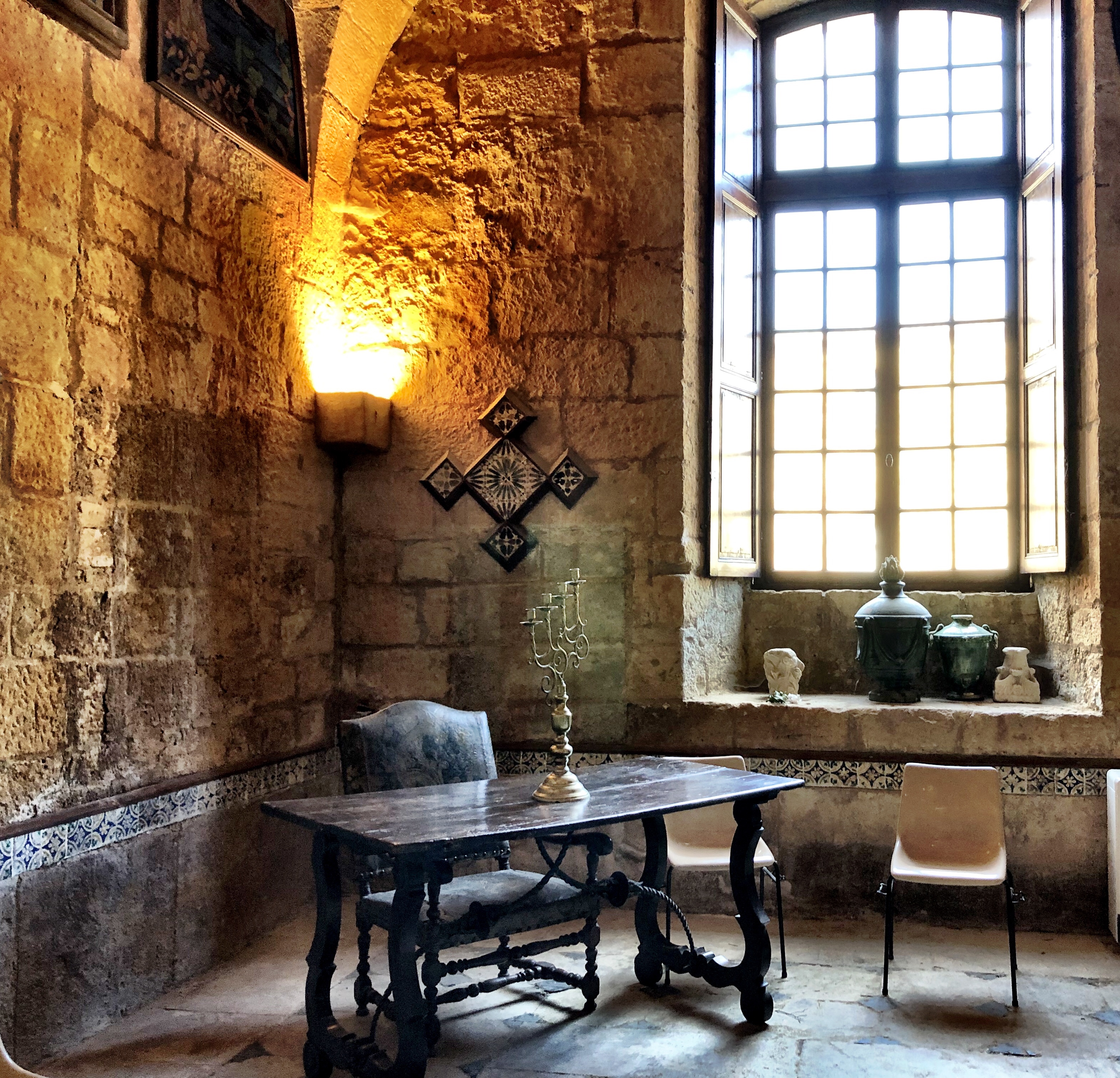
Lastly, I will just mention the Abbaye de Fontfroide, a Cistercian abbey in the isolated Corbières hills west of Narbonne. It’s a beautiful monastery in a lovely setting, nestled in a narrow valley amongst forested hills festooned with pine and olive trees. Expecting some unattended ruins, we were surprised to discover a well-maintained monument, to include a lovely restaurant where we enjoyed an excellent lunch before we set about exploring this historic edifice. It’s privately owned and the owners are also one of the many producers of Corbières wine in the area. They also appear to rent out the abbey as a film location; we arrived to find that several rooms of the abbey were temporarily off limits as a film crew was beginning to dismantle set decoration, lighting, sound and catering equipment that had been set up in many areas. A bit disappointing, but we were still able to see a great deal and we had a rewarding experience.
Abbey Garden: FontefroideCloisterAbbey CourtOld Chair/New Chair: Abbaye de Fontefroide
There was much more but I won’t burden you with an even longer account. We had a lovely time. Thanks for letting us share a little bit of it with all of you.






 Finding Our France