The Magic of Rochefore-en-Terre

Sainted Stone

Cherie and I haven’t been out travelling for pleasure in the past couple of weeks. Frustrated by waiting for our new house to come together, we have been commuting back and forth to Fougères every couple of days in order to expend some anxious energy. Wallpaper has been our latest objective. There are acres of it plastered onto nearly every single wall of the living space. Three and four layers of the stuff. One of our English neighbors in Malestroit loaned us a steamer and it has been very useful for removing the papers, layer by layer.

Wallpaper Beware! Cherie Wields a Wicked Putty Knife

But, wallpaper removal is about as exciting as watching paint dry. Perhaps even less so. Despite the obvious attractions of a lecture on the fine art of dissolving wheat paste and old tobacco stains, I thought we might instead offer a few words about one of our favorite destinations: Rochefort-en-Terre.

A Vista Over the Rooftops of Rochefort-en-Terre

A short drive south from Malestroit, through rolling countryside dotted with dairy farms, lush corn fields and woods harboring red deer and wild boar, brings you to an area of high stone ridges cut through with deep ravines. Stands of oak and pine cling to these rock outcroppings where the colors of grainy grey, burnt orange, and deep mottled green predominate the landscape. Perched on top of one of these ancient ridges is the small town of Rochefort-en-Terre.

View of the Main Street, Rochefort-en-Terre
Place des Halles, the Mairie (Town Hall) at the Far End

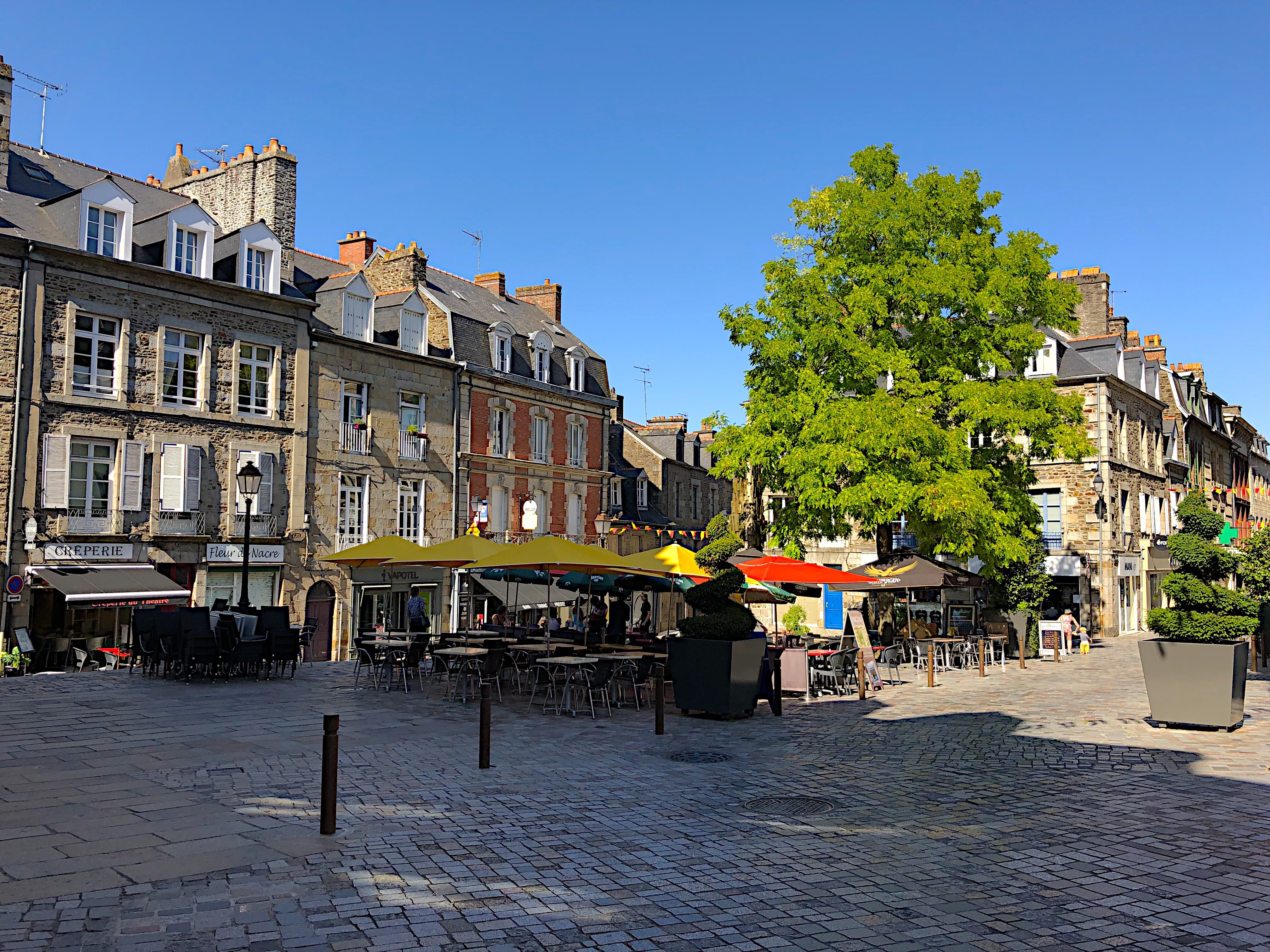
I generally try to avoid too-often abused descriptions such as “cute”, “quaint”, or “picturesque”. But in the case of Rochefort-en-Terre, I really don’t think I have a choice. I’m not alone in this. Rochefort-en-Terre has been designated as one of Les Plus Beaux Villages de France. And most beautiful it is. The town’s buildings, all constructed of a mottled grey stone, are closely packed in together along a central street which forms the commune’s spine.
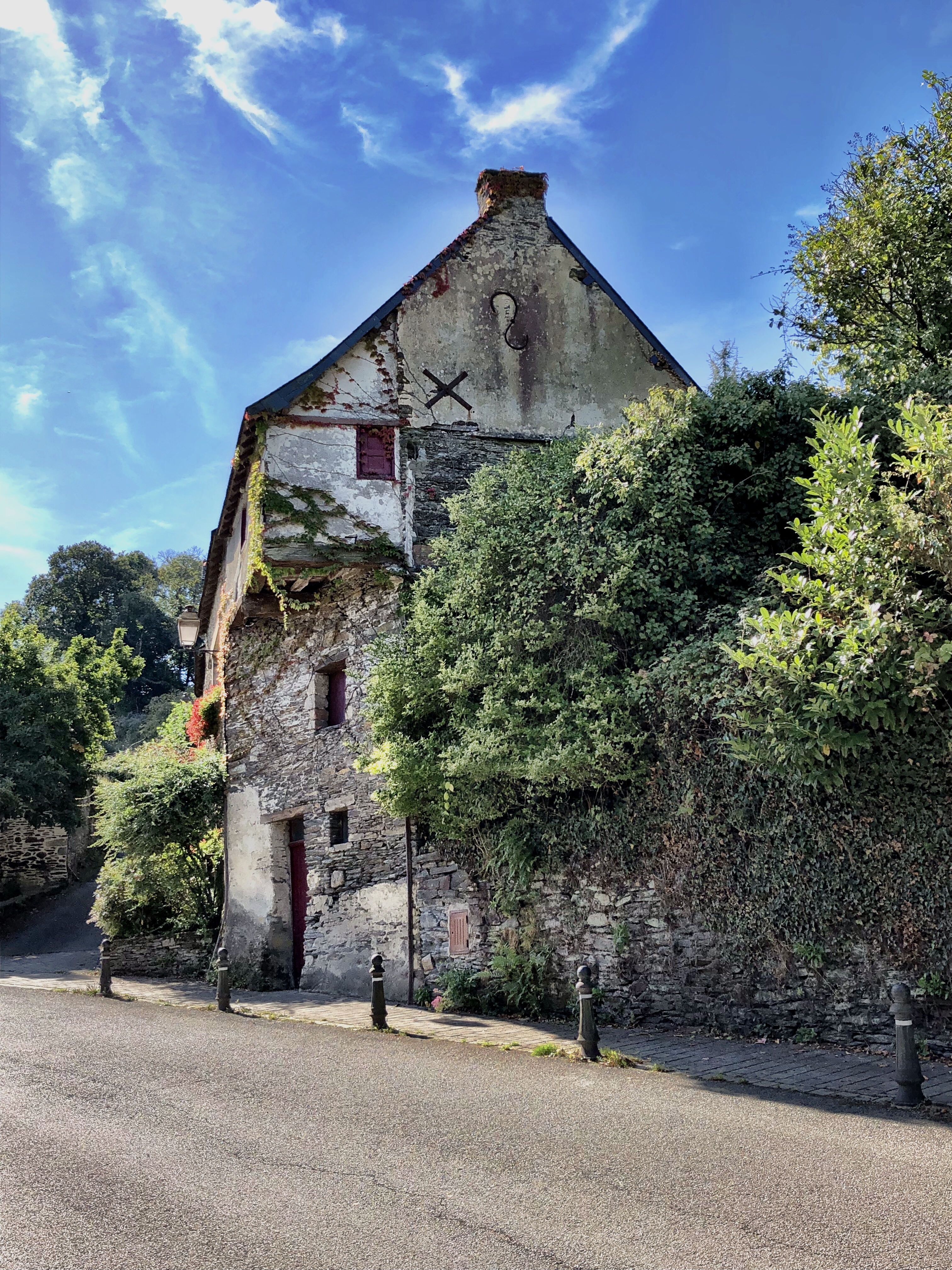
Ancient Townhouse
Sixteenth-Century Lavoir (Laundry Shelter) in the Meadow at the Bottom of Town

Radiating from this street are numerous narrow passages which meander amongst the two and three story homes and shops. Following these passageways provides unique vistas of the valley below or glimpses of secluded cottages and alleys festooned with climbing roses scaling ancient rock walls. Several long, winding stairways join the various levels of the town as it spills down the hillsides. Long, extended back gardens enfold small orchards of apple and plum trees around which the grass is cropped closely by diminutive sheep and goats. Even the backyard livestock is cute in this town.

The Château

Crowning the town at the top of the rocky ridge is a château where once stood ramparts and a castle. Sadly, the château is not open to visit; much restoration work is being applied to it at present. In the 20th century it was purchased by the american painter, Alfred Klots [Extra points if you know of this painter’s works – he was completely unknown to us.] The guy had good taste. It’s a beautiful château and the ruins of the 12th century fortifications make for a dramatic entrance through a still-standing gateway.

A Door to Untold Stories (Okay, Four Stories, to be Precise)

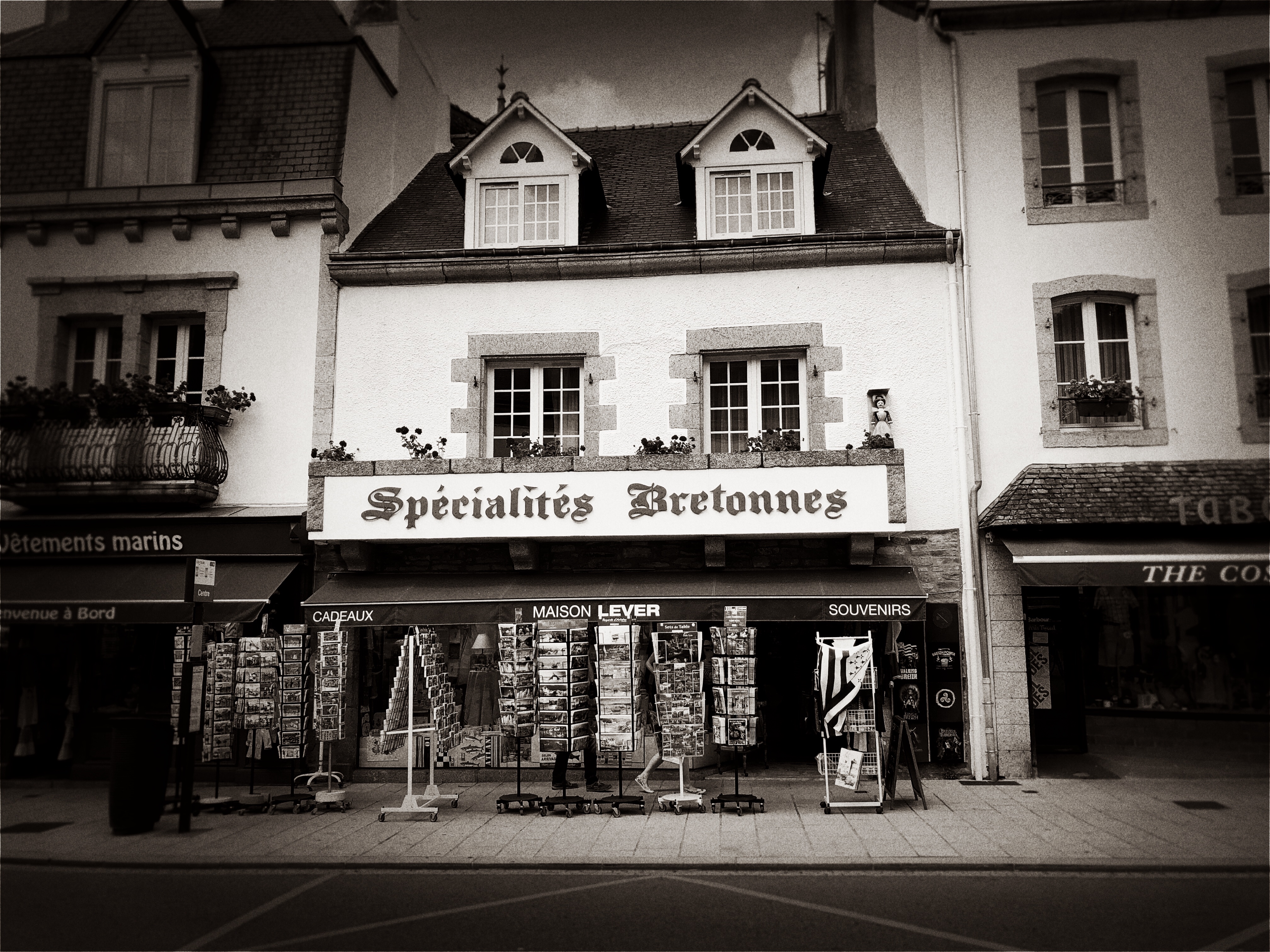
The main street of Rochefort-en-Terre is packed with shops, most of which cater to the many tourists who come to enjoy the town year-round. We particularly enjoy the excellent chocolate shop – no surprise there – where you can fill your own bags from a vast variety of bins containing all kinds of sweets. Choose your own death by chocolate. There are also several nice cafés and restaurants lining the cobblestone streets and we have had a number of good meals here.

Antique Shop

Rochefort-en-Terre also hosts a nice little antique shop at which, you will not be surprised to read, we are regular visitors. The owner is a fairly elderly fellow. Quite charming and warm. When last we were there, we purchased an old lock from him. While chatting we explained that we were from the United States. At that, he began to tell us of his childhood during World War II and how american soldiers had liberated the area. He noted a particular memory that brought tears to his eyes, recalling that a G.I. gave him an orange and it was the first one he had ever tasted. Monsieur was, to this day, very grateful to the american soldiers who freed the town from Nazi occupation. It was quite touching and his emotional response to the memory made us tear up as well.

He gave us a discount for the old lock too. Just for being americans, I suppose. Although we hardly deserved it. But we felt privileged to share the moment with him. Memory of World War II still runs quite deeply through the french consciousness, we have found. Hardly surprising, given the devastation of battle and occupation which so wracked the country for the entirety of the war. While americans have a collective memory of World War II, it is quite different, I think. Here, its impact was so much more universal, visceral and conflicting. Military defeat, deprivation, resistance, betrayal and even collaboration. These sometimes conflicting themes loom large in this country, and a national reconciliation of this time in french history remains elusive to some extent. A sobering thought.

Who Needs Thomas Kinkade?

Rochefort-en-Terre really shines during the Christmas season. Last winter we met our friends Penny and Julian for a visit in the evening. The town is alight with illuminated decorations along the streets, the squares, the church and the shops too. It’s enchanting. I am not what you would call a lover of Christmas. In fact, for me, it’s one of those things that, every year, I just try to get through as quickly as possible. Like a funeral. Or any film with Leonardo DiCaprio in it. But even I can’t deny the intoxicatingly festive spirit which permeates Rochefort-en-Terre at Christmastime. The four of us took a slow stroll amongst the old stone buildings, twinkling with colorful lights in the crisp air of a winter’s evening. Threading our way through groups of cheery revelers we stopped for cups of vin chaud (mulled wine) to keep our engines warm as we continued onward, enjoying the enchanted ambiance and each others’ good company. Despite my accustomed Christmas pessimism, I couldn’t help but feel cheery myself. Resistance is futile in Rochefort-en-Terre.

Notre Dame de la Tronchaye
Good Doggie!
A Good Place to Contemplate

I should mention the lovely and unusual church in the town. It sits just off the main street, somewhat sunken on the downslope side of a small square. Eglise Notre Dame de la Tronchaye was begun in the 12th century. With later additions, it still feels quite ancient, with double aisles, a wooden ceiling and wooden tie-beams carved with fantastic beasts at their terminals. Outside, multiple gables line the length of the nave roof, overlooking several beautifully carved gargoyles in a variety of shapes and guises. It’s a unique design offering many surprising architectural elements which no doubt evolved over the many centuries of this building’s existence. I highly recommended a careful and considered wander through this church.

Cute, Quaint, Picturesque

As you can see, there are good reasons why Rochefort-en-Terre is fondly considered to be amongst the most beautiful towns in France. Yes, it can be a bit touristy, but it’s a simple matter to step off the well-trod tourist street on to quiet and often deserted passageways and alleys – even in the height of the season. We’ve done it several times now, and the town never fails to impress. We’ll be back for many more visits, I’m certain. Even after we’ve moved further away to the north in Fougères. Rochefort-en-Terre is just one of those places that sticks to your soul. For our part, we’re quite happy to have it comfortably lodged there forever.
The Colors of Pont-Aven

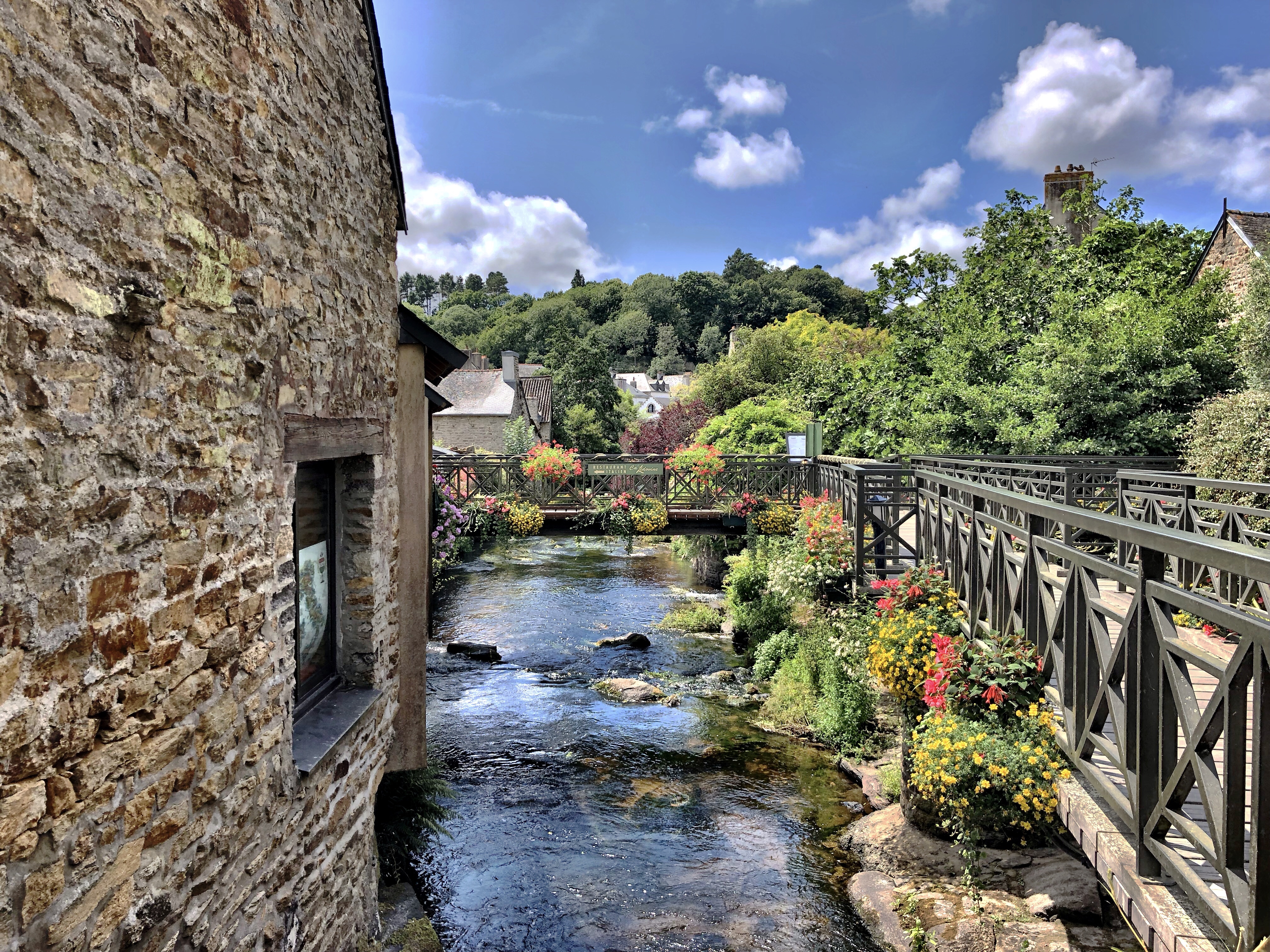
The Aven River Coursing Gently Past Foot-Bridges

A somewhat hastily planned outing to the Breton town of Pont-Aven was on our agenda for this weekend. Frustration with the glacial pace of progress on our house renovation in Fougères continues to build so we felt we needed a sanity break. What better way than to visit a picturesque ville and a château on a lazy summer’s day? It was also my birthday (54 years – almost equal to the number of hairs on my head) so I was keen to get out and do something. Not that I feel the Grim Reaper’s breath – surprisingly minty, by the way – on my back, but I am gaining a greater appreciation of how fleeting time can be. Best to gather ye rosebuds while ye may, n’est-ce pas? [Obscure reference to 17th century English poetry courtesy of my liberal education.]

A Breton Idyll

From Malestroit in Morbihan, we drove to the département of Finistère which encompasses the westernmost portion of Bretagne. It’s about an hour-and-a-half drive through gentle hills festooned with oak, beech, and lush farmland of cow pastures, maize and grain crops. It’s pretty country, reminding me somewhat of the area where I grew up in western Oregon.

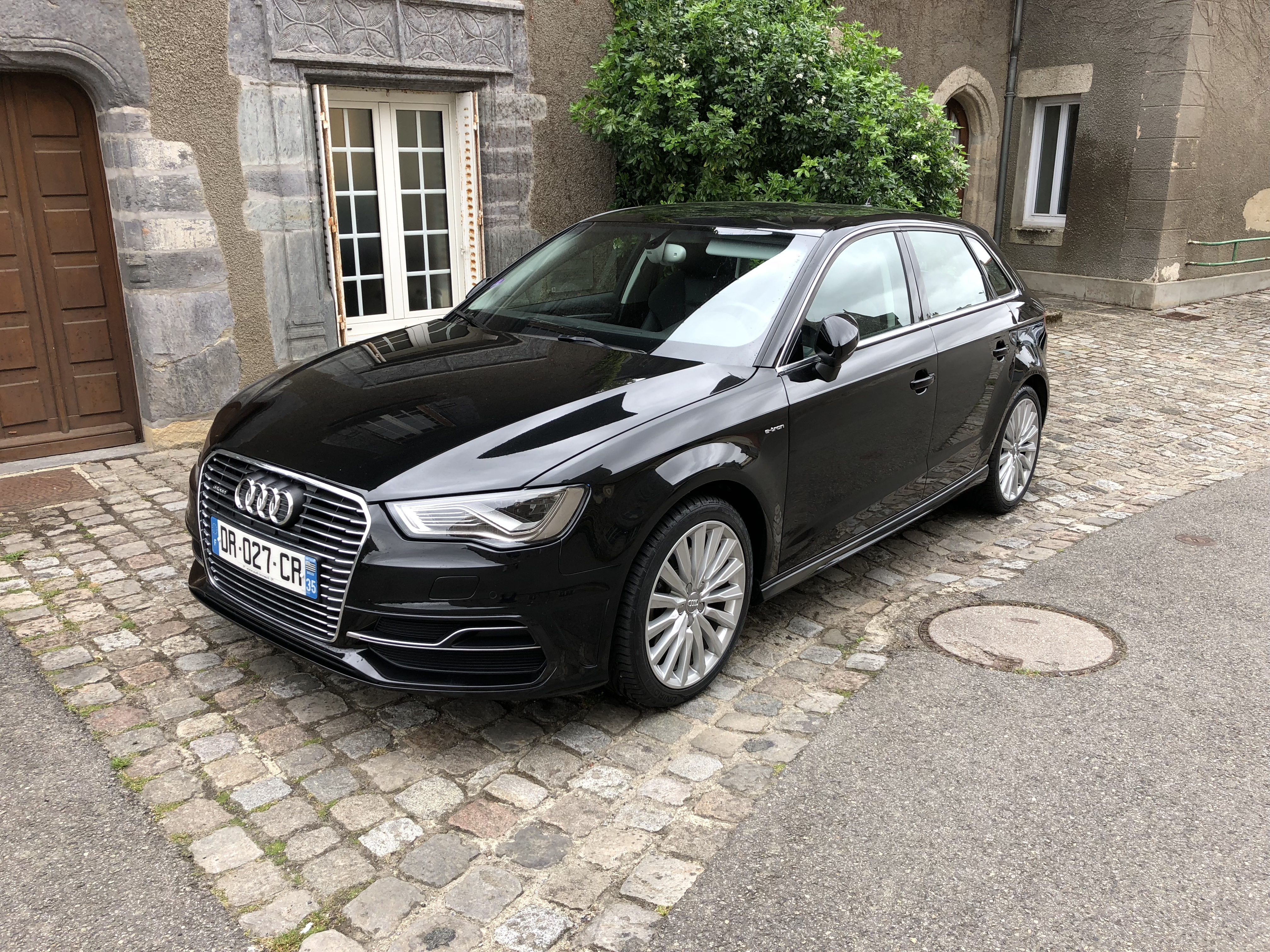
Our trusty Audi which we purchased not long after we moved to France has proven to be a great car. We bought it used but with low mileage. A plug-in hybrid, the electric battery will get us around 60 kilometers on a full charge. It doesn’t sound like much, but it actually translates in to a considerable savings in fuel consumption. Like most people, the majority of our car trips are short errands around town. We find that we complete most of these trips using only the electric battery.

Our primary intention in purchasing a hybrid electric car was to reduce our carbon emissions. Because, you know, man-made climate change is a real thing and we prefer to try to contribute to reversing it rather than sticking our heads in the sand. So, the car is good for that. It is quite satisfying to be quietly making one’s way through the cobblestone streets under electric power. Of course, we try to walk when we can. And our hybrid electric is certainly not the best solution available. But we feel it’s at least a small positive step towards a wiser, more sustainable future.

Our Audi A3 e-Tron (2015)

The Audi also saves us a bit of cash. In our present situation living in Malestroit, we don’t have a place to park the car where it is appropriate to charge it from an outlet in the house. Thanks to some very forward-thinking action on the part of the town’s leaders, Malestroit has installed, not one, but two charging stations in its main parking lot. And one of those even offers free charging. A slow, full charge of wind-turbine-generated power takes about two-and-a-half hours. Not the most convenient, given that I have to take the car out and pick it up from the charger. But still a pretty sweet deal. Once we are moved in to our house in Fougères, we can simply plug the car in from our garage at will. Can’t wait!

Waiting for the River to Rise

Pont-Aven rests cozily in a narrow valley through which the River Aven flows on its way to the sea. In fact, the tidal limit of the estuary comes up to the southern end of town. There, the river widens, accommodating a sizable fleet of pleasure boats moored either side of the main channel. Except for this channel, the river bed stands dry at low tide. The boats are modified to remain upright on their landlocked moorings by the use of legs fixed to either side of their hulls so that, in concert with their deep keels, they always have at least two points on the ground to stabilize them. It’s a pretty harbor and would be a lovely place to keep an old sailboat. I can dream, can’t I?

Calming the Current: Along the River Aven

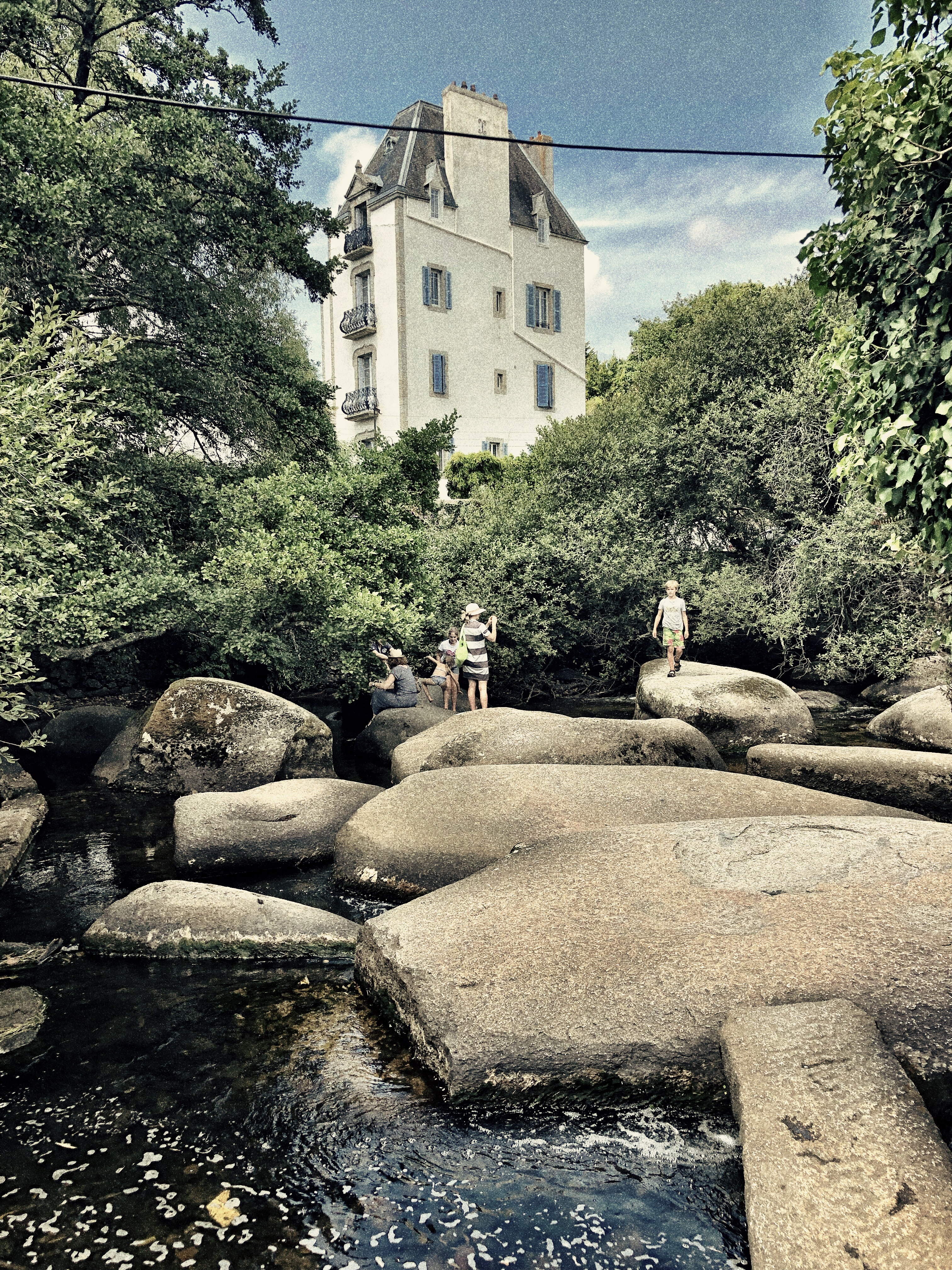
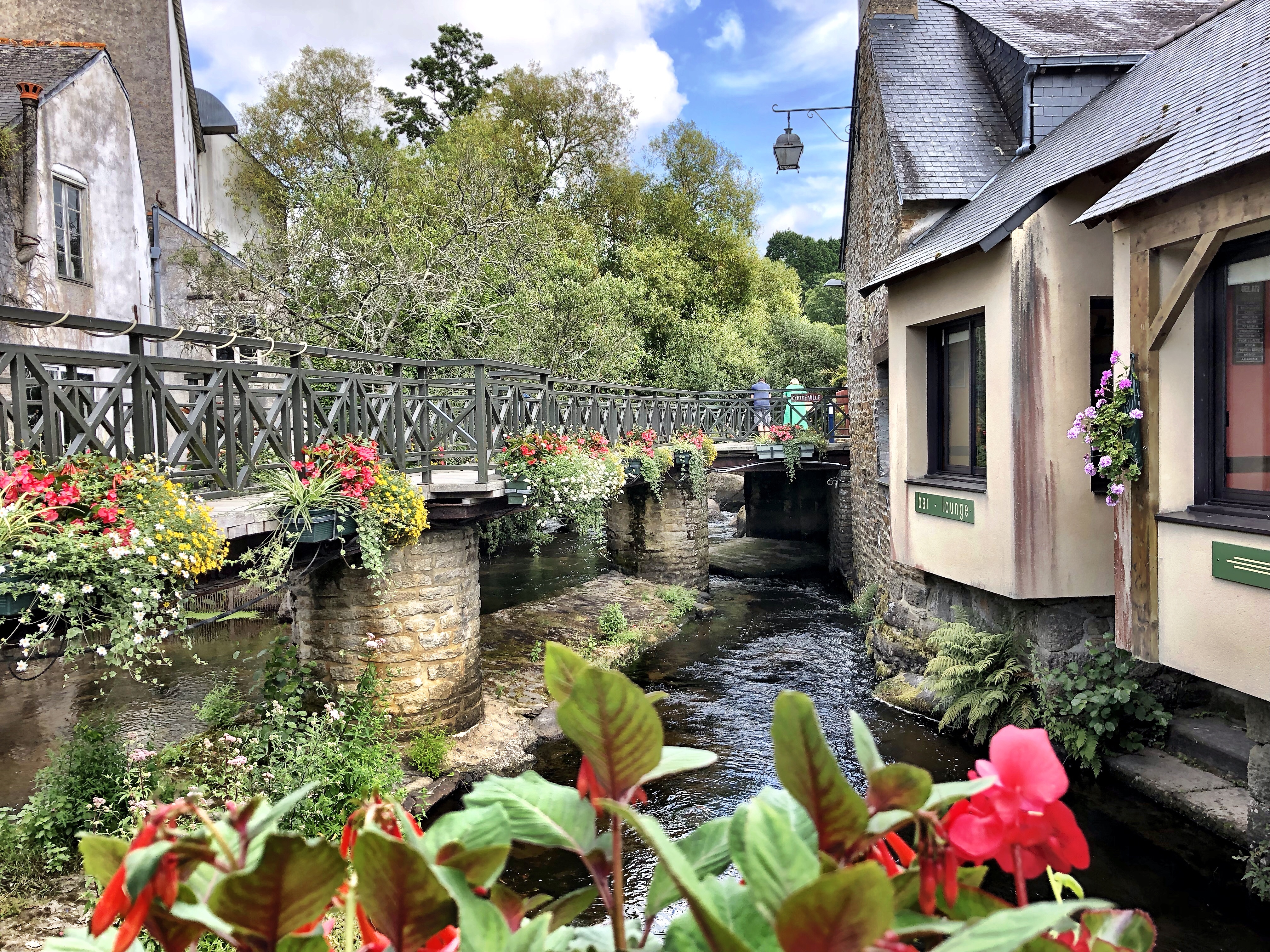
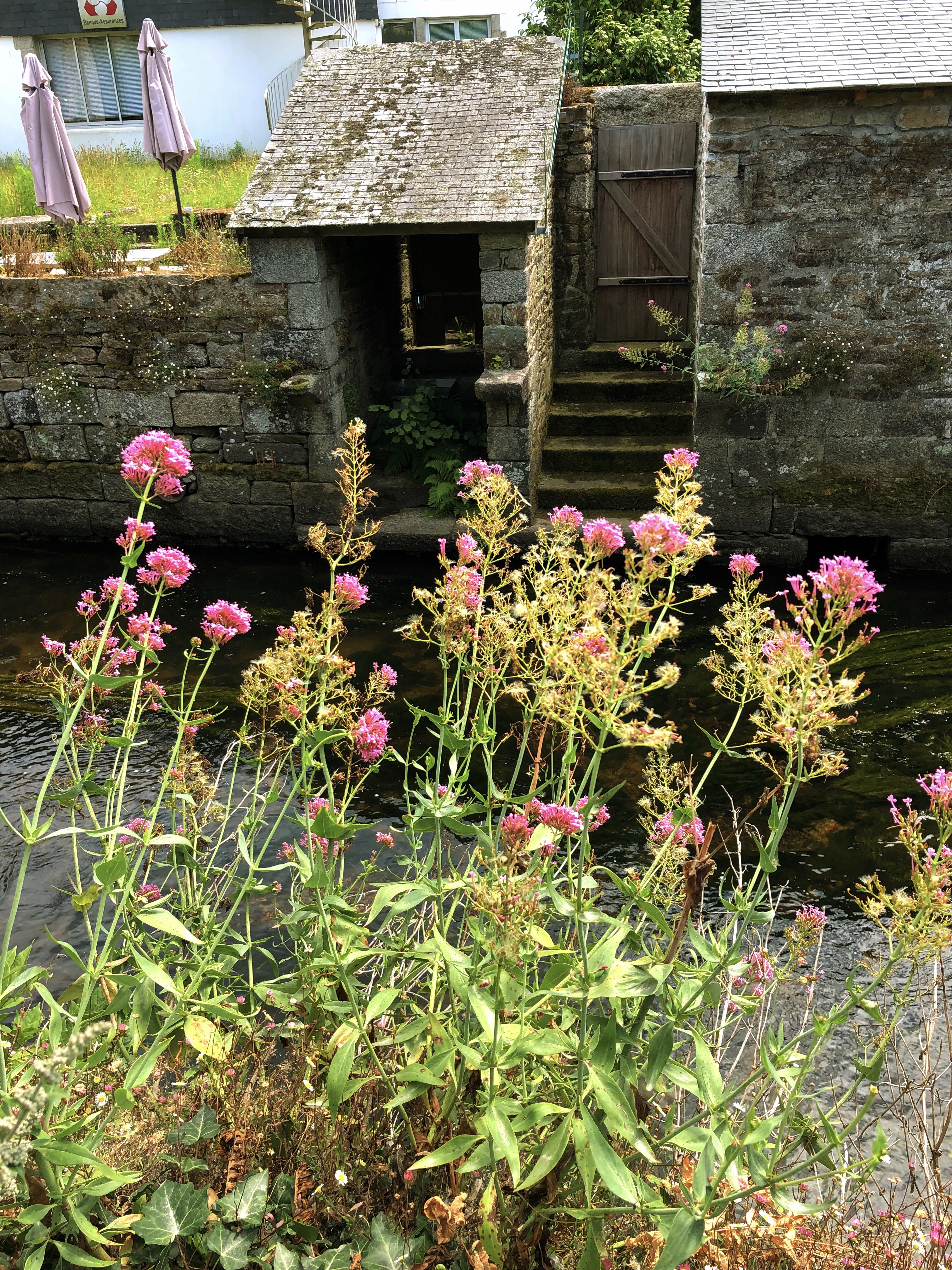
The river Aven forms the spine of the town. As it flows through the center of the ville it is channelled into numerous mill races (the mills themselves now long disused) which are criss-crossed by a series of pedestrian bridges. The bridges are well-kept and made all the more colorful with rows of flowers in planters along their railings. The watercourse is often interrupted by patches of large boulders, strewn about as though, in the dim mists of times now long forgotten, géantes celtique were interrupted in their crude game of pétanque, leaving their pieces lay as they were thrown. Along the banks of the river, numerous lavoirs step down to the water, where once the householders of the town washed their clothes. In the rare quiet moment, we could imagine the sounds of scrubbing, beating and rinsing as it must have been for centuries. On this warm July day of sun and puffy clouds, the whole made for really pleasant scene. We soaked it in for a good long time as we meandered along the paths and bridges.

One of Many Bridges Tracing the River’s Path
Now-Silent Lavoirs (Wash-Houses)
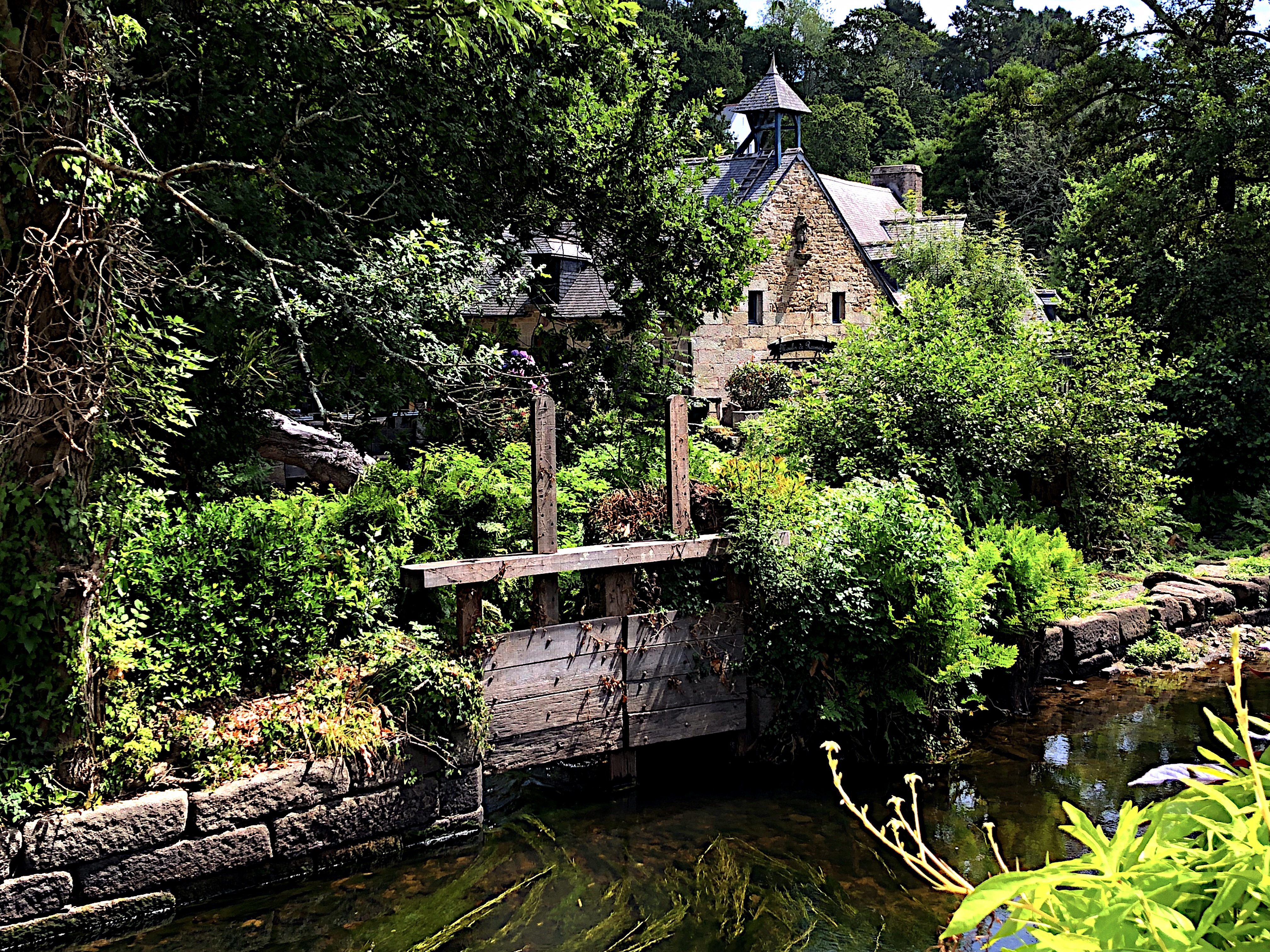
A Sluice-Gate Amongst the Bracken, the Mill it Used to Serve in the Background

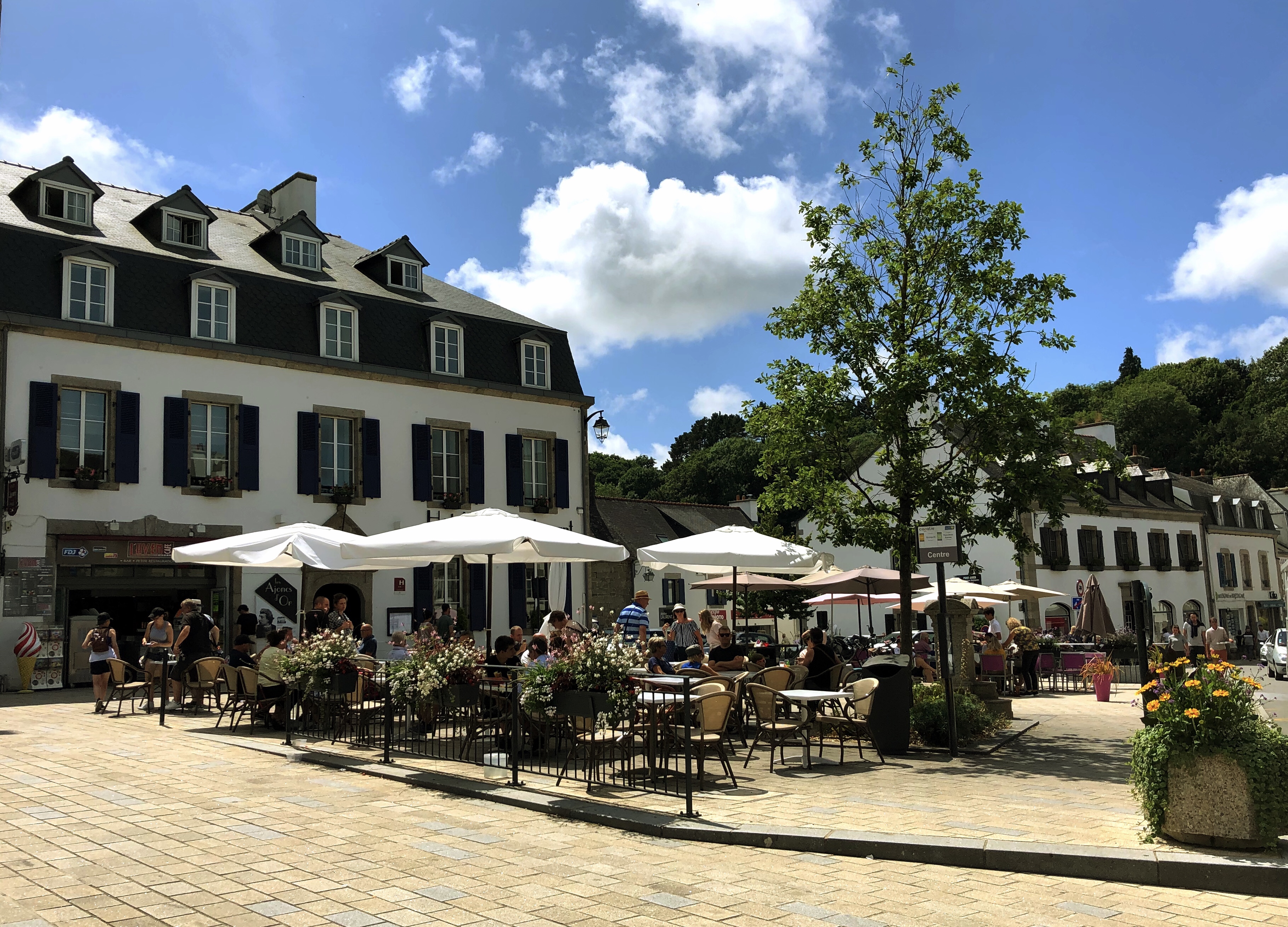
Our river walk was particularly satisfying because we had just enjoyed a quiet lunch. The restaurant is situated at the very heart of this busy tourist town and we were seated at a widow above the street. Inveterate people-watchers, we engaged in one of our favorite spectator sports, amusing ourselves with the myriad of visitors marching past our view.

Tourist-y!

Pont-Aven is quite popular with tourists – it has been so since at least the 19th century. From the 1850’s to 1900 it became the frequent summer haunt of artists, the most famous of which was Paul Gaugin. [For any of you interested in art history, I recommend a quick read of the Wikipedia page for the “Pont-Aven School”. A lesser-known, nonetheless influential art movement.] It’s not hard to see why this area attracted artists and continues to do so. The light, the many colors, the juxtaposition of a myriad of textures, architecture and nature, the people, the boats and, running through it all, the water. There’s so much to dazzle the eye.

La Place de L’Hôtel de Ville

We really enjoyed our trip to Pont-Aven. A lovely town in a lovely setting. It’s definitely worth a visit for anyone and we ourselves are quite likely to return someday.

Kernault – A Modest Country Retreat

After a few hours in town, we decided to spend the remains of the afternoon at the manor.

You know. As one often does.

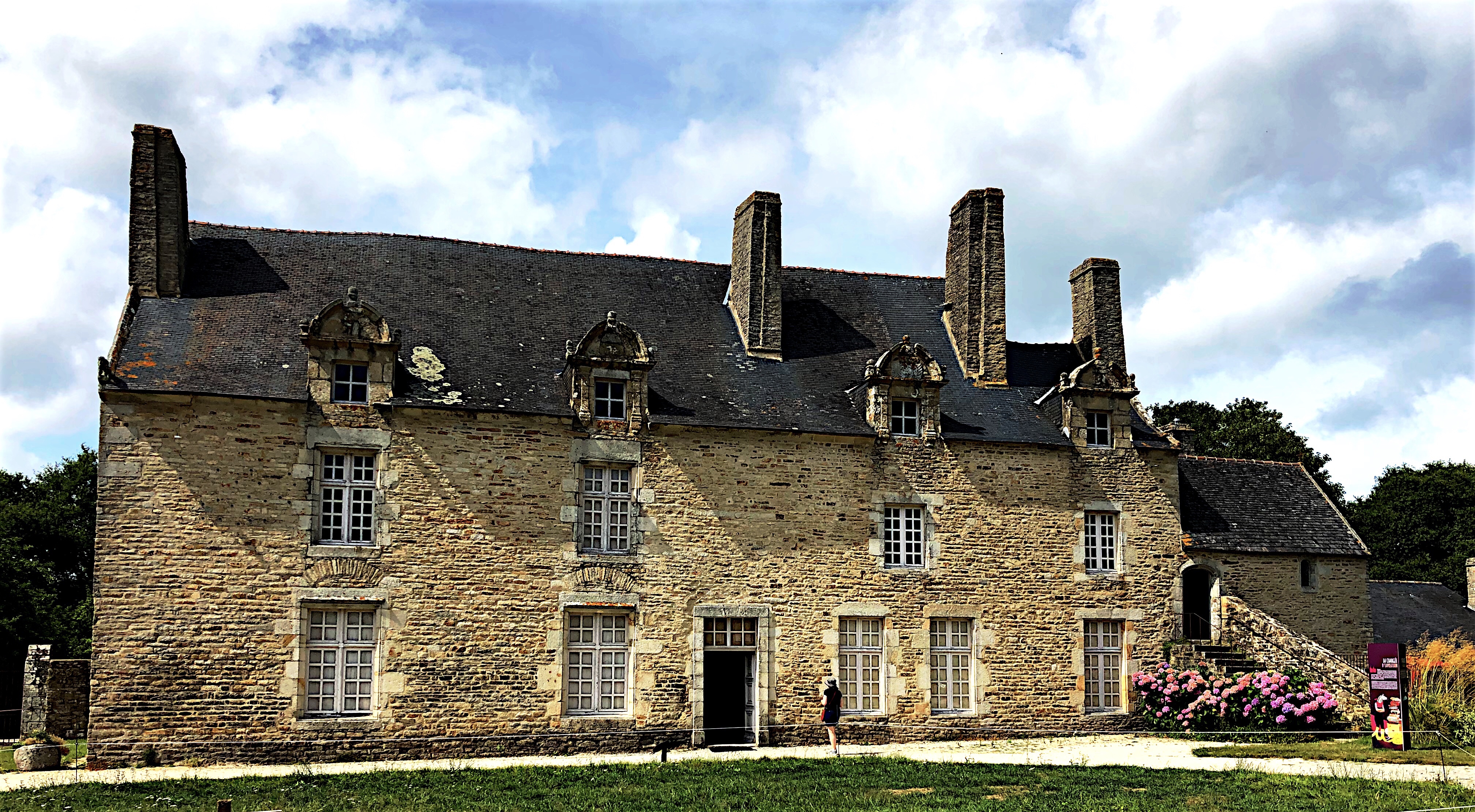
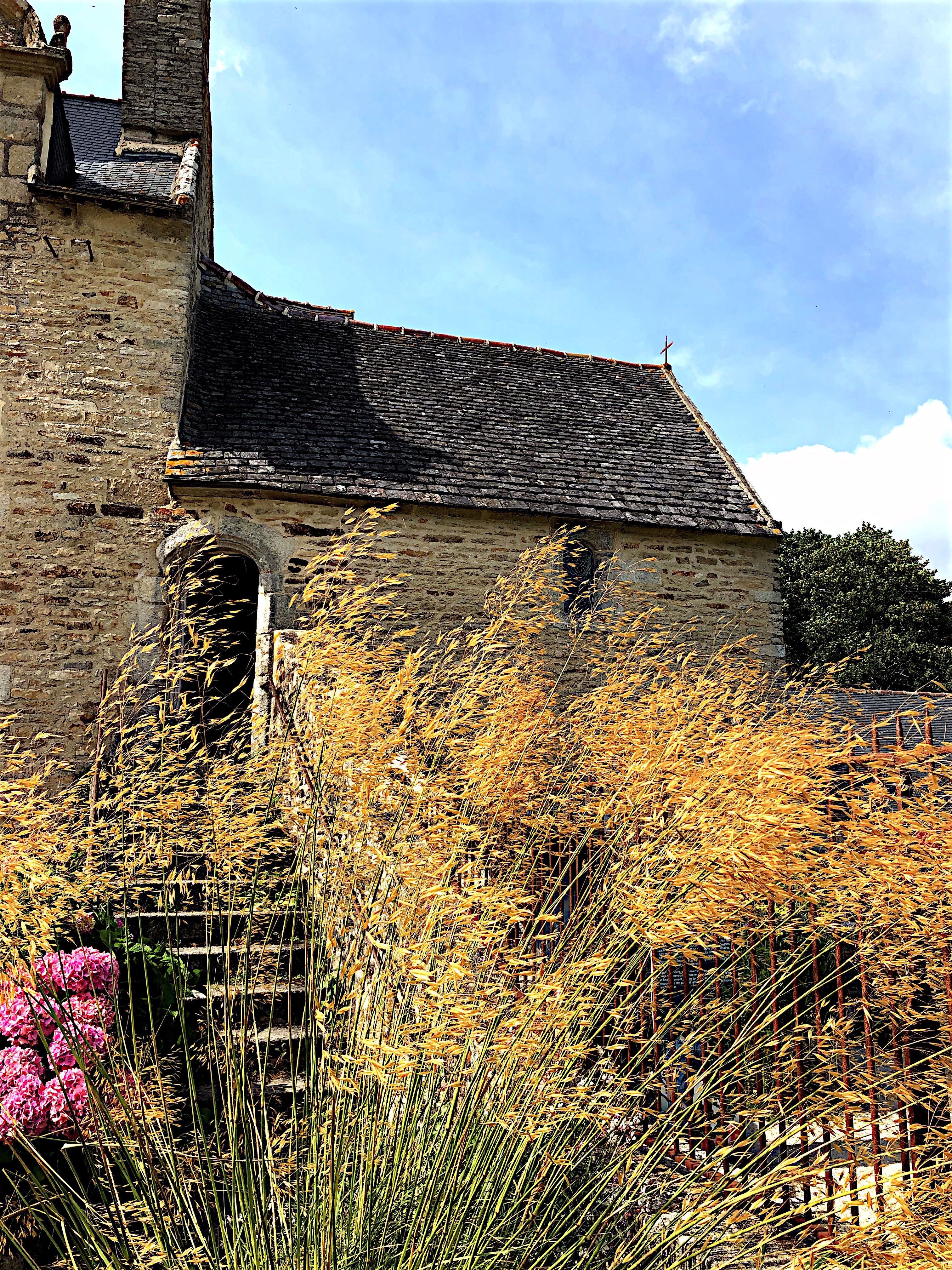
Unfortunately, the manor in question does not belong to us. But thanks to the kind people of Bretagne (and payment of a small entry fee) we were allowed to poke around the house and grounds of Le Manoir de Kernault. The house was begun in the 15th century and later modified successively in the 17th and 19th centuries.

The Chapel Behind a Spray of Golden Grass
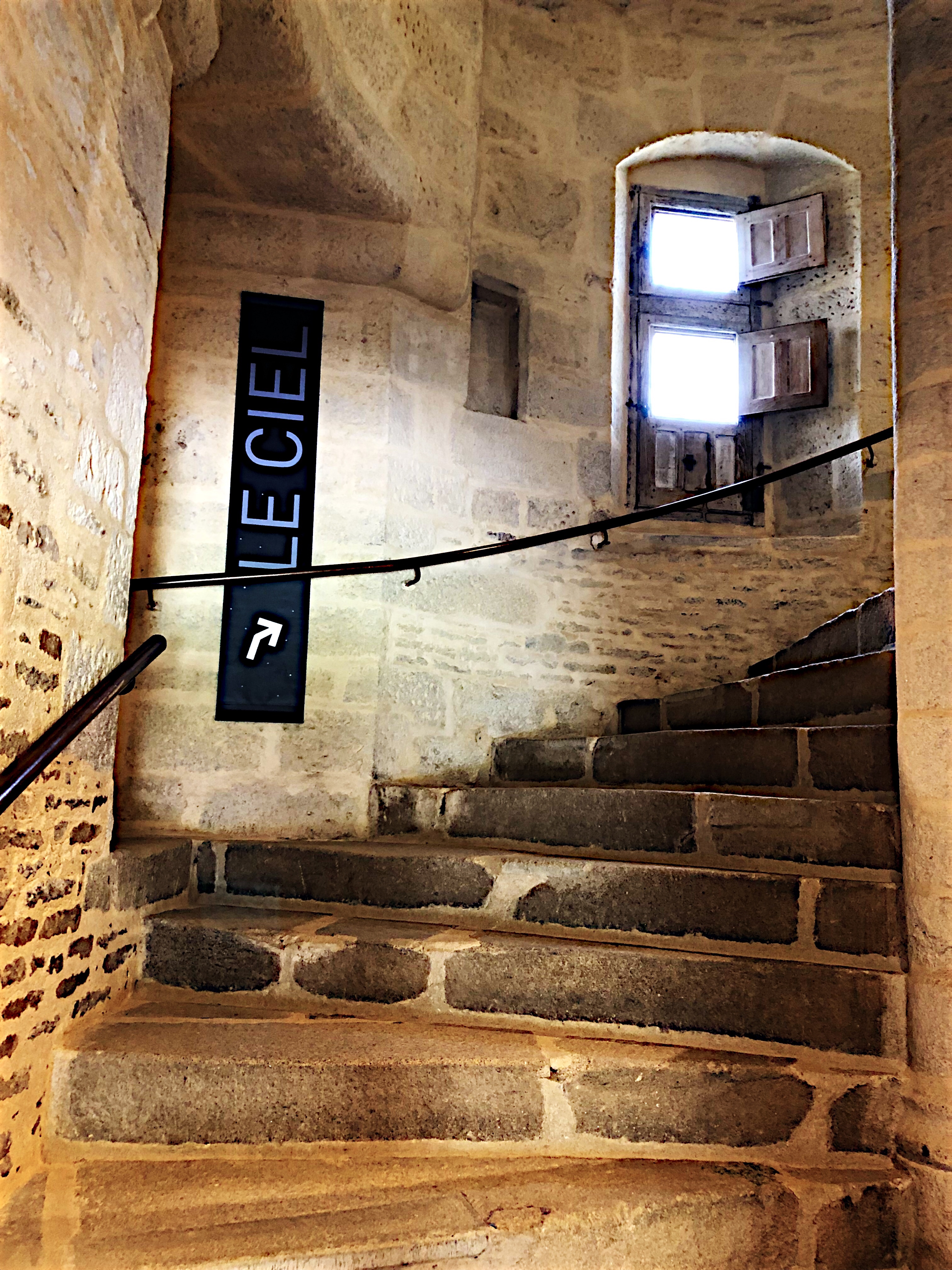
Gentle Stone Steps
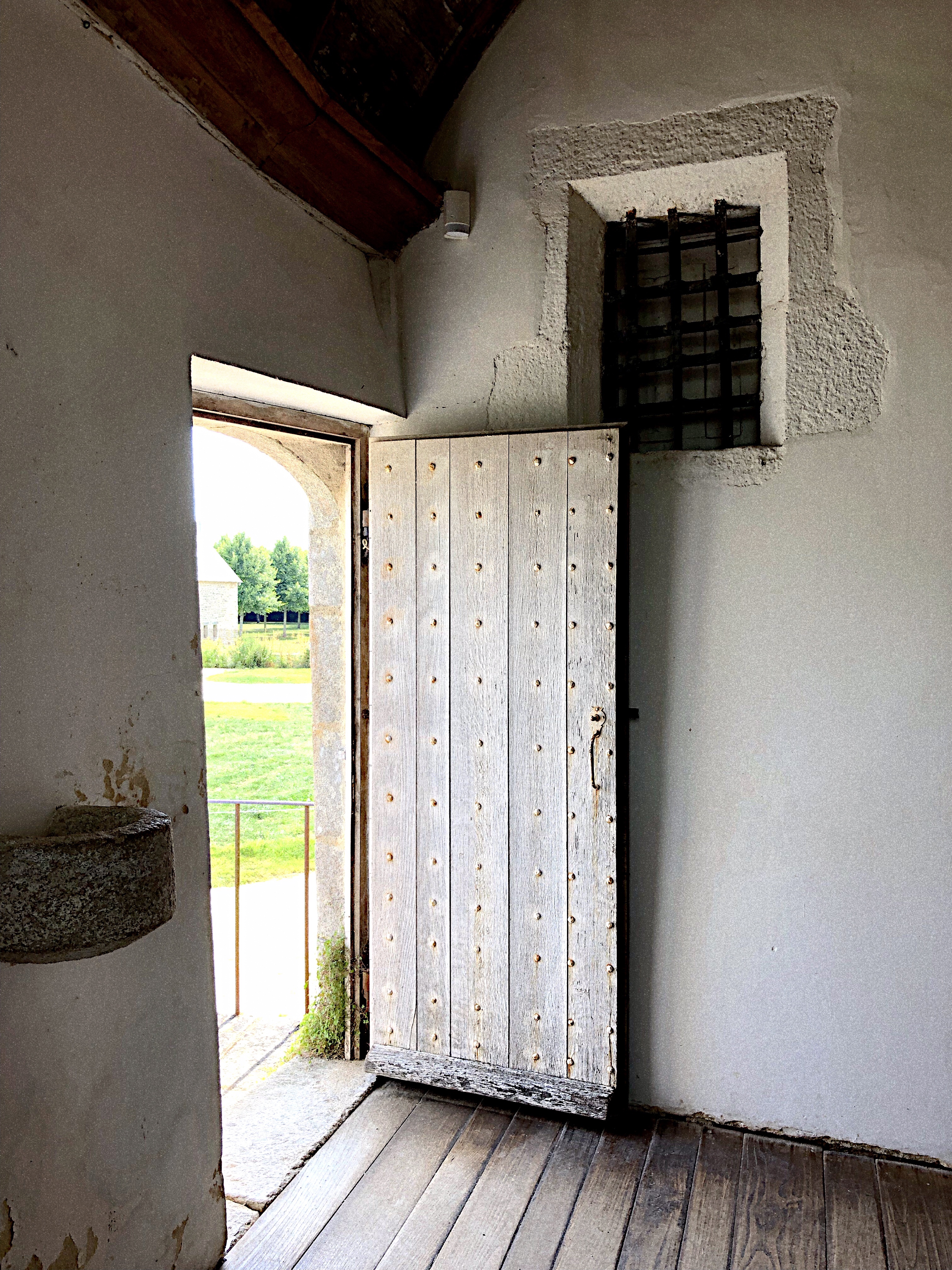
The Chapel Entrance for the Cheap Seats

The house itself is a beautiful example of Breton manorial architecture and there remain many elements of the original building. An unusual feature is the attached chapel. Manorial chapels were most often separate structures situated within the confines of the house and outbuildings. This one, however, is built on to the side of the house with an exterior stairway access for servants and manorial workers and a private doorway from within the house itself for use by the seigneur (lord) and his family.

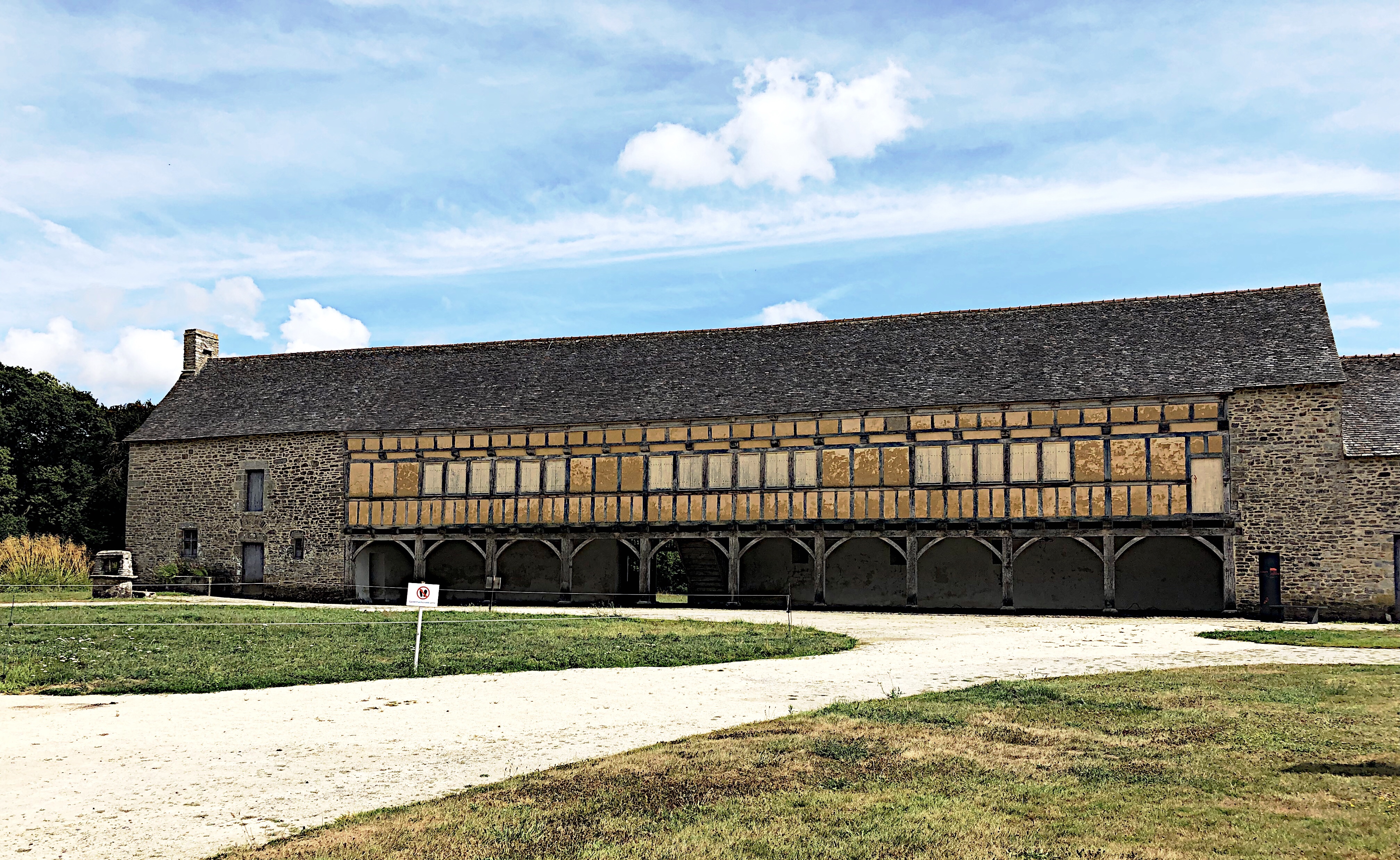
Not Your Average Grain Silo

Directly opposite the house is a large grain store built in stone and half-timber. Such a rare thing to survive. It’s quite large. Far too large for storing the crops produced by the manor’s fields alone. Researchers have theorized that the manor must have been speculating on crops from other farms in the area, storing the grain over several years until a time when the selling price was advantageous enough to reap a significant profit. Sound familiar? Some things never change.

Café in a Former Workshop
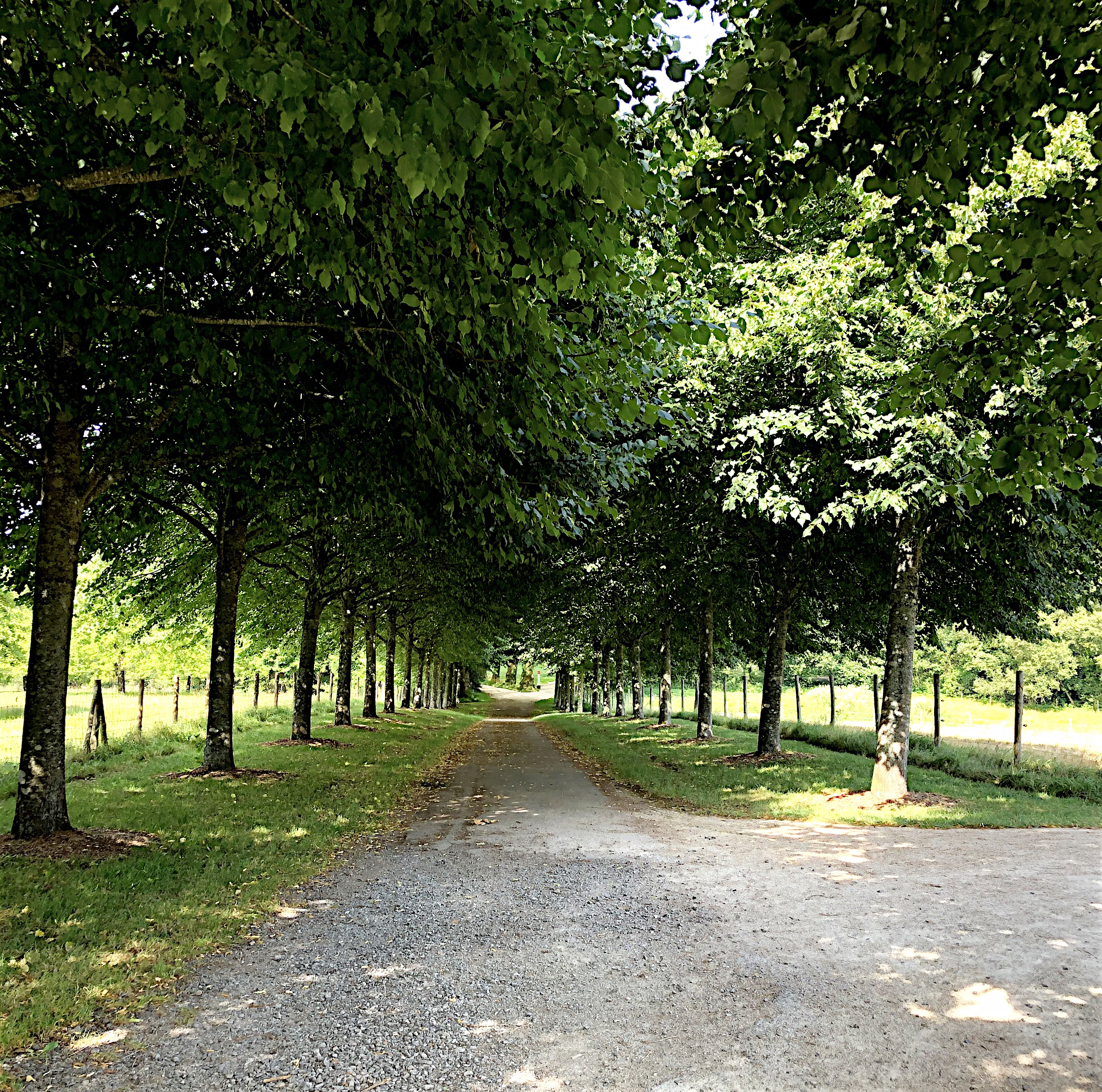
The Cool Shade of an Allée on a Warm Summer’s Day

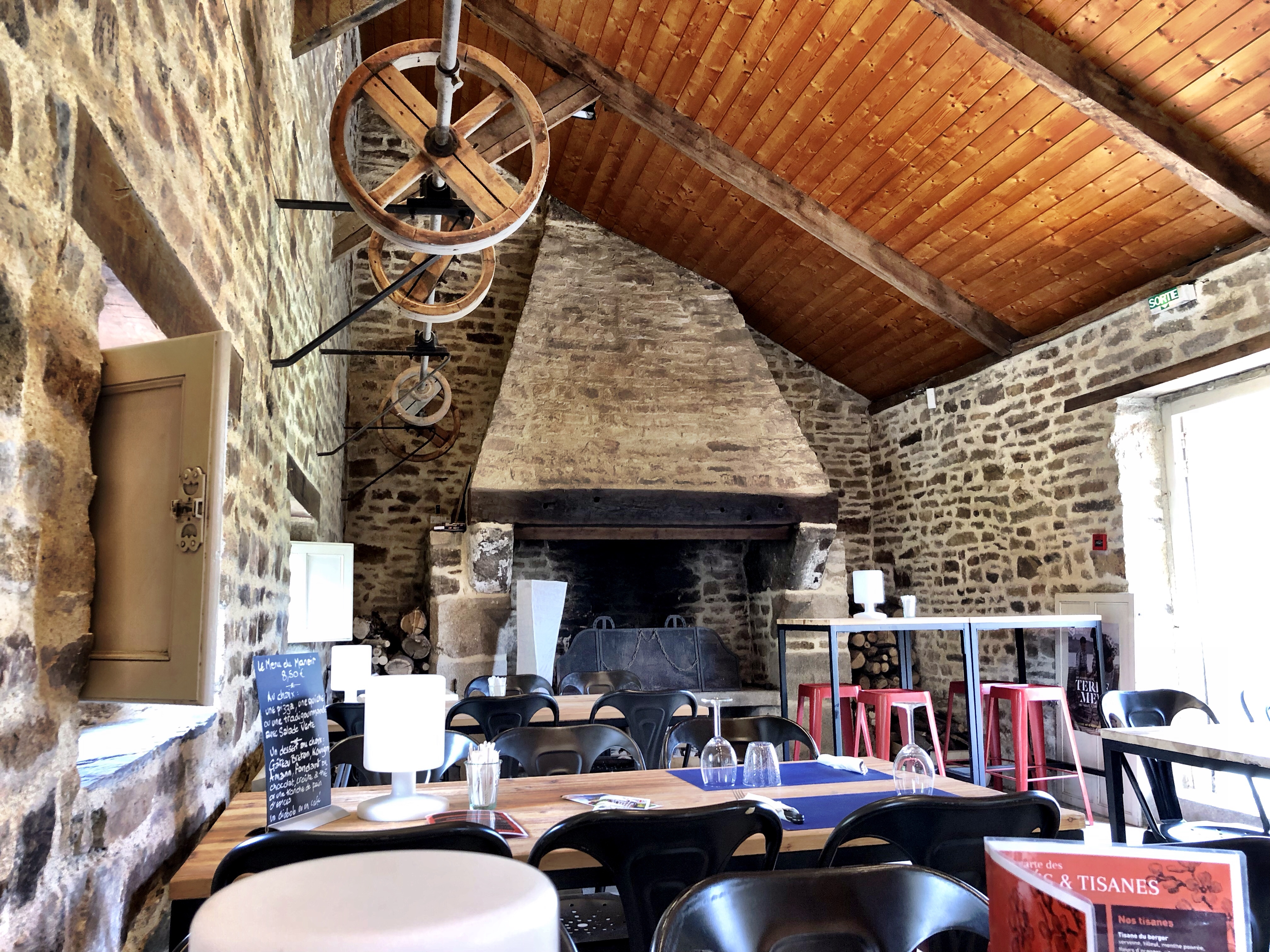
We had an interesting and pleasant wander through the manoir’s buildings and fields, pausing to have some tea at the lovely little café in one of the farm’s outbuildings. By the late afternoon we had run out of steam [Did I mention I just turned 54?]. So, even though there was much more of the farmland and animals to see, we called it a day and promised ourselves that we would return to explore further.

Blue Skies and Archangels

This post is an edited version of an email sent to friends and family in April, 2019.

Place du Théâtre, Fougères

This weekend we made another visit to our home in Fougères and took the opportunity to cross over the border to Normandy.  We’ve been lucky enough to have Jessica (Cherie’s niece) visiting us for a few weeks so we wanted to show her our new house and the town which we will be our new home.

We drove up to Fougères from Malestroit on Friday afternoon in pleasant weather, gave Jess a tour of the tower and then walked around town as dusk approached.

View of Église Saint-Léonard Looming Over the Medieval Quarter

The next morning we took advantage of the outdoor market which is held just up the street from our house on Saturdays, had some pastries and hot chocolate and headed off for Normandy with a very particular goal in mind: Mont-Saint-Michel.

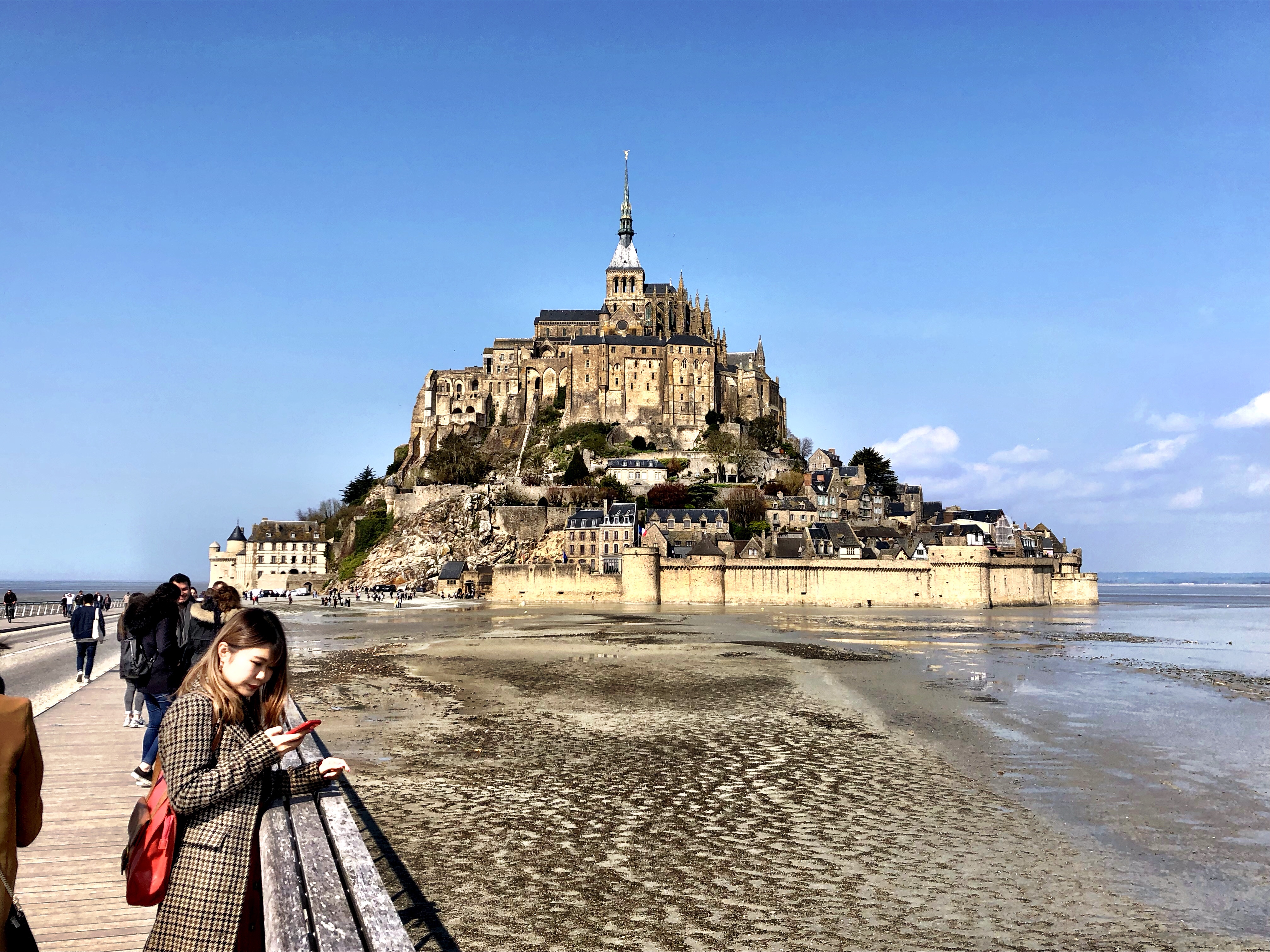
The Approach to Mont Saint-Michel

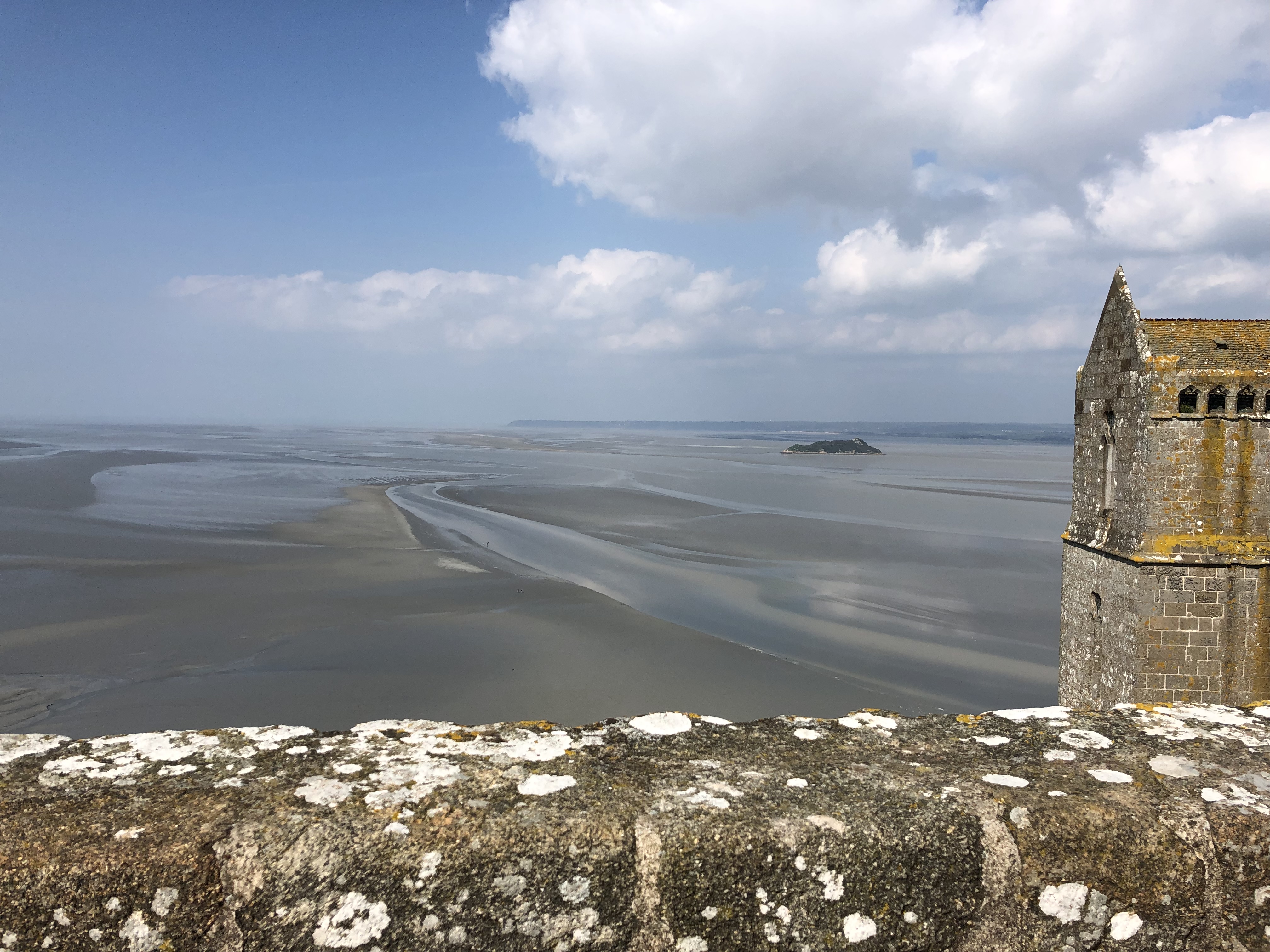
MSM is only a 45 minute drive from Fougères so we fetched up to the many-acre parking lot just before lunchtime. Perfect. MSM is situated on a large rocky island which springs up out of the vast tidal flats at the mouth of the Couesnon river – the very same river which flows by Fougères much further upstream. It’s a lovely setting, surrounded by lush farms and small villages on the mainland, contrasted by the wide expanses of mud flats and the waters of the bay.

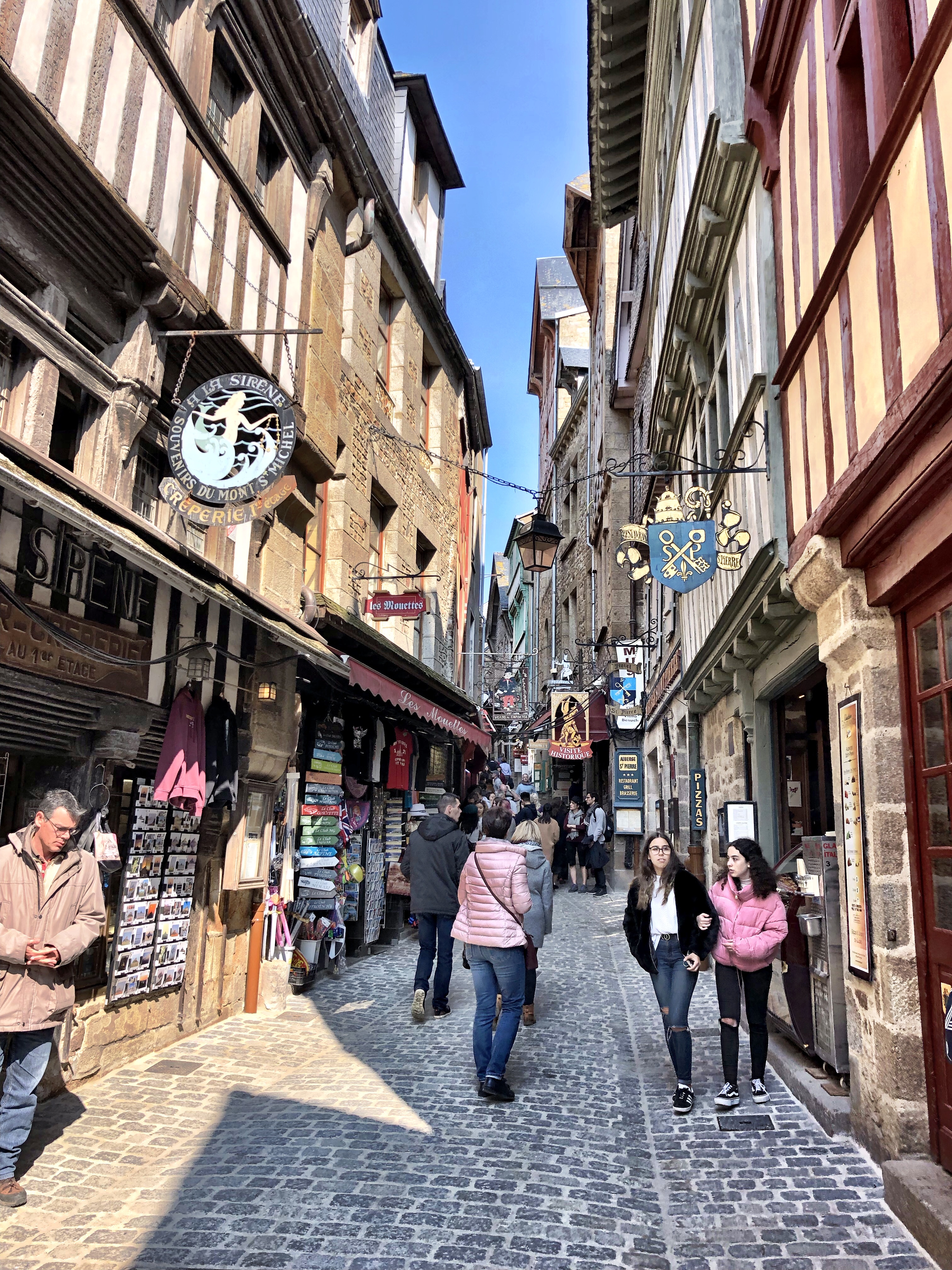
Hyper-Tourism Along the Beautiful Grande Rue

As a UNESCO world heritage site, MSM is a massively popular tourist destination. Even during the off-off-season in March, there were substantial numbers of visitors eager to see what all the hype is about. The site is extremely well organized to handle large crowds of people. One must park in the lot on the mainland and either take a free shuttle bus to the mound or walk and nicely groomed, broad pathway (about a 35 minute walk). Dogs are allowed in the village at the bottom of the mound, but cannot enter the abbey on top and not on the shuttle bus. But they have kindly (and wisely) included a kennel service at the welcoming center. We had Saxon with us and he is still not able walk for long distances because of a back problem, so we took advantage of the kennels for a mere 8 euros. He wasn’t very happy about it, but I think the trauma was greater for Cherie.

Wood and Stone: A Beautiful Scene on the Grande Rue

To say that MSM is amazing is an understatement.  Take every wonderful thing you’ve heard about Mont-Saint-Michel and double it!  Photographs of it are quite impressive, but it’s even more magnificent in person.  Yes, it’s very touristy with an abundance of opportunities to purchase souvenirs.  But that’s only evident in the lower village area which is nevertheless beautiful and charming. 

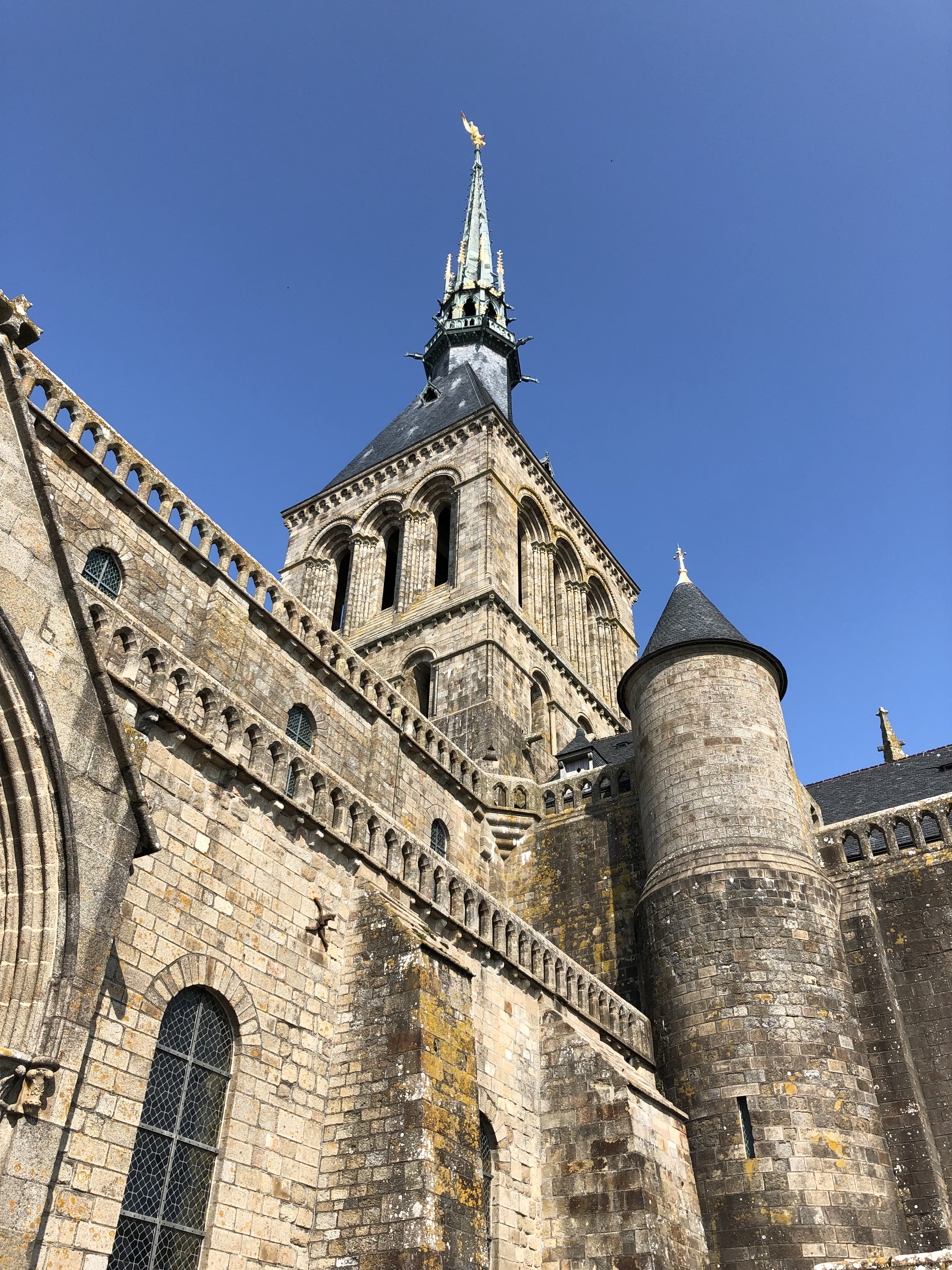
The Iconic Spire of L’Abbaye du Mont Saint-Michel

But, to my mind, the star attraction is the abbey at the top of the mount. It’s really beautiful and visitors are allowed to tour a good deal of it. One can either take a guided tour or simply view the abbey precincts on their own. Only 10 euros and you’re allowed to walk in the footsteps of monks who have lived on the top of this rock since the 8th century. We all enjoyed it immensely!

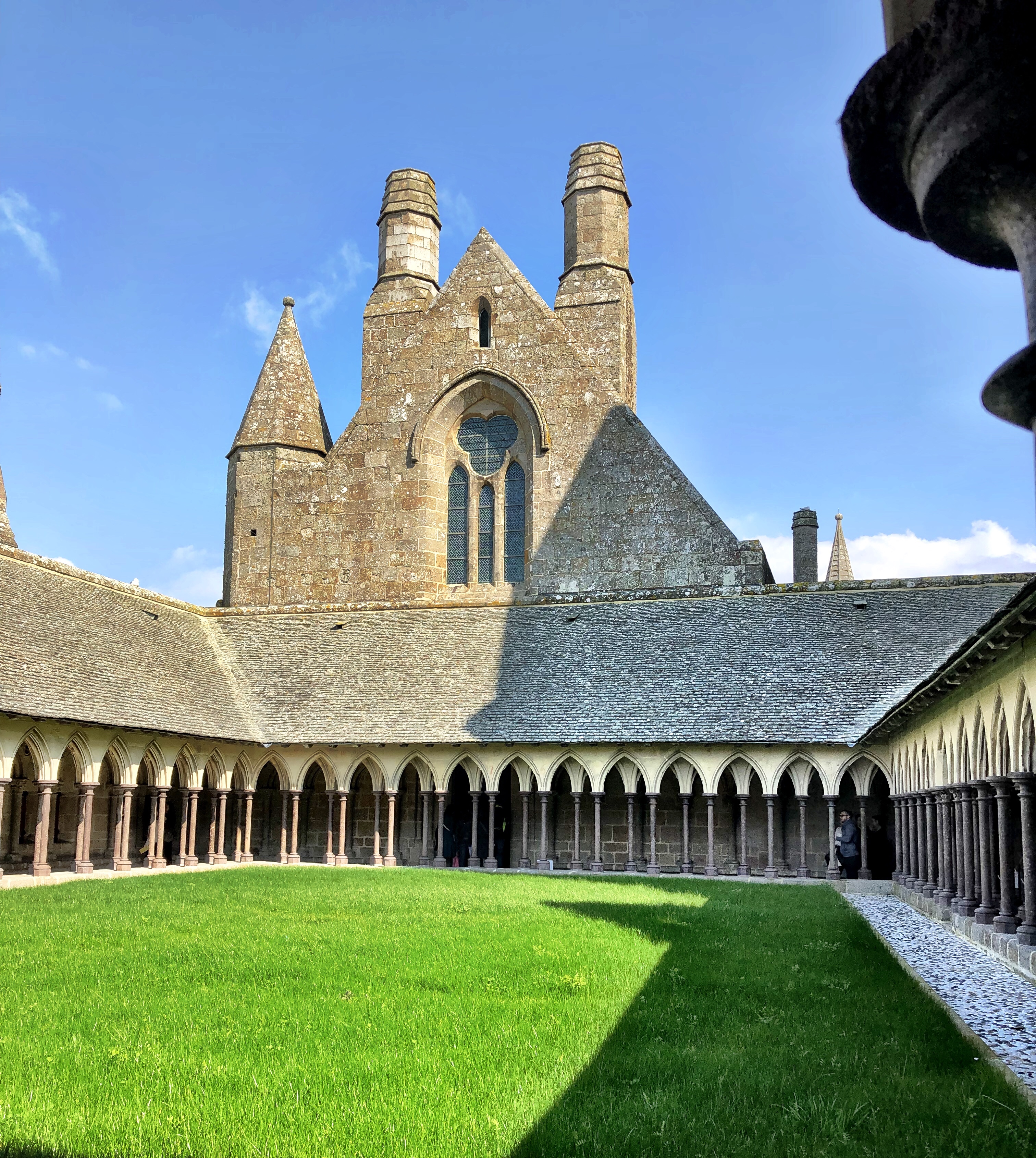
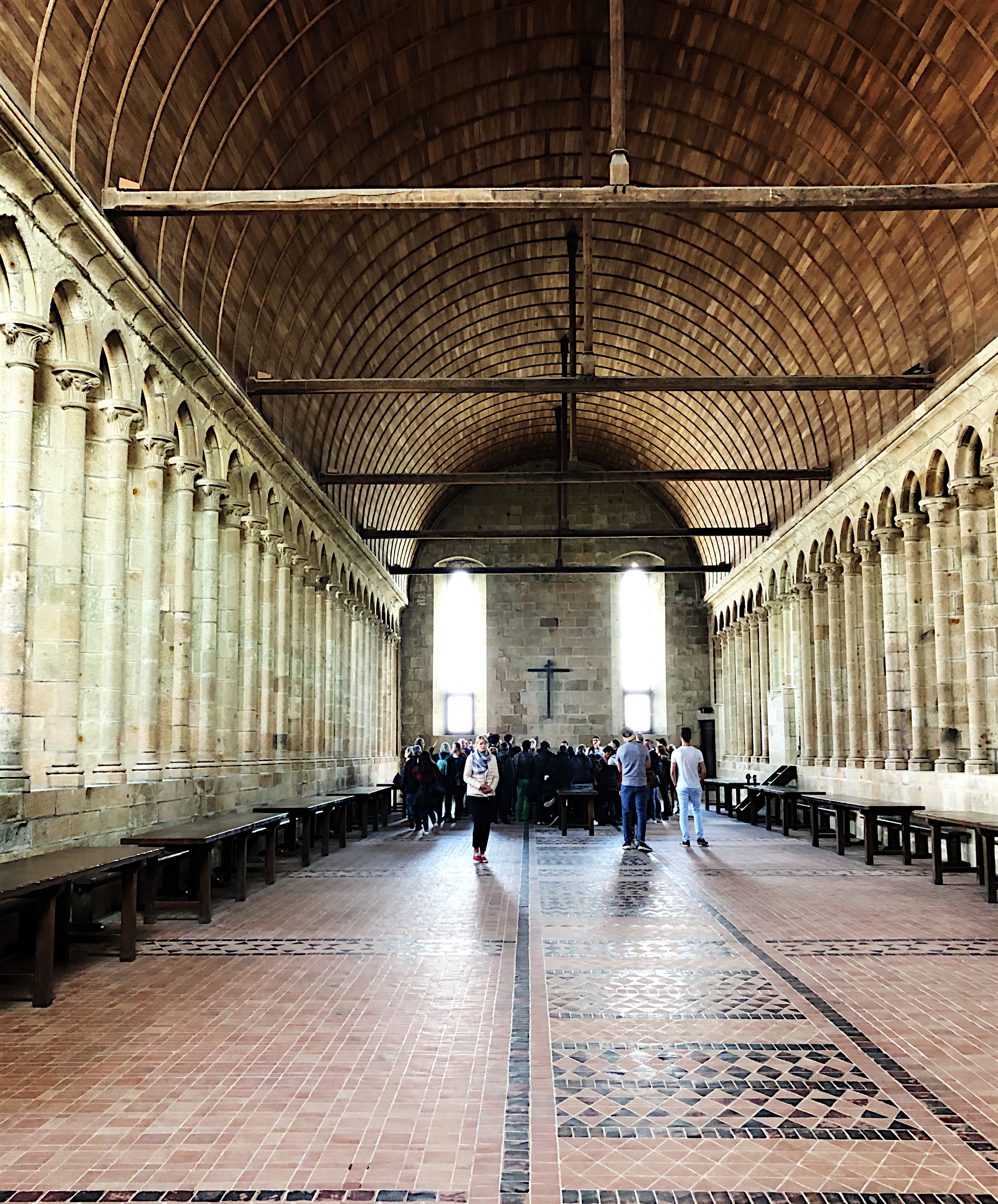
A few more photos to give you a taste of MSM. But, truly, they do not do this incredible monument justice. You will just have to see it in person to appreciate its rich history, and unequalled beauty. Enjoy!

The Baie du Mont-Saint-Michel as Viewed from the Abbaye
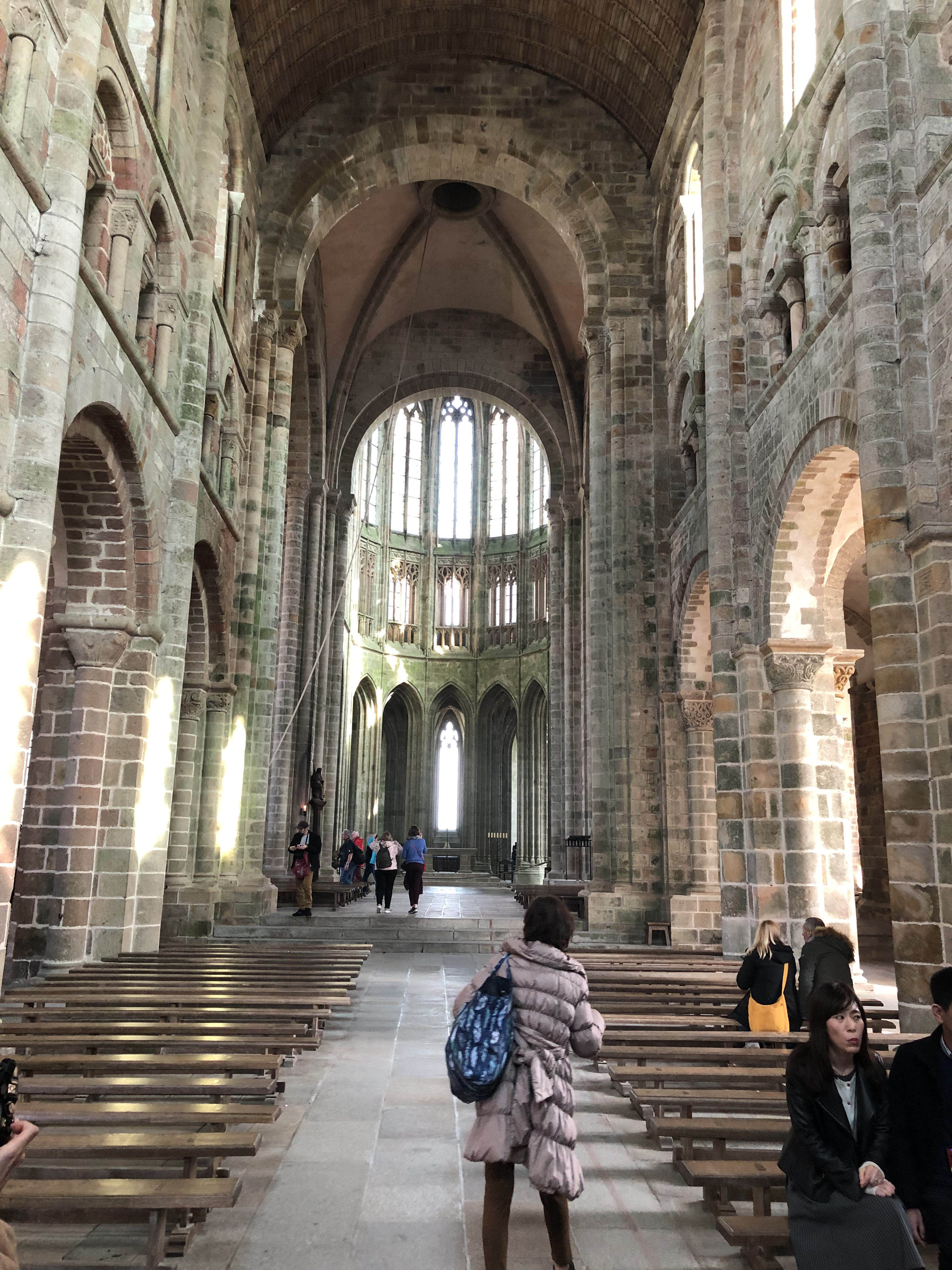
The Abbaye Church
Garth and Cloister
A Forest of Pillars – Epitomé of the Stonemason’s Art
Monks’ Refectory
Impressionnant!