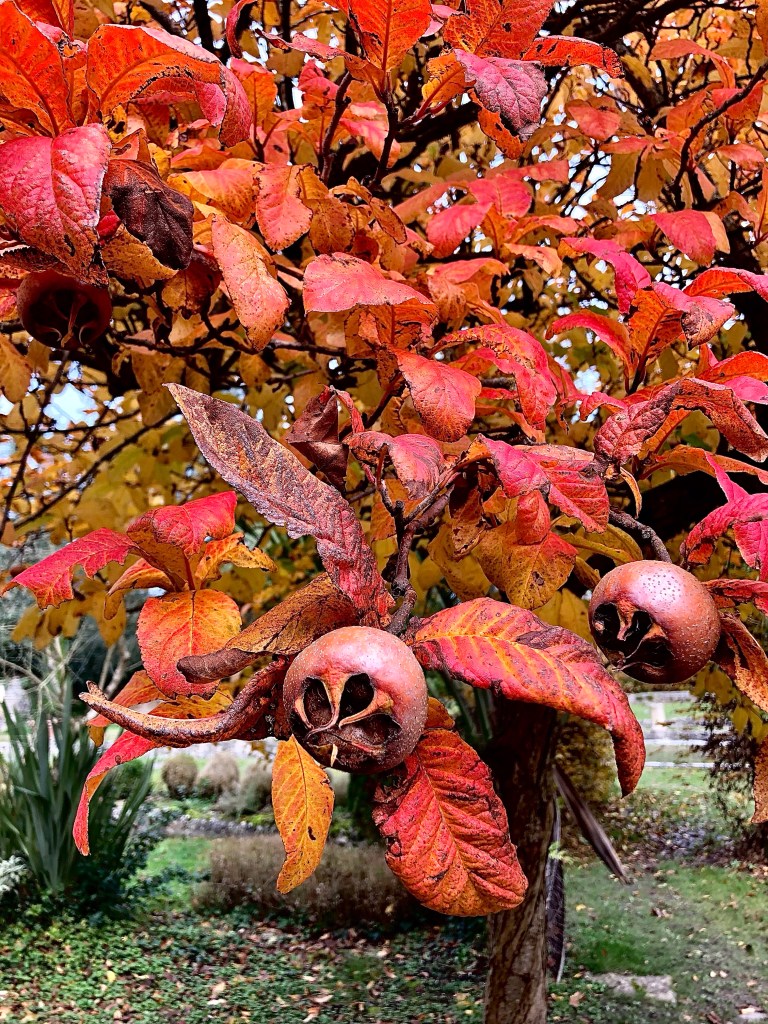
Autumn Bounty – A Medlar Tree Amongst the Roman Ruins of Corseul
We are in the depths of Autumn now. It’s often quite stormy. I’m cold all of the time – the French have a particular word for this: frileux – and I’m wishing our chimney was in good repair so that we could have a cozy fire. Yet another repair project for the future.
Nevertheless, this time of year has its attractions. Bretagne is a land dominated by deciduous trees, the gold and red hues of their waning leaves making for a very colorful season. The view from our elevated perch in the tower over the park allows us to watch the grand carpet of shrubs and trees laid out below us as it gradually shifts tones from day to day.
Cherie and I try to maintain our quest to visit as many local sites of interest as possible. But it is decidedly more of a challenge to do so during the off-season. Many, if not most, privately-held attractions in France tend to close from October through April. Doors are shut, shutters are closed and gates are locked to visitors for months on end. So, we look for the sites which remain accessible.
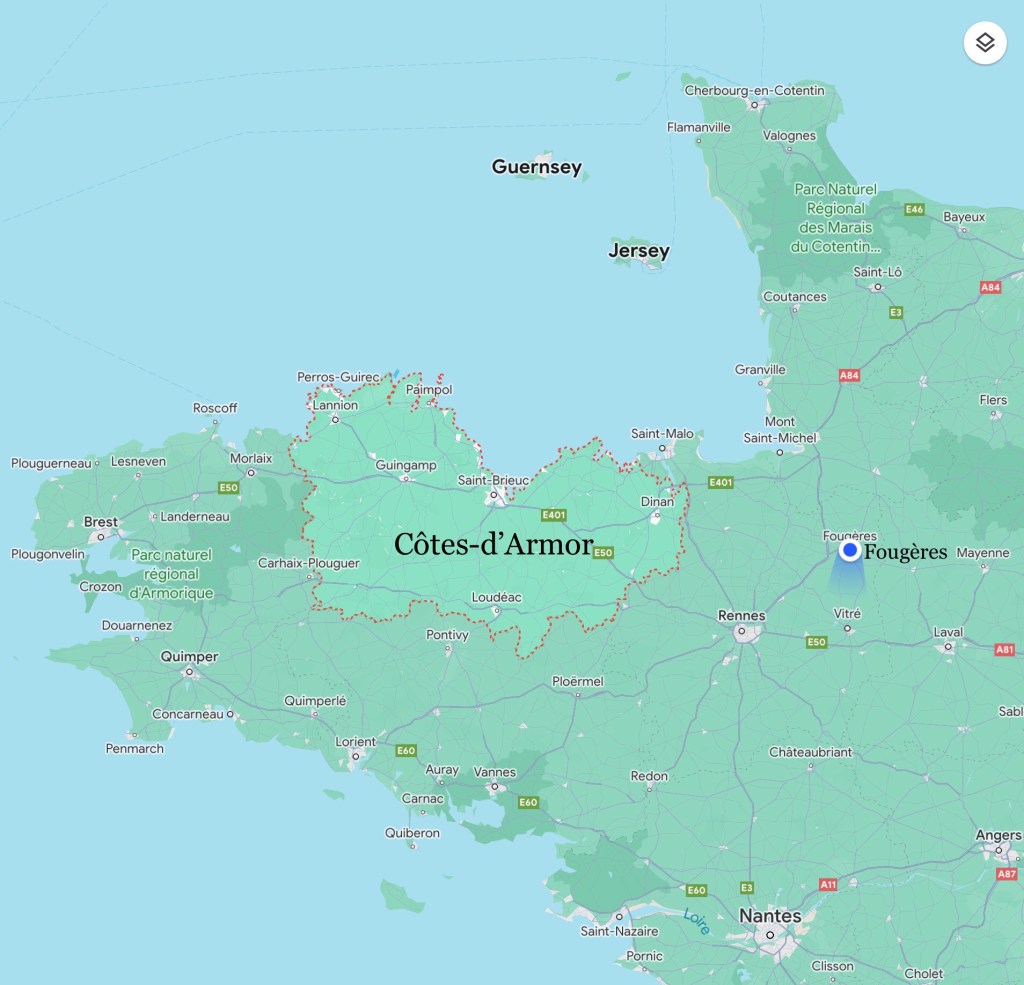
The Département of Côtes-d’Armor with Fougères to the East
This week we ventured westward into the heart of Bretagne, in the département of Côtes d’Armor. With the exception of Dinan, we haven’t really explored this part of the region. When searching for a house in 2018, we made some brief sojourns to Tréguier, La Roche-Derrien and Pontrieux, but we never did much in the way of sightseeing. It’s a lovely part of the peninsula with lots of green, rolling countryside and rocky coastline looking northward to England across the Channel.
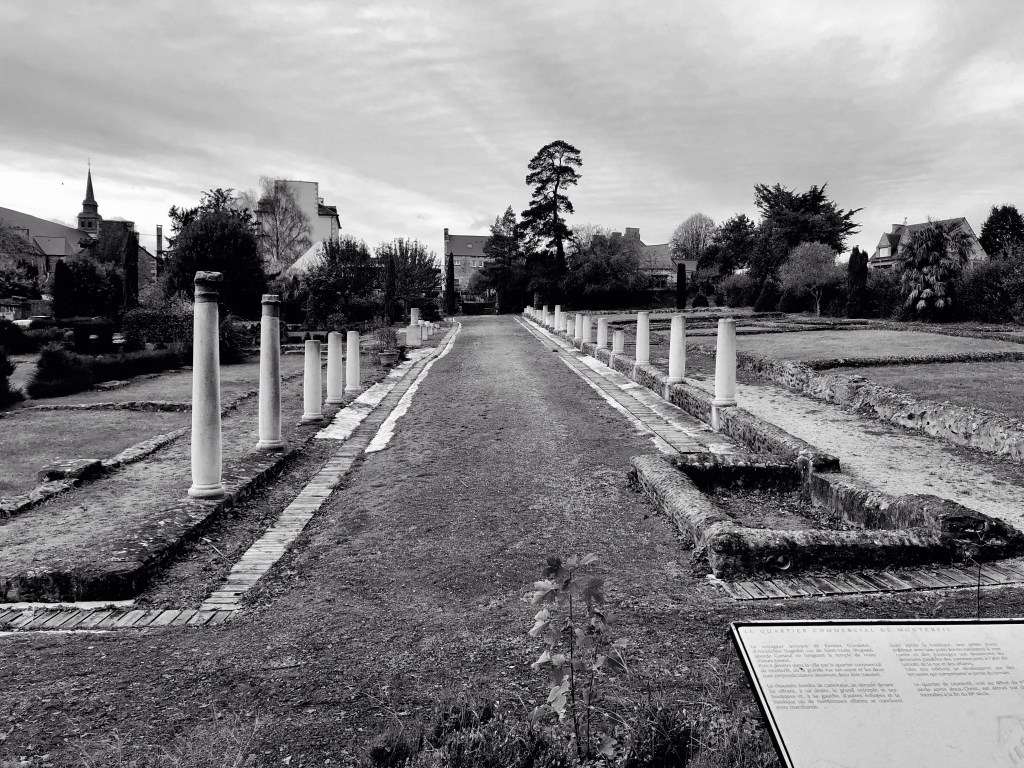
A Swanky Street in Gallo-Roman Corsiolitum
Not too far west (11 kilometers) of Dinan is the village of Corseul. A village which has the good fortune to sit upon the ruins of a Gallo-Roman town. Dating from the 1st century, Corsiolitum, as it was known then, was the capital of the Coriosolites – the local gallic tribe who so kindly agreed to be overrun and absorbed into the Roman Empire. In return they ended up with the latest in Italian urban design, complete with paved streets, underfloor heating and shopping.
Shards of Lost Civilization
The ruins in Corseul are subtle. One can walk down a short section of streetscape marked by the remains of townhouse and warehouse foundations. Well-posted interpretive signs help visitors to imagine the scene as it may have been as a bustling hub. Extensively excavated in the 1980’s and 1990’s, the remains have been tidied up quite a bit. This includes what appeared to us as the imposition of cement copies of architectural elements such as rows of columns, textured and broken. A problematic practice which is, thankfully, rarely employed.
Move Over, Mars, There’s a New Goddess in the Temple
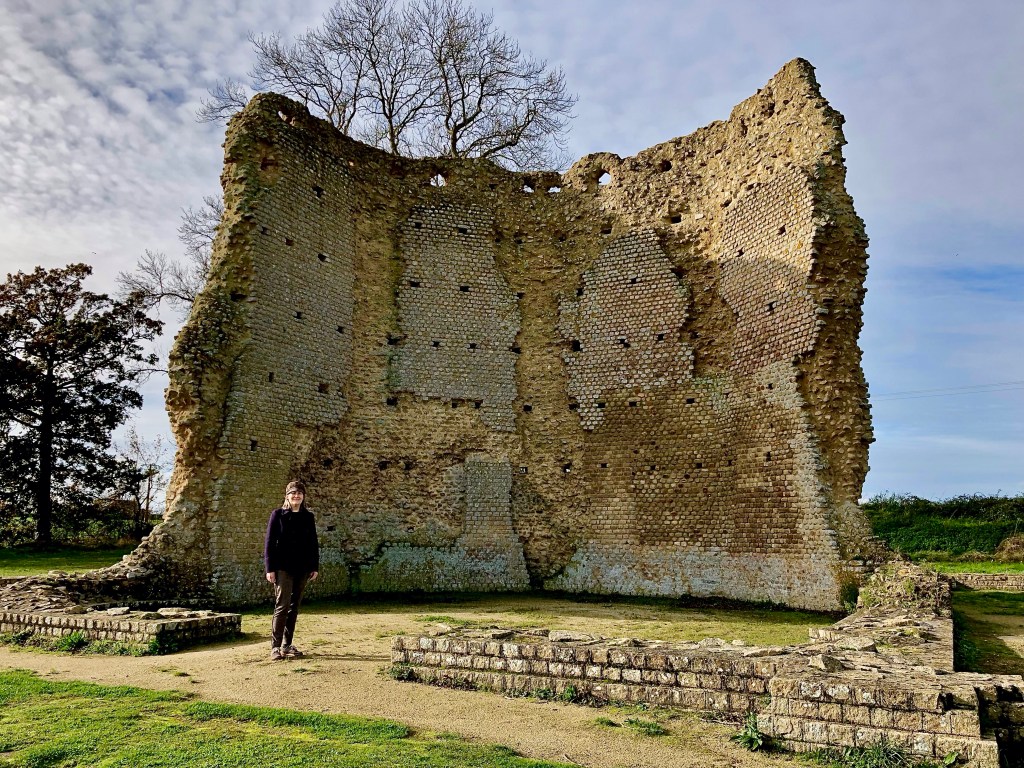
Just outside of town is the site of a Gallo-Roman temple complex: the Temple of Mars. It is a remarkable site with the remains of a roman tower standing tall like a sentinel above the foundations of a complex of walkways gateways and ancillary structures. Constructed in the first century, its primary purpose was dedicated to the worship of the god Mars. But there was also a smaller temple for veneration of the emperor. The builders also saw fit to include a separate entrance to the complex for the wealthy elite. Some things never change.
Reconstruction of the Temple of Mars
One of the interpretive signs in Corseul noted what we thought was another roman site to the other side of town. Following a narrow rural road up into the hills, we ended up at a wide spot near a dead end marked “parking”. Somewhere, down a dirt drive, was an historic monument. At least that was where the vague sign pointed to. Shrugging our shoulders, we parked and trudged along a lonely track through an oak wood. It was only five minutes later when we sidled up to the remains of a medieval castle. Hmnnn … not quite what we were expecting. But a pleasant surprise nonetheless.
A Castle in the Wilderness
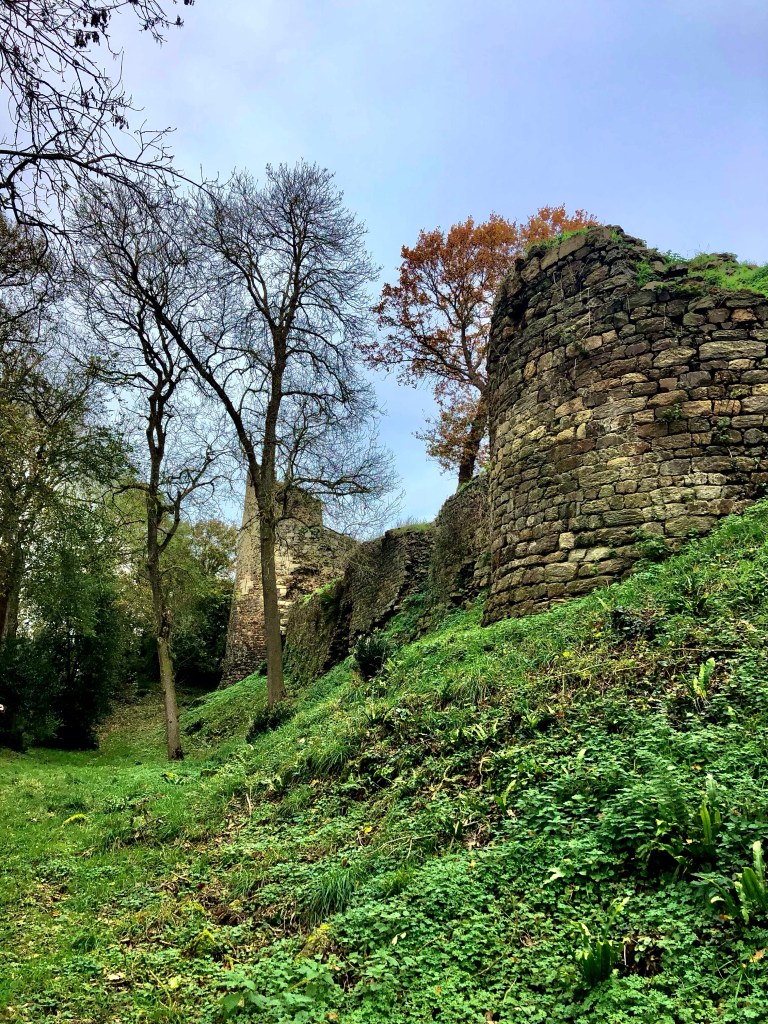
The château-fort of Montafilant was built in the 12th century. It remained in use until the end of the 15th century when it was abandoned. After that, its structures served as farm sheds and its ramparts as a handy quarry for stone by local inhabitants. Amazingly, there is still a substantial portion of walls and towers remaining. Enough to see that this was a considerable fortress. It rests on a promontory above two steep-sided valleys. Montafilant is a no-frills monument. Quite the opposite of the ruins back in town, this castle is raw. No effort has been spared to present this edifice as anything but what you see. All the better for it in my opinion. For those willing to do a bit of exploring, this castle is worth the time and effort. If you go, make sure to continue along the outside of the wall – you will find a large corner tower and a further rampart with a dry moat around the other side.
Léhon’s Medieval Bridge with the Abbey in the Background
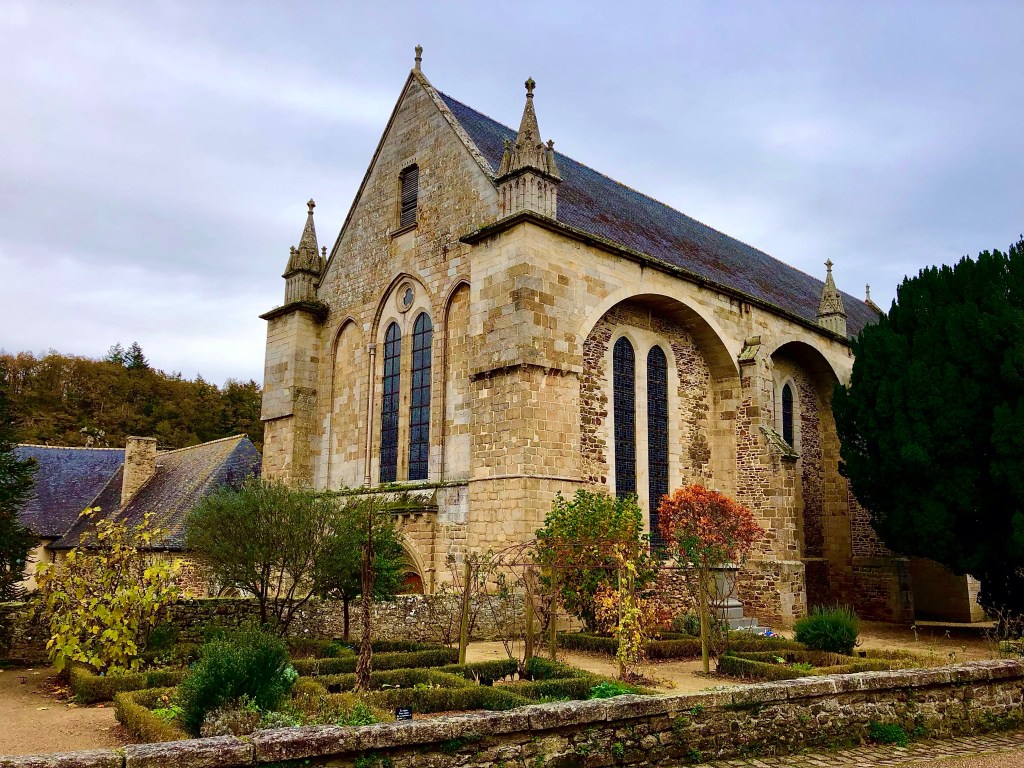
Our final stop for the day was the village of Léhon. Now it is, effectively, a suburb on the south side of Dinan. But it originally grew up around an independent abbey and castle along the banks of the Rance river. This Petite Cité de Caractère’s most picturesque area is the bourg surrounding the medieval abbey, overlooked by the castle ruins on the escarpment above. We enjoyed a nice afternoon stroll through the compact bourg, over its lovely medieval stone bridge and along the river to the canal lock and back. It didn’t take long. The bourg is quite small. Especially since the abbey was closed for the season. We plan to come back sometime when it’s open to visitors.
L”Abbaye Saint-Magloire
All in all, we passed an enjoyable day of visits and got to know this part of Bretagne a little bit better. We witnessed 2,000 years of history in the span of an afternoon. Not bad for a day’s work!
Lock and Lock Keeper’s House on the Canal North of Léhon
Today, a quick post for a quick outing. About 45 minutes to the southeast of us, just inside the Pays de la Loire, sits the old Abbaye de Notre-Dame de Clairmont. It’s not too far from the city of Laval, which we have also visited (see our previous post about Laval here: A Light Late Lunch in Laval). It’s not the easiest place to find. Especially if you are coming from the less well-travelled direction. Google Maps got us lost down an old dirt track. But we were determined to find the abbey so we hit the main road between Laval and Ernée where we had seen a historical marker sign for the site. From there it was fairly simple. There were yet more signs leading us down some pleasant country lanes and, finally, down a graveled drive to the abbey itself. Piece of cake!
A Bit of a Fixer-Upper
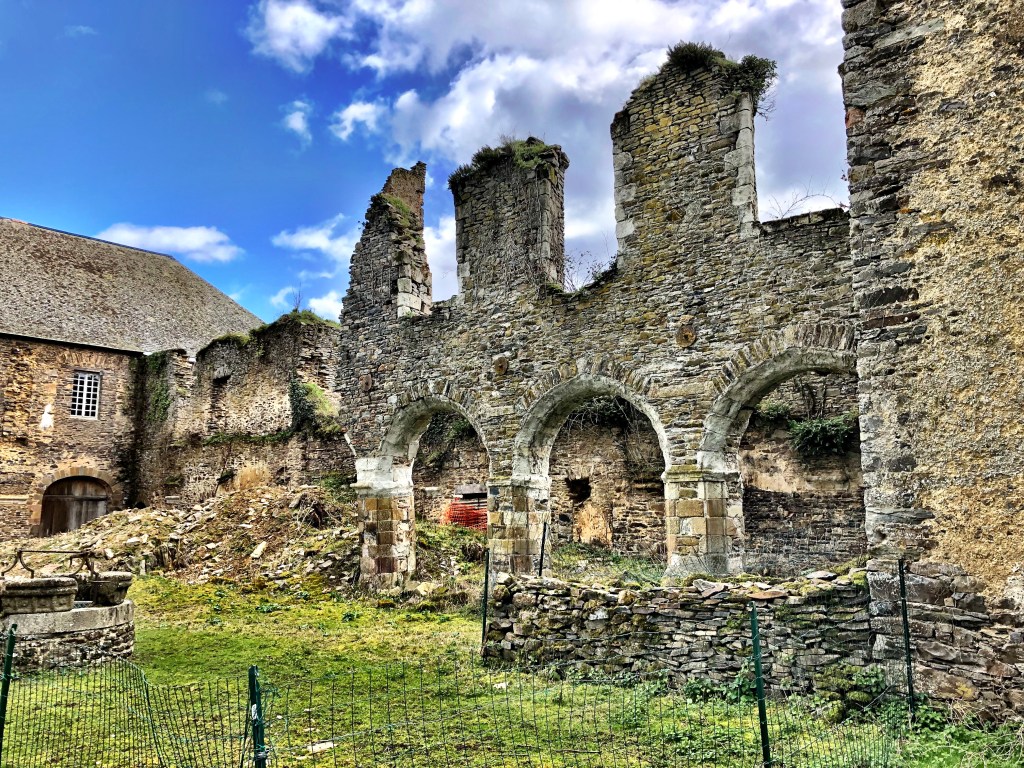
We had been under the impression that this was a working abbey. Boy, were we wrong! The only work going on at Clairmont now is the work to save it from crumbling into the ground. And even that seems to be intermittent at best. Still, it is an evocative place and there is much to see. As we exited our car were greeted by a couple of volunteers who were on their way out. They cheerily directed us to the billetterie (ticket office). Much more grand than it sounds – especially in French – the ticket office consisted of a small, room with limewashed walls storing, amongst a seemingly random collection of household items and old furniture, an old gentleman with a table. He greeted us with a reserve customarily extended to invitees of a tax audit. The day was chilly, and so was monsieur.
After taking our payment for the nominal entrance fee, the man launched into a fifteen-minute recitation on the history of the abbey. Despite my instinct to eject myself from this uncomfortable situation, the old man’s well-rehearsed speech was interesting. I held fast. At one point during his spiel, Cherie attempted to improve the connection with monsieur by injecting that we were familiar with a location he had just spoken about. But he was having none of it. Ignoring her attempt at warmth, he simply continued on, displaying admirable breath control for someone of his age. At length, he came to the end of his presentation, handed us an informative pamphlet and directed us out of his room toward the rest of the abbey grounds. We might well have been his only visitors that day. I think he had things to do.
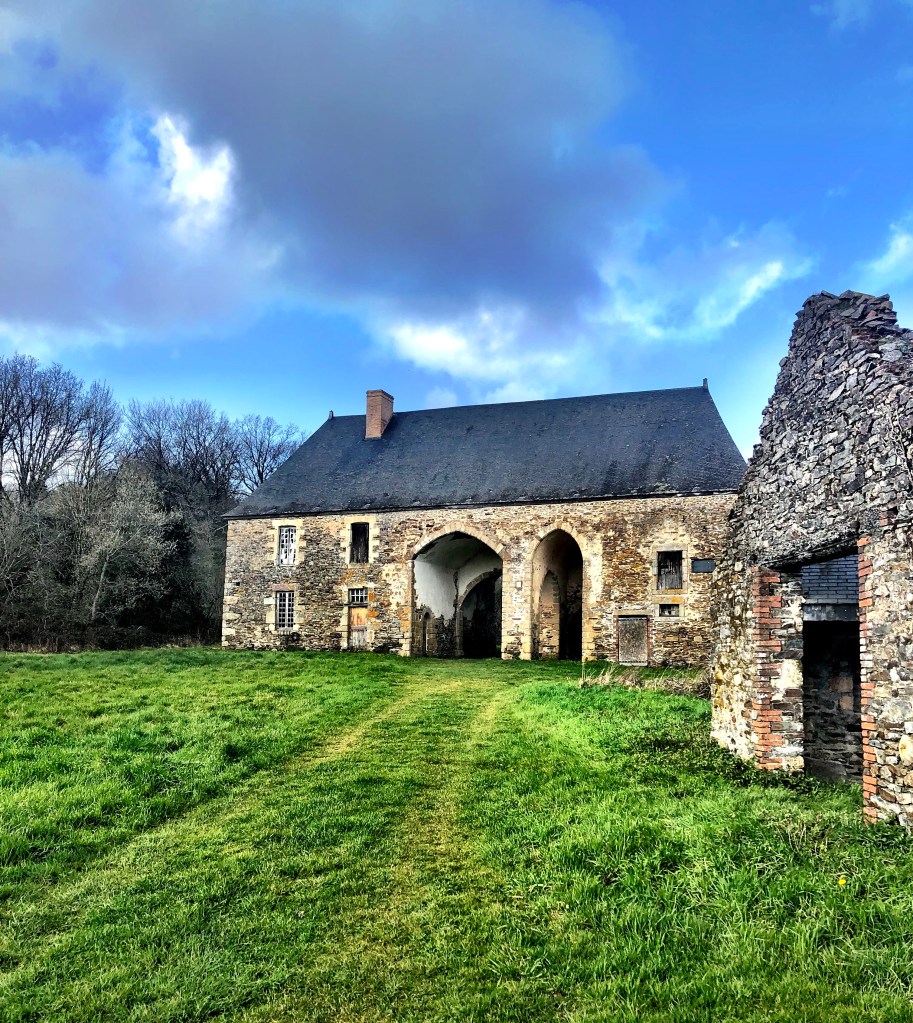
The Lay Brothers’ House
L’Abbaye de Clairmont was founded in 1142. Established by monks of the Cistercian order, the monastery was initiated at the behest of the baron of Laval so that he and other lords of the region might have a sacred place of burial secured by the daily prayers of its inmates. At its height, Clairmont was home to 40 monks and 60 lay brothers, active in their rigorous religious devotions. It was a thriving and wealthy abbey until decline set in toward the end of the 17th century. By 1791, the last few monks had left. The abbey became a working farm, with even the church converted into agricultural use to store hay, grain, carts and tools. It remained a farm until 1952. But by then the buildings had fallen into ruin. Two friends, beguiled by the history and romance of its medieval heritage, purchased the entire site and initiated a program of restoration which continues up to today.
La Porterie: The Porter’s Gatehouse
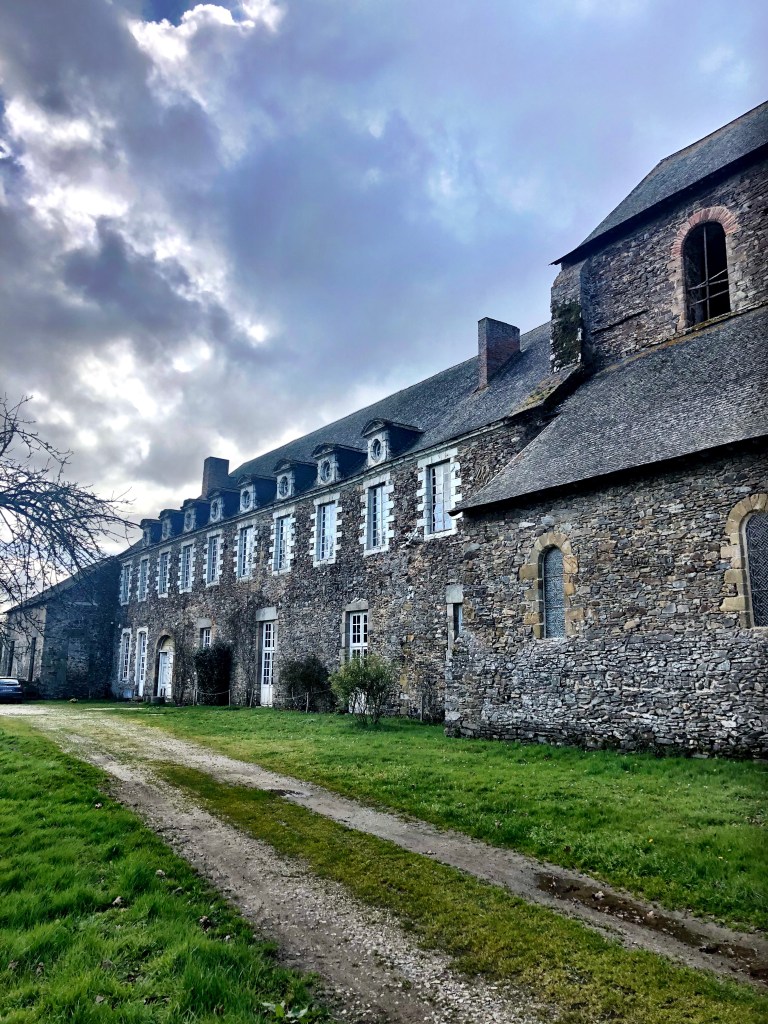
From what we could discern, most of the monastic building are from the 12th century, except for a large dormitory which was added in the 17th century. Much of the complex remains in a partially- or fully-ruined state, though much work has clearly been done to shore up and stabilize the various historic structures. Despite this, there is definitely a rough beauty to this place, highly evocative of its rich and interesting history. The architecture is simple, functional and solid. But it is also, in its own way, graceful, elegant in that early Cistercian style of design which pleasingly weds form and purpose to a sense of the divine.
Inside the Abbey Church
We spent a good hour wandering around the monastic buildings, letting our imaginations mingle with the tranquil atmosphere, interrupted only by the rustle of wind in the trees and an occasional plea from the small black sheep which meandered furtively within and without the cloister. We truly had the place to ourselves. In spite of its ruinous state, there is much to see. And it is not difficult to gain a picture of how it must have once looked.
There are Still Halos to be Found Here
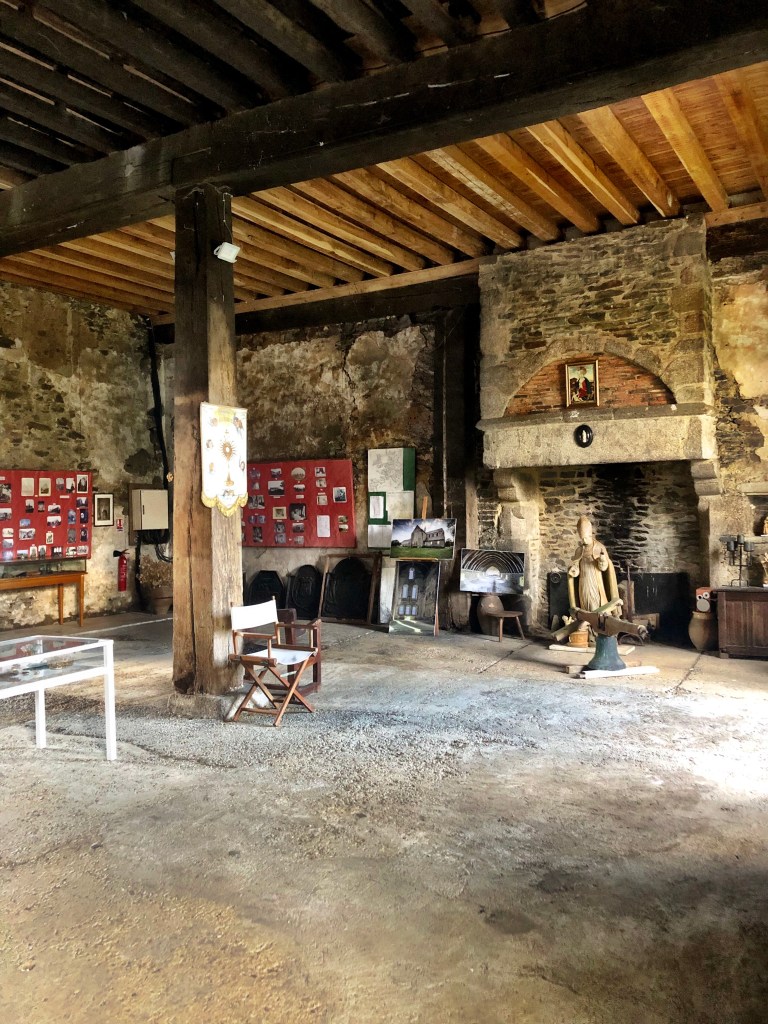
On our way back to the car, another volunteer appeared and offered to show us into what we think was the old chapter house. It now serves as a repository for any remaining stone or wood carvings, decorative tiles, and other ephemera from the time of the active monastery. There are just enough items in here to hint at the former glory of the place. It must have been really something. We were also shown an old chapel room. Small, dark, with a vaulted ceiling, it is little more than a cave. But it still, apparently, serves as a place of occasional worship. This volunteer was very warm and inviting and we ended up chatting with her for sometime in the afternoon sun in the carpark. At length, we said our goodbyes and she returned to her work.
A “New” Addition: The 17th Century Monks Dormitory
Although it wasn’t quite what we thought it would be, we enjoyed our visit to Abbaye de Notre-Dame de Clairmont. It tugs at our souls to see such a once-magnificent monument reduced to a sad ruin. But seeing the continued efforts of volunteers to restore it gives us hope. It’s perhaps impossible to save everything – there is so much around here to save – but it is good to see that people do care. Saving some of this remarkable cultural heritage is surely far better than allowing it all to disappear. What a sad and empty world it would be without these beautiful and important reminders of our past.
So, yeah, it’s been quite a while since our last post. I’ve no excuses to offer you. Just laziness. I’ve never been, umnn … what is that word? Disciplined. I have no idea how I made it through graduate school. Sheer luck, I imagine. To those few of you who actually look forward to this blog, I can only offer my apologies for the wide gap between posts. I’ll try to be more disciplined. But, given fifty-seven years of shockingly low creative output, I’d say the odds of that happening are profoundly unfavorable.
Priming the Tower’s Ground Floor Doors and Windows
On the up side, today I committed myself to updating the blog – to fill in the gap since my last post. Because some things happened; stuff got done; we spent time with people; places were visited. So this one is a somewhat random collection of what we’ve been up to since last September.
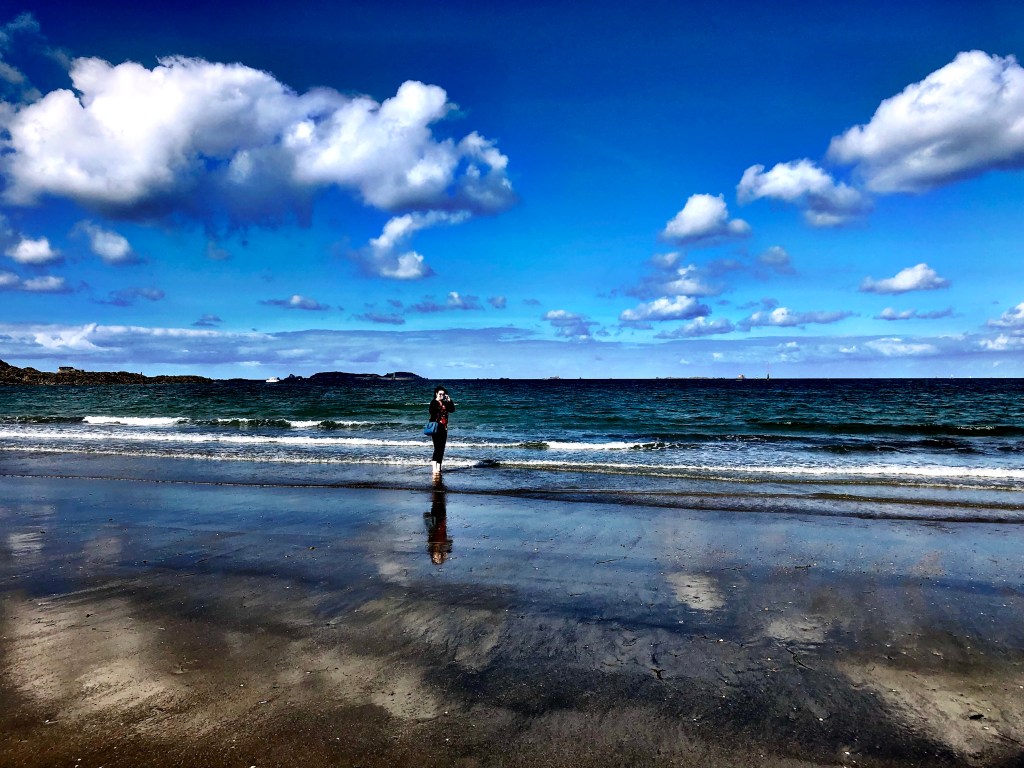
Jess Dipping Her Feet in La Manche (the English Channel) at Dinard
You may recall that our recurring cast member – Jessica – had come to visit us again last Autumn. We had a great time hanging out, making gallons of tea and vats of oatmeal (our breakfast go-to), catching up on many of Jess’s TV suggestions we had yet to view, and rambling around to visit wonderful places. Some of those places, such as Dinan, Jublains, St. Malo, I’ve written about in previous posts. But we wanted to show them to Jess. Plus, it’s our policy never to refuse a repeat visit to any of the fantastic sites we have seen before. In addition to some old favorites, we also traveled to a couple of remarkable locations which were new to us:
St. Stephen’s Cathedral – Vienna
Everyone should go to Vienna. Seriously. Everyone. At least that’s how I feel about it. I was lucky enough to experience this beautiful city with my parents when I was a young teenager. I loved it. My fond memories of the people, the architecture, the food, and, above all, the casual sophistication permeating the city have stayed with me ever since. Jessica attended university there for a short while a few years ago and she was eager to revisit her old stomping grounds. In my experience, grounds never stay stomped no matter how hard or how often you’ve stomped them. You just have to keep stomping them on a regular basis or they will become decidedly stompless, unstomped, lacking in stomp. And if that happens, all of your previous stomping efforts will have been for nothing. With this profound truism in mind, and concerned that all of her hard-won ground-stomping would eventually go to waste, I encouraged Jess and Cherie to spend a few days’ visit in Vienna.
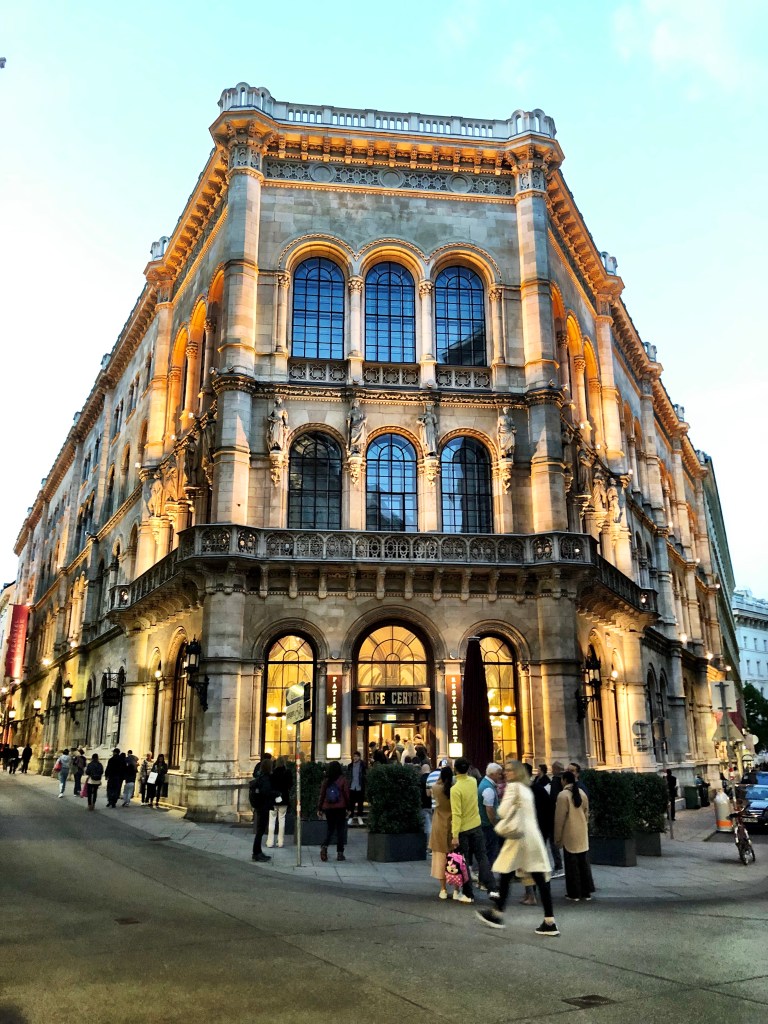
Now THAT’s a Coffeehouse!
Saxon is not much of a traveler these days. He just can’t do a full day of walking anymore. And stomping, for him, is right out. So, somebody had to stay home with him. That duty fell to me since I had already been to Vienna. Cherie and Jess flew from Rennes to Vienna via Amsterdam. By all accounts, they had a wonderful visit. Jess’ old haunts were refreshed with some crisp new stomping. They visited that city’s celebrated old coffeehouses, tested a good many pastries, toured old houses – including the massive and opulent summer palace of the Habsburg emperors, Schönbrunn – basked in beautiful art, and even viewed a full recreation of a roman town. Jess had been missing one of her favorite cities in Europe, so it was good for her to return. And Cherie had never been to Austria before, so she was quite happy to see what all the fuss was about. Needless to say, she was not disappointed. We hope to go back together some day and do even more exploring. There is so much to see in this beautiful country.
An Imperial House for the Summer: Schönbrun Palace
Eventually, Jessica had to go home. Not really sure why, exactly. Something about a job, family and friends. It was all a bit vague, but Cherie and I nevertheless resigned ourselves to the sad fact of her departure. Springing for one last hurrah, the three of us left early for Jess’ flight in order to spend a couple of days in Paris. It was a bit of a last-minute decision so our lodging options were a bit limited unless we wanted to pay €300+ a night. We didn’t. So we took a holiday rental apartment just east of the périphérique (the ring road around Paris) in the suburb of Bagnolet. Kind of far out from the center for our liking. But the Metro made it easy to get into the city and back, so it was only a minor inconvenience.
While in Paris, we spent one soggy day just wandering around the center. Window shopping, actual shopping, sightseeing and just generally soaking up the very special atmosphere of this beautiful city were our occupations for that day. We enjoyed a brilliant impromptu lunch in the Latin Quarter (the 5th arrondissement, I think) at a nice little restaurant called Le Petit Châtelet. Jessica had wanted to visit the notable English bookstore Shakespeare & Co. (which she did) and this bistro was conveniently right next door to it. Though it was quite late in the lunch hour, they kindly squeezed us in to an outdoor table, nicely situated for people-watching against a backdrop of Notre Dame cathedral. I had a really excellent brochette of lamb. What more could you ask for? It was one of the most enjoyable lunches I have ever had. Man, I love Paris!
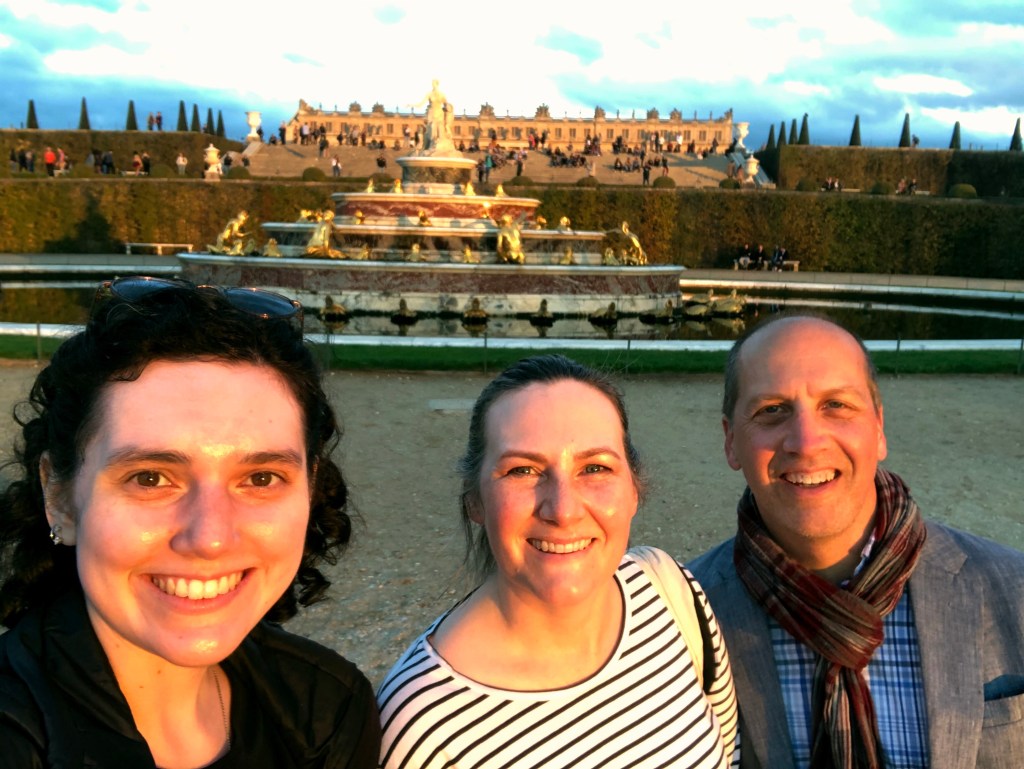
Selfie-time at Versailles!
The real star of our mini-vacay to Paris was actually not in the city at all, but instead in smaller town to the west: Versailles. You might have heard of it. Assuming you were born on planet Earth. We scheduled an entire day to visit the celebrated palace and its grounds. It turned out that we weren’t the only ones to have the idea to take a look at old King Louis’ place. Even in late October we were but three in a massive, massive horde of tourists. To say the least, the palace is pretty impressive. Not only in sheer scale, but also in its uncompromising and unapologetic opulence. We got lost several times, but eventually wound our way through most of the countless chambers, anterooms, galleries, etc. which are open to visitors. The restoration work lovingly conducted on many portions of the architecture is so magnificent. The french are unequalled masters at supporting and promoting the heritage trades and nowhere are the results of this more prominently in view than at Versailles.
The Off-Season – Hall of Mirrors
While the architecture of the palace of Versailles gets the most attention, the gardens and landscapes of the grounds are equally impressive. They’re massive. We were all exhausted by the time we had wandered around even a moderate portion of the grounds. It’s no wonder that the palace does a brisk business in renting out bicycles and golf carts. We were also fortunate to have enjoyed really beautiful weather that day so everything – the boiseries, the fountains, the grand canal, the parterres, the bassins – was looking its best.
The Palace Grounds (click on each photo to enlarge)
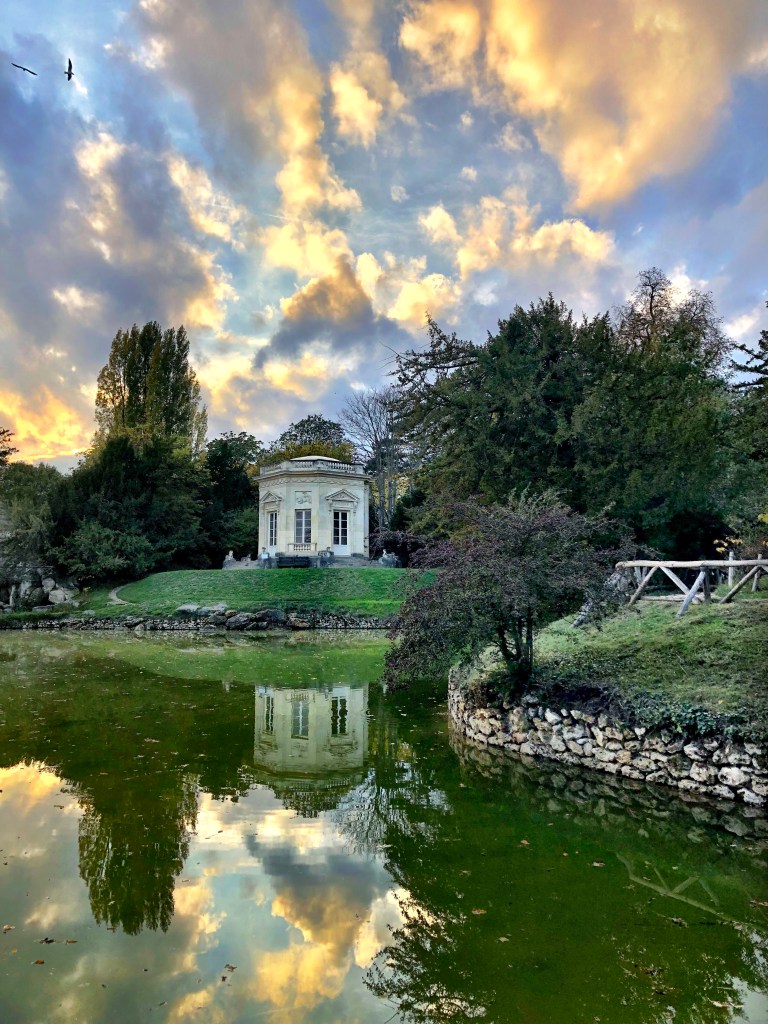
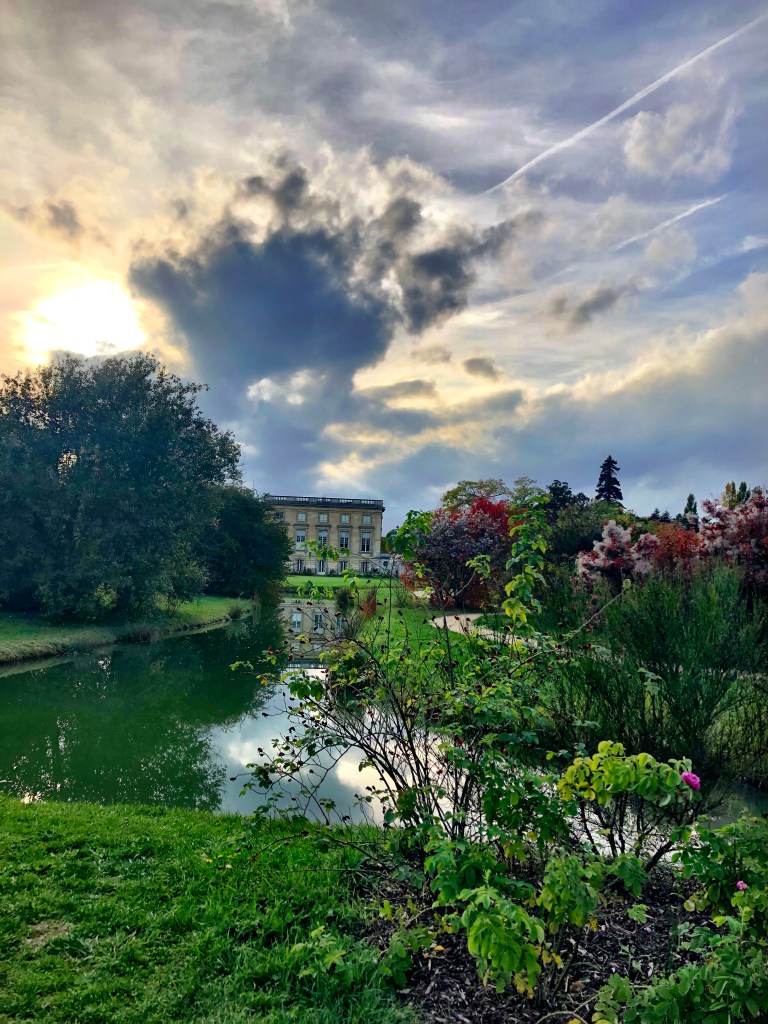
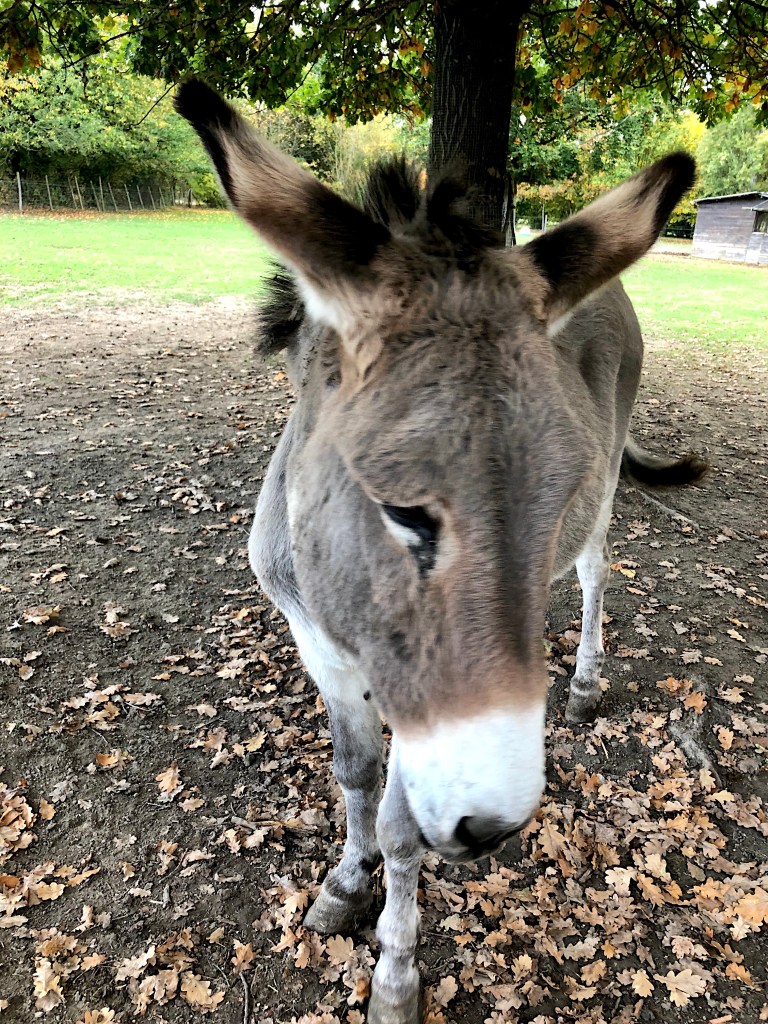
To get away from the hubbub of the palace, Marie Antoinette had a little place of her own in these grounds. To be more precise, she had an entire fantasy farm village constructed, sort of a theme park, so that she could enjoy a rural idyll whenever the whim took her. This village accompanied her Petit Trianon, a small mansion reserved for her particular use. These smaller sites were, in many respects, more enjoyable to visit than the main attraction. They conveyed a more intimate insight into the lives of french royalty and those who labored around them. Plus, the village had lots of farm animals to see so Cherie was in heaven.
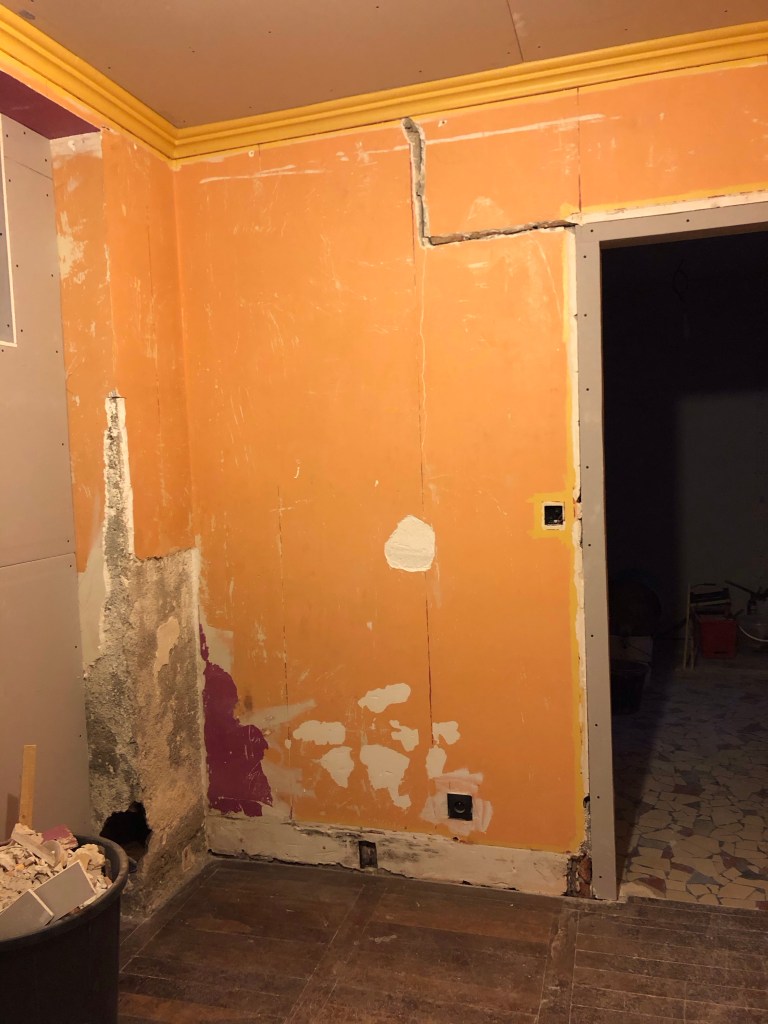
BeforeAfterOur Petit Salon (click on the photo to enlarge)
Every day we sit in our house and stare at the many details which we have yet to finish. I have the knack for happily looking past the incomplete parts, or at least ignoring them for a time. Mostly because I have no confidence in my ability to address them. Cherie, not so much. She’s never met a problem that she doesn’t want to correct immediately. And she has enough confidence for the both of us that we are just the right couple to take it on. The galling thing about this is that she is usually right.
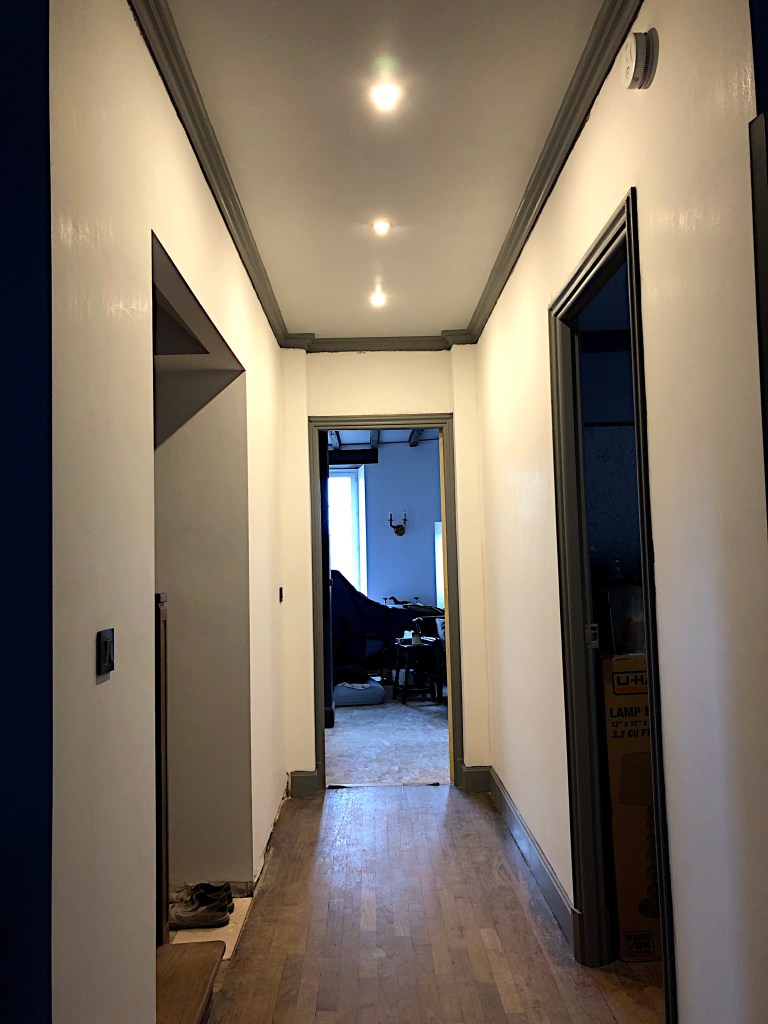
The Hallway in Mid-RepairPretty Much DoneA Hallway in Transition (click on the photo to enlarge)
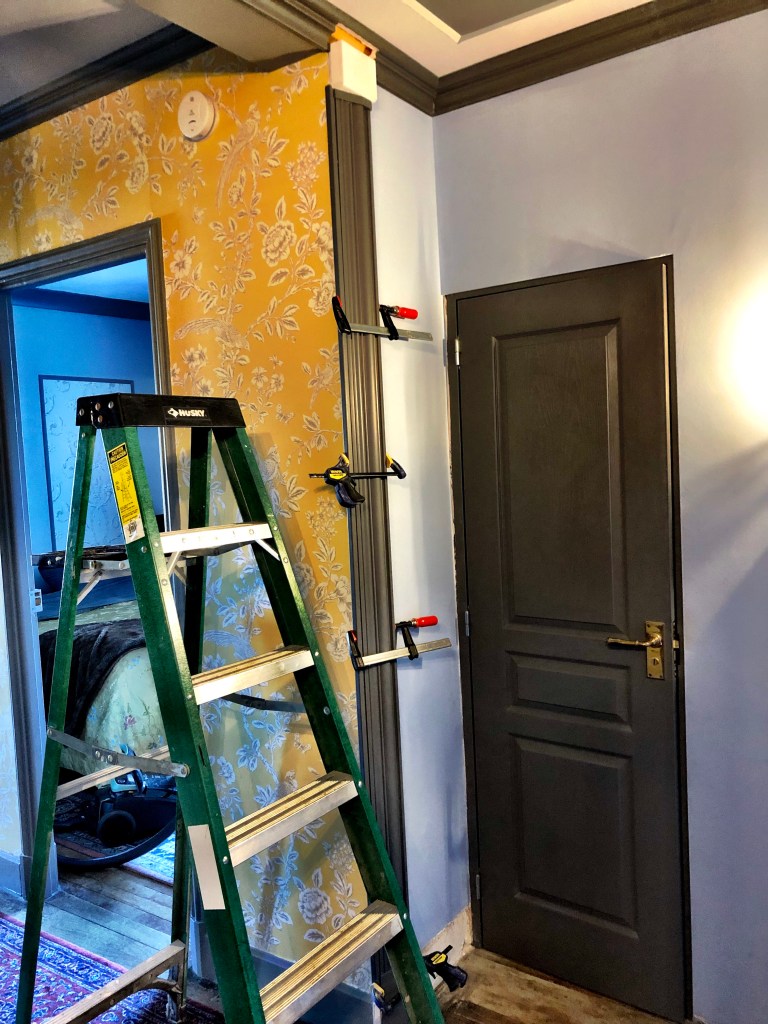
The most visible of our architectural defects was the missing baseboard [“skirting board” for our british readers, or “plinthe” for our french readers] and other bits of trim in our hallway. Also a missing bit of flooring. Every time she sat on her preferred end of the couch Cherie was confronted by the sight of ragged plaster and gaps at the bottoms of the walls, and plain, unadorned edges. It was driving her mad. After a few hundred none-too-subtle comments from her side of the couch, it finally occurred to me that I should probably try to do something about this. The thing about trim and moulding is that one bit nearly always depends on the other. It doesn’t do to think about elements of it in isolation. The entire design has to be thought out before you start. After many cups of tea and much hand-wringing, I finally put it all together. Cherie then painted it nicely. In the end, we’re quite satisfied with the result. And Cherie no longer has to stare into an unfinished view.
Clamping it in to Shape
Still buzzing with the endorphins of triumph from our hallway project, we took the natural step of continuing the beautification process into our petit salon. It, too, was suffering from a lack of baseboards and trim. This room actually had trim when we bought the house, but we weren’t satisfied with it. Moreover, the changes we made to this and the adjoining rooms resulted in enough damage to the trim in here that it just wasn’t worth keeping it anyway. So we ripped the old stuff out. We were, however, able to keep the crown molding [corniche, in French] though we will probably replace some day. The openings/doorways – all five of them – in the petit salon are a bit quirky so it required a bit of creative thinking to manage the trim design. I think we’ve arrived at a reasonable and pleasing solution. Although, I will never shake the feeling that I could have come up with something better. The room is still not complete. The window between the petit salon and the garage will have a renaissance-inspired leaded glass insert – a future project which I hope to complete during the dark days of next winter. Nevertheless, the addition of trim has been a big visual improvement to this space.
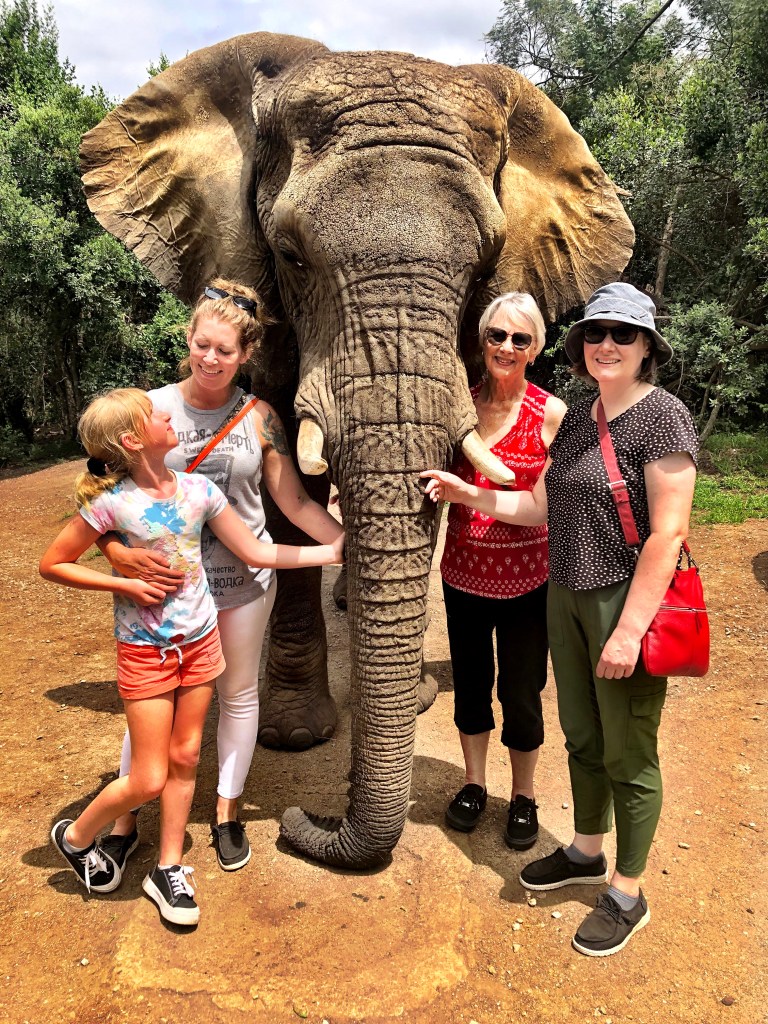
Matriarchs: Finn, Kasi, Valerie and Cherie Enjoying the Companionship of an Elephant
Just before we started in on the work on our hallway and petit salon, Cherie embarked on her longest trip yet. Joining up with her mother in Amsterdam, they both continued on to South Africa. Cherie’s sister Kasi and her daughter Finn live in Knysna, a six-hour drive east of Cape Town, and it was time for a visit. As with Vienna, our dog kept me captive in the tower in Fougères. The lovely town of Knysna is nestled in a broad river mouth where it empties into the Southern Ocean. Regular reports from our correspondent there informed me of beautiful ocean views, fine dining, and friendly people. Mom, her granddaughter, and two daughters had a wonderful, long-delayed (because, Covid) visit with each other.
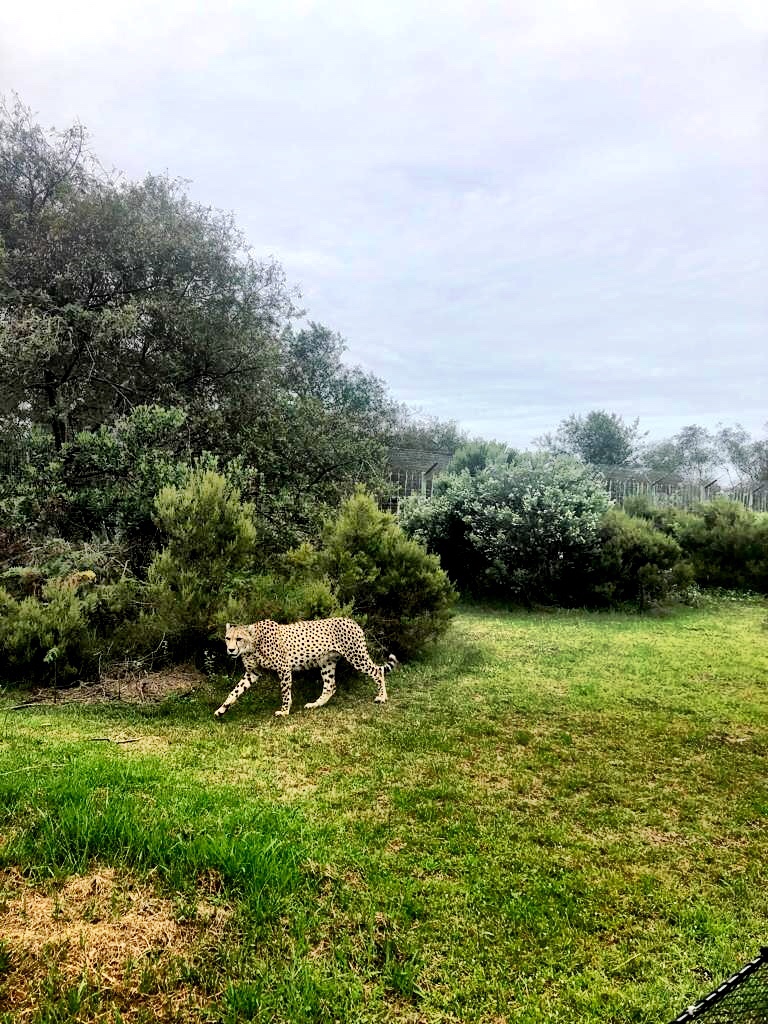
A Beautiful Cheetah
In addition to a warm reunion with Kasi and Finn, Cherie got to do some amazing things. She had the privilege of walking hand-in-trunk with elephants, as well as seeing an astounding variety of animals such as springboks, impalas, waterbucks zebras, giraffes, rhinoceroses, inyalas, in the wild. Later, at a wildlife sanctuary bed and breakfast she had the privilege of seeing lions, cheetahs, caracals, ocelots, leopards, servals, african wildcats and black-footed cats. Several other locations, including a wildlife rehabilitation center, afforded her visits to see a wide variety of indigenous birds and other mammals, amongst which there were several species of monkeys and primates. You may have caught on by now that Cherie loves animals. So this was a particular treat for her.
Your Moment of Zen (click to play video)
Our Christmas holiday in Fougères was brightened this year by a visit with a good friend from Seattle. Before moving to France we lived in the Capitol Hill neighborhood of Seattle for many years and Betsy was our neighbor. We became friends and even worked together on a project to renovate an old disused basement boiler room into a small apartment. So it was very happy news to hear that she was going to join us for a few days at Christmas. Of course we did a lot of catching up but we also took in some sights.
A Little Night Magic: Mont-Saint-Michel
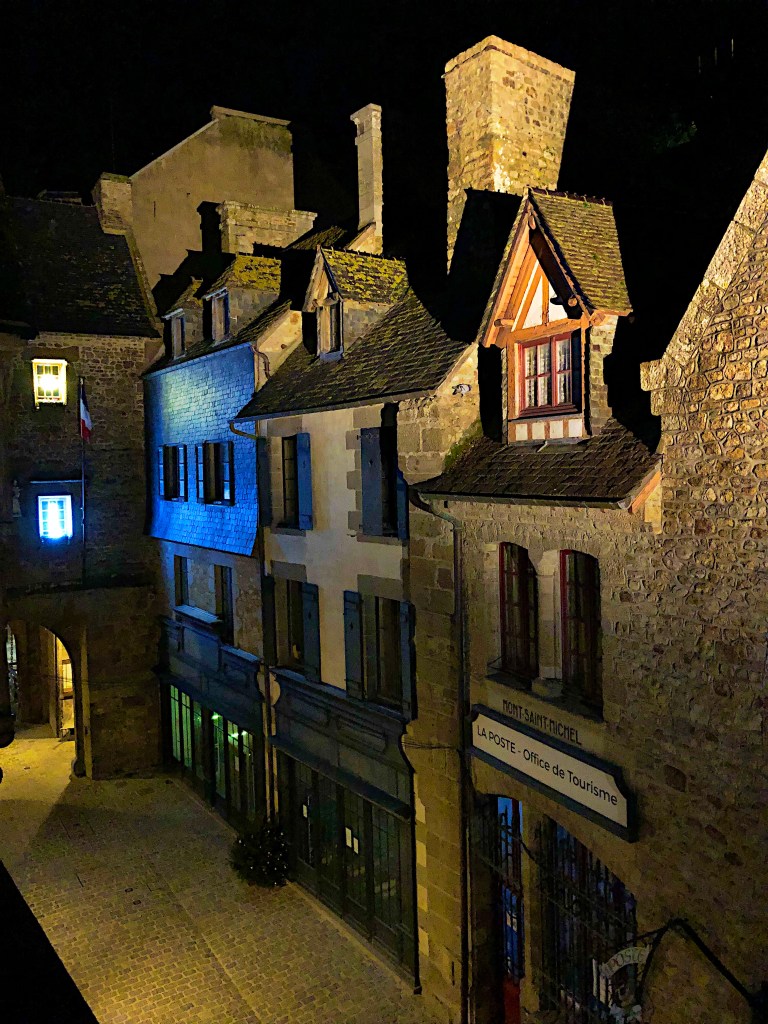
Here, I’ll just mention Mont St. Michel again. Because this time we visited at night and we also thought it would be interesting to see it around the holidays. We were surprised to learn that you can actually get in to the island village at night. Of course it makes perfect sense when you think about it. But Mont St. Michel is such a special jewel-box of a place that it almost feels like an attraction that closes for the evening. But it’s a real village and working abbey, with real people who live there. Duh! Anyway, what’s also nice is that the navettes (shuttle buses) also run between the massive parking lot at the visitor center and the mount late into the night. It is so convenient. Sadly, but understandably, the abbey itself is closed to visitors at night. But the chance to see the exterior of the monastic heights lit up in the dark is well worth the visit.
Quiet Time: Evening Street in Mont St. Michel
We nearly had the place to ourselves. Which is a dramatic contrast to a madly crowded visit to this world heritage site on any given day. Absent were the usual hordes of tourists, the frenetic air of visitors on a tight schedule anxious to tick another item off their bucket list. Almost all of the shops were closed and only a couple of restaurants were keeping their doors open to serve hotel guests staying overnight. Above all, it was quiet. Only the sounds of our shoes on the cobblestones reached our ears against a background of the low static of clashing waves as the high tide surged around the base of the mount outside its walls. Magical. If you get a chance to visit this amazing place in the evening, don’t pass it up. It’s a very different and rewarding way to experience Le Mont-Saint-Michel.
Renaissance Christmas: le Château Rocher Portail
Probably the most christmas-y thing we did with Betsy was to visit a nearby château: Rocher Portail. This beautiful renaissance château was constructed from the 1580’s to 1607 and is nearly completely original in its form. The gardens are also being restored their original design. Rocher Portail also has the proud distinction of being the home to several goldfish which we donated from the little pond in our jardin at La Tour Desnos. A good move for them because their new digs are much more grand and spacious. An antique dealer friend of ours from Fougères is well-acquainted with the owner of the château and he arranged the goldfish adoption. As a result, we were a few months ago warmly welcomed by the estate’s owner to transfer the fish and take a short private tour of the main house. Lucky us!
But I digress. This time around we wanted to see this lovely château all festooned in the season’s decorations. At night. So one chilly, slightly damp evening Cherie, Betsy and I took the short drive toward the small town of Maen Roch and arrived at a beautiful sight: Château Rocher Portail all dressed and sparkling with multi-colored lights. We had a wonderful time walking the grounds and touring the house and outbuildings. All of the rooms in the house are excellently dressed with period furnishings, demonstrating how the building would have looked when it was an active residence. It was interesting to see the interior at night in an approximation of candlelight.
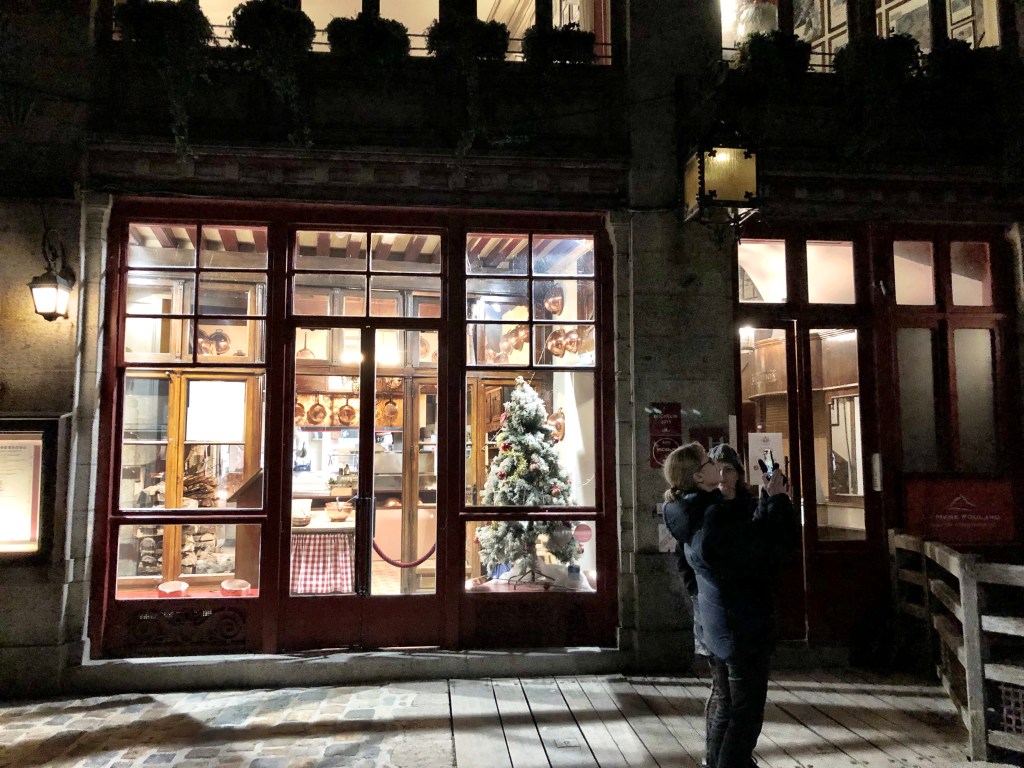
A Little Night Dining
We all had a cheery good time visiting this treasure of an estate. I should note that, sadly, Rocher Portail is rumored to be discontinuing its regular openings to visitors, so it may well prove more difficult to get a good look at the Château in the future (unless, perhaps, you have some goldfish to unload). Curiously, they will carry on with their elaborate Harry Potter schools for magic events, so don your sorcerers robes and pack your favorite wands if you want to get a thorough view of this lovely renaissance estate. We felt quite lucky to have had one of the last non-wizardy chances to have a visit.
A Very Rare Thing: Betsy Captured on Film
Well, that should be enough (or likely much more than enough) to catch you up with our lives over the past few months. Cherie and I enjoyed a wonderful Christmas day with Betsy. But she had to return to Seattle the next day so we said our bittersweet goodbyes at the airport in Rennes, hoping that she will return for another visit someday soon. Work on the house remains a preoccupation for us – even more so now that we have recently acquired the small apartment above us. We have some plans for this new space, but that story will have to wait for a future post. As always, we are mindful of how fortunate Cherie and I are, living in France and enjoying everything – including the challenges – this new life has to offer. We hope that you may find your fortune as well! Until next time …





















 Finding Our France