Unknown's avatar

About John Kocan

John & Cherie and their dog Saxon currently live in Brittany.

Pretty Little Parné

Rush Hour in Old Parné

Cherie and I have been in a bit of a self-imposed lockdown. Not due to illness or lack of interest. We’ve just been busy with the many little things in life which can bog you down if you are not careful. Bills, banking, tax preparation (for two separate countries), a thousand little house projects, managing the holiday rental … how do people accomplish all of these things when they have jobs and kids?

The tasks just keep coming. But sometimes you just have to throw down the tools and have some fun. So we bravely ran away and took an afternoon off to visit a nice village about an hour’s drive southeast of us: Parné-sur-Roc.

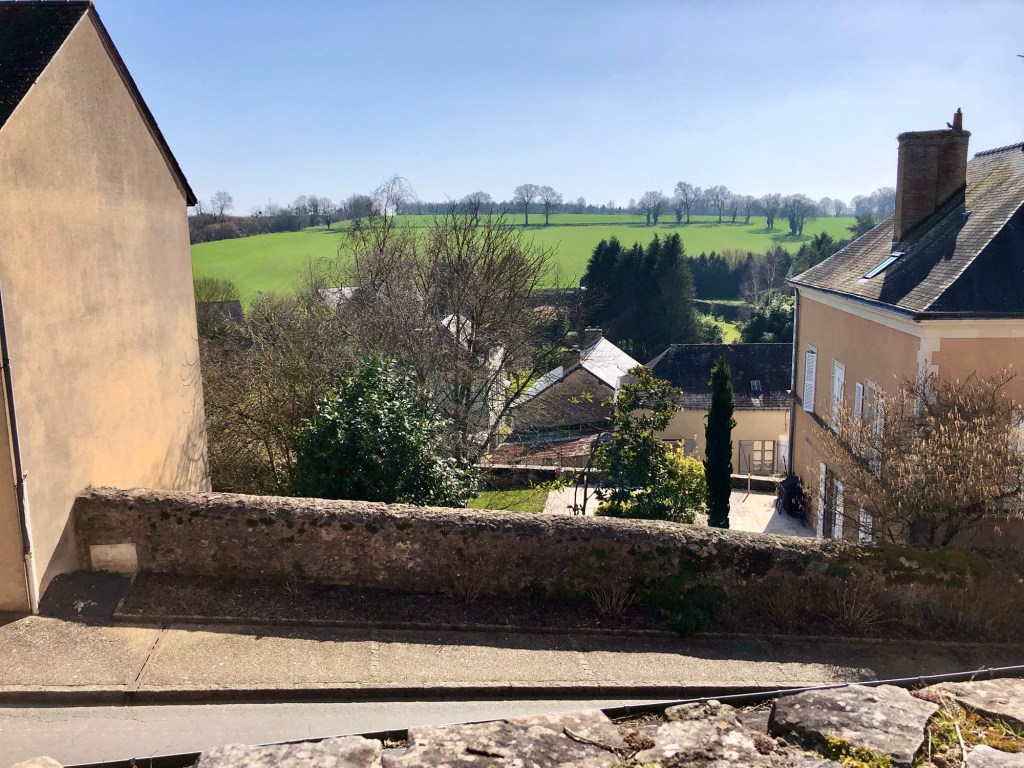
Looking Out Over the Val d’Ouette

Driving south, a few kilometers past the city of Laval, a country road takes you to Parné. We were lucky, in early March, to have sunny weather so we parked the car and took a long stroll through the village streets. Much of Parné stands upon a slope which rises from the Val d’Ouette where the small river slowly winds its way westward between verdant hills.

Les Fours à Chaux – The 19th Century Lime Kilns

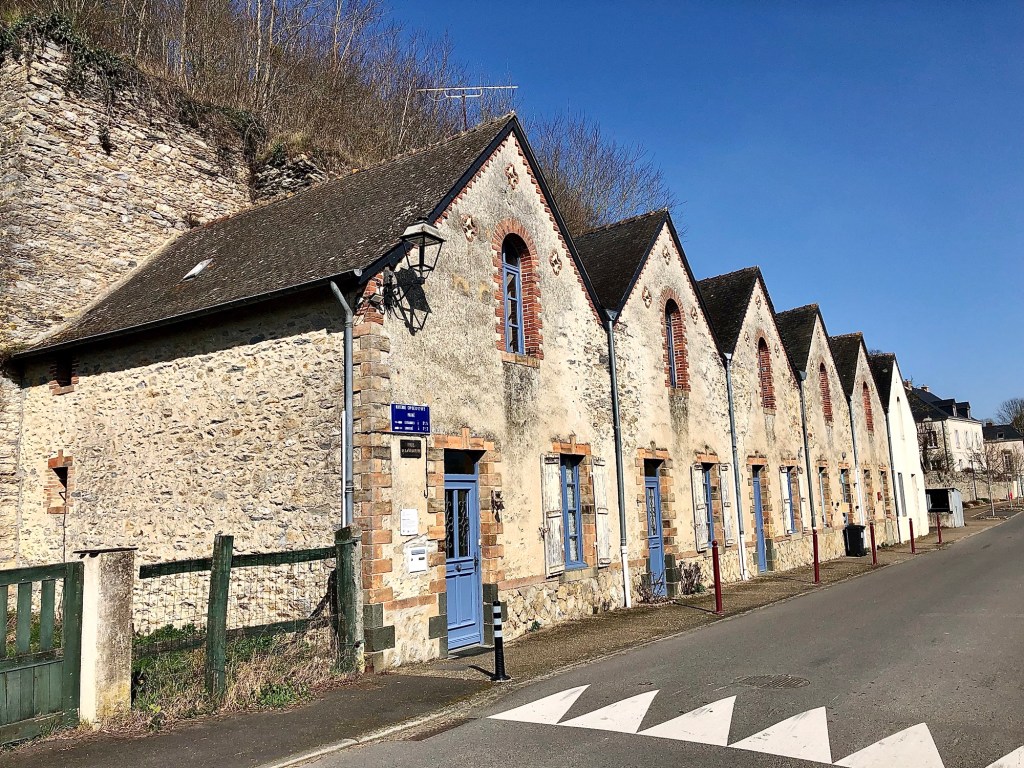
Parné’s a small place, home to around 1,300 inhabitants. But it has been around for several centuries. Probably since at least the time when the area was a province of the Roman Empire. They must be doing something right. During the Middle Ages the village found itself on the main pilgrimage route leading from Tours to Mont-Saint-Michel. In the 19th century, entrepreneurs of the area took advantage of local limestone deposits by building a series of successful lime kilns, the remains of which continue to rise above a row of workers’ cottages built to house their employees. Now, the main occupations are in agriculture, manufacture of aluminum and PVC building construction components, and a trout hatchery.

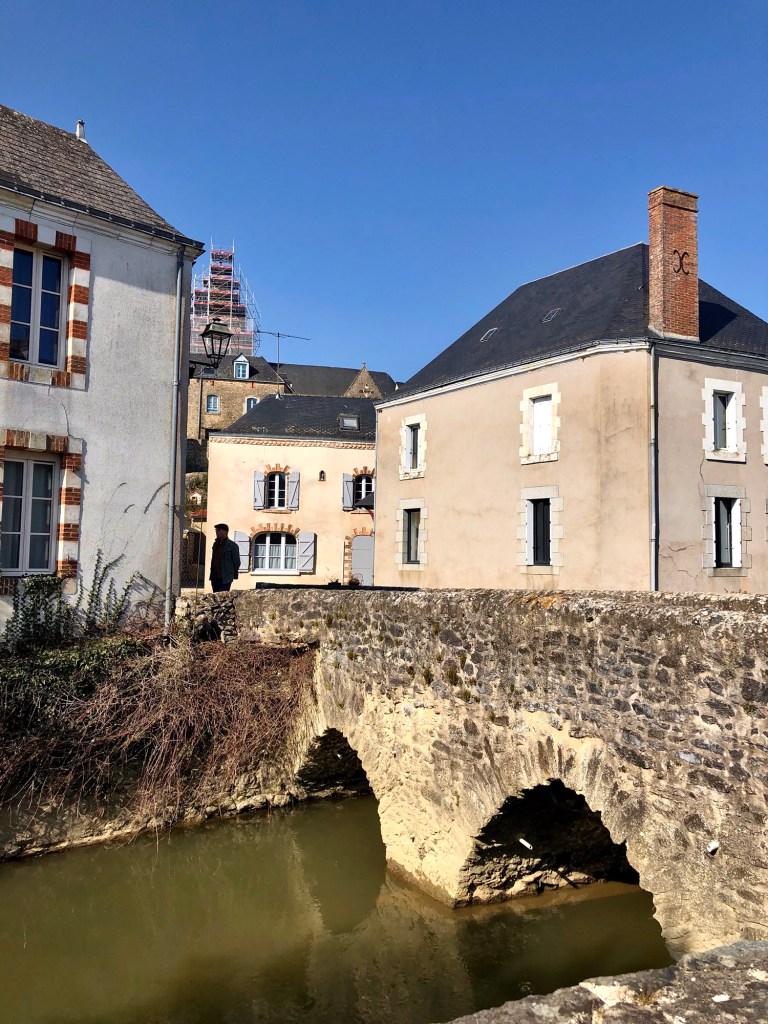
John Enjoying a Moment of Reflection on the Medieval Bridge

At the point where the old pilgrims’ way crossed the river spans a medieval bridge. Simple, with two arches (a third was added in the last century to facilitate water flow), this ancient bridge has somehow managed to last for centuries. It has seen countless travelers tread its roadway – ranging from the most humble animals to the very kings and queens of France itself. It’s a beautiful thing, with its quiet, timeless solidity and imbued with such deep history. Spending a few quiet moments here, with the sound of the burbling river and the songbirds chirping in the trees will do you much good.

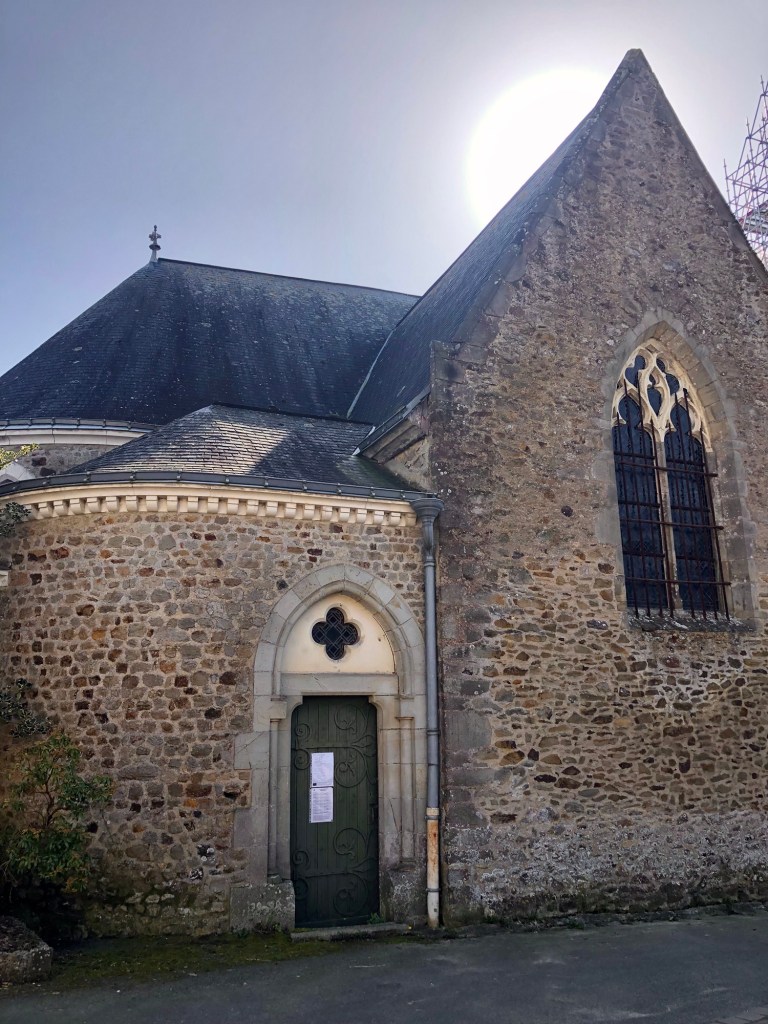
A Small Part of Église St. Pierre Without Scaffolding

Strolling up the hillside to the center of the village, we came upon a lovely church. Or, at least that’s how it seems in photos I’ve seen. We were disappointed to discover that Église St. Pierre is currently enshrouded in scaffolding. Head to toe. Front to back. Restoration is a constant fact of life in Europe. Which is, of course, a good thing. But it was a shame on this day. Because this 11th century church is also reputed to have 13th, 16th and 17th century fragments of frescoes remaining on the walls. We would have loved to see them, but the inside of the church was closed off as well. Perhaps another time.


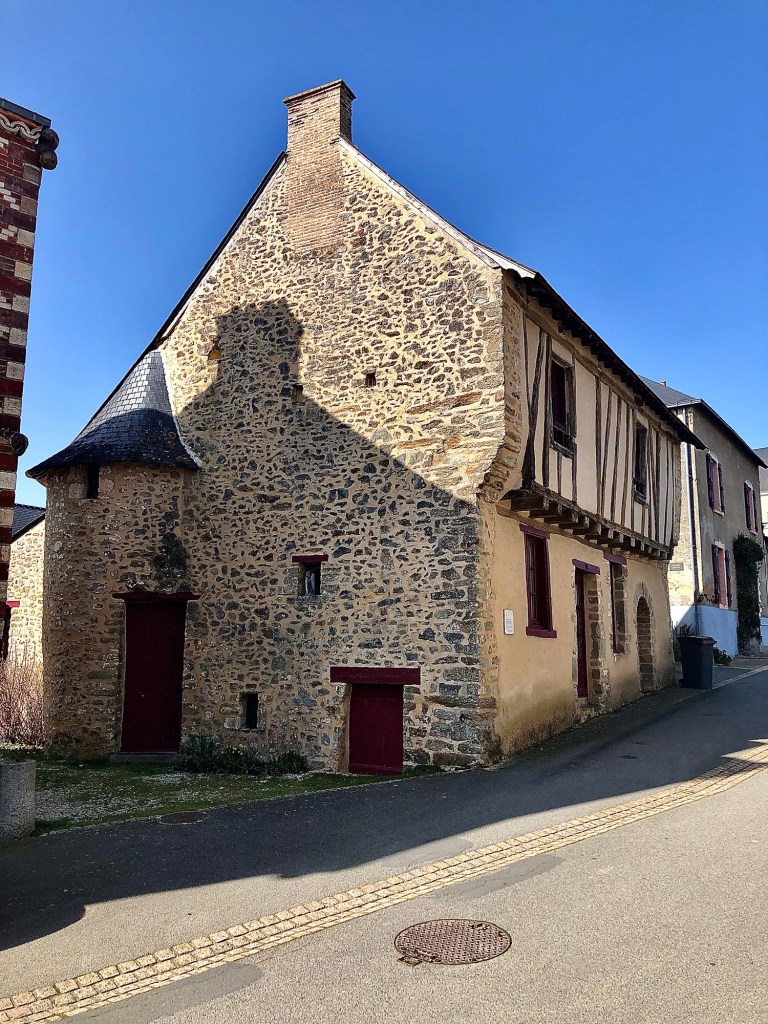
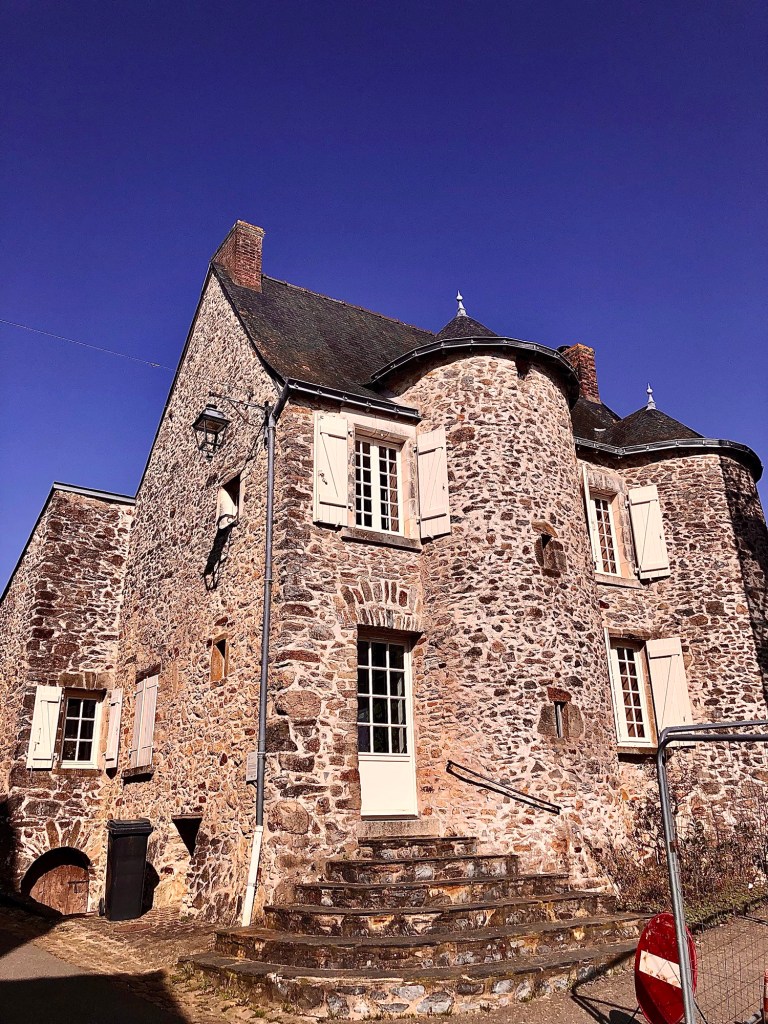
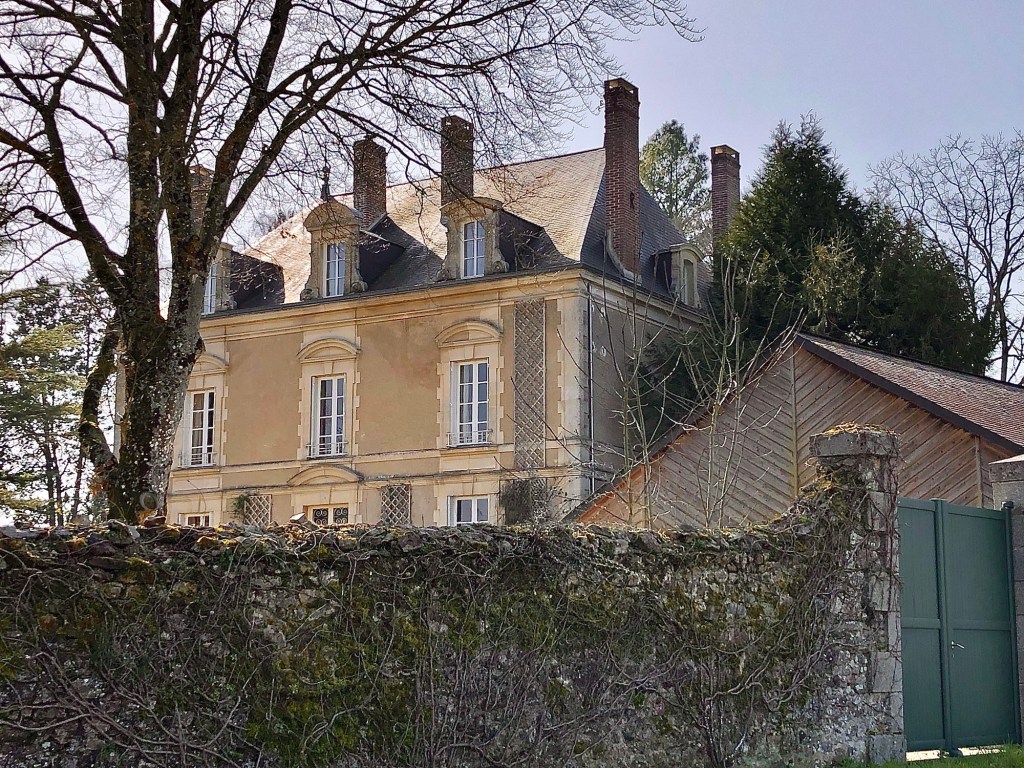
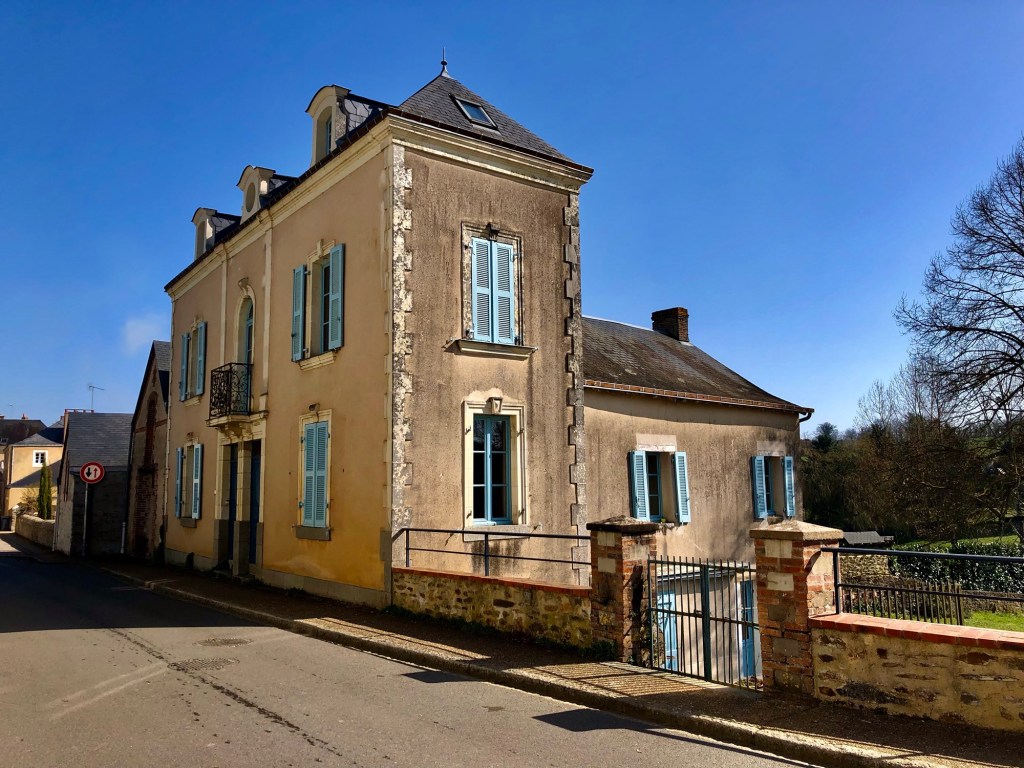
There are several lovely houses ranging around the core of the village. There are some nice examples of medieval domestic architecture (my favorite) as well as from later periods. All of them blend together in a very pleasing way. Many have plaques which present a brief history of the building. We found them to be informative and interesting and they helped us better understand the area’s past. I wish our own town would do something similar.

19th Century Workers’ Cottages

We enjoyed our visit to Parné-sur-Roc. Because it’s a small place, it is probably best to include it as part of a day-trip to nearby Laval and Entrammes. The three together make for a full and well-rounded day of sightseeing. You won’t find any food or window shopping in Parné (or Entramme, for that matter), but Laval will serve you well in those respects. This small village is definitely worth a look.

Bonnes Fêtes!

Château Fougères Wrapped in Rouge

In the immortal words of Ebeneezer Scrooge: “What’s to day [sic], my fine fellow?” Now that we’re retired, we often awake with that question in our minds. Each day is much like the other throughout much of the year. But, in December, the days are still distinctive, pointing us inexorably toward the holidays. The French embrace Christmas with no less enthusiasm than Americans, or any other place, for that matter. Reminders of the season are everywhere in our town. Fougères is scintillating with lights and activity right now.

Rue Porte-Roger in Holiday Splendor

I’m not really one for holidays, but even I am struck by a certain excitement in the atmosphere. I’ve just taken a walk into the square this early evening to pick up a fresh baguette for dinner. It’s already fully dark, but sparkling lights are everywhere illuminating the way. The streets are filled with townspeople and visitors alike, all of them in high spirits as they peer into the shop windows or chase after their children scattering excitedly over the cobbles. There is a certain infectious intoxication that even a hardened cynic like myself can’t entirely dismiss. The walk has done me good.

Within la Tour Desnos, Cherie is entirely in her element. She loves this festive season. The lights, the decorations, the parades, the food, the music: it’s all definitely her bag. With the warm bread now tucked under my arm, I reflect fondly on how much joy these celebrations give her. Returning home, I turn the lights on the wreath hung on our front gate and rush back into our ancient but cozy home. There I find Cherie radiating good cheer and bustling about the kitchen. The lights on the Christmas tree are casting rays of hope throughout the house and the familiar tunes from A Charlie Brown Christmas fill the air. We kiss each other warmly in greeting as I deliver the baguette, my hunter-gatherer duties now fulfilled. Perfect.

Taking a Break From Our Morning Walk for a Quick Selfie

We hope that all who read this find their own bit of perfection this holiday season. Together with our old buddy Saxon (now thirteen years old and counting) the three of us have been enjoying yet another wonderful year in France. May you, too, enjoy peace, happiness and lots of laughter in this time.

I recommend starting with a warm baguette!

Merry Christmas and a Happy New Year to everyone!

From Bastard to Conqueror – William in Bayeux and Falaise

Fanciful 19th Century Ode to William the Conqueror in Falaise

This post has taken a few months to produce. Principally, because I am an arch-procrastinator. There is no task that I can’t put off until later.

Much later.

But, in my defense, it also took this long because the post covers two separate visits which – conveniently, for the purposes of stitching together this weak excuse – happened several months apart. Earlier this summer (June) we made a somewhat rushed trip to the town of Bayeux. Then, just a couple of days ago, we had a look around the town of Falaise. So, how could I have possibly written this post until today?

Erm … we’ll just ignore the fact that I could have simply done two separate blog posts. Arch-procrastinator, remember? Also, there is a through-line connecting these two town visits: the life of William the Conqueror. So let’s focus on that. Stay with me on this …

William (Guillaume in French or, commonly, Gulielmus, in Latin) was born in Falaise around 1027 or 1028. At the time, the town was the seat of power for the duchy of Normandie. A castle already stood on the rocky outcrop where the remains of the last fortifications exist today. After his father died while returning from pilgrimage to Jerusalem, little Billy became duke at the age of 7 or 8. Many years passed, during which the young ruler gained much experience in waging war and governing an expanding duchy. Finally, in 1066, he took a short sailing trip with a few buddies. On the way, they decided to conquer England and commission the stitching of the longest “Mission Accomplished” banner ever made. That banner ended up in Bayeux where boatloads of visitors (and their buddies) travel to see it firsthand. There. See? Through-line.

Bayeux Cathedral

Bayeux is a small town of around 13,000 inhabitants, just a few kilometers northwest of Caen, in the département of Calvados. It’s also not very far from the D-day beaches. Interestingly, it is this relative proximity to the allied invasion landing sites that helped to spare the town from destruction. As a result, it is one of the very few villes in this part of Normandie to have retained its pre-war character.

Elegant Entrance to the Forecourt of the Tapestry Museum

We arrived in Bayeux on a beautiful day with only one solid objective in mind: the Bayeux tapestry. But that would come after lunch. We found a nice local bistro where we had a bite to eat and then made our way to Le Musée de La Tapisserie de Bayeux. Housed in a former 17th century seminary, this well-organized and well-presented museum houses excellent displays on the town’s history. But the star of the show is undoubtedly the tapestry itself. Actually, it is an embroidery: a linen textile base onto which wool thread of ten different colors is stitched.

Bishop Odo Spreading the Love

The general scholarly consensus is that the “tapestry” was commissioned by William’s half-brother Odo, bishop of Bayeux (and proud new owner of massive parts of England, courtesy of brother Billy) in the 1070’s. Possibly created in southern England, it is thought to have been hung in Bayeux Cathedral (definitely worth a visit) after completion. The entire length (68.38 meters, or slightly over 224 feet) of the tapestry is displayed in a darkened room (to protect against damage from light) behind glass. We were happy to discover that one can get very close to the textile and see it in great detail. Absolutely brilliant to think that one is looking at an embroidery which is nearly a thousand years old.


Though relatively small, the center of town has a bustling high street. We were there in late June on a weekday and it was completely rammed with tourists – a good deal of them American or British. But, as is usually the case, the side streets are where few tourists dare to tread. And it’s there where we not only found a more peaceful version of Bayeux, but also some beautiful scenic gems. The narrow medieval streets of the old town are hedged in by lovely old buildings, many of which display interesting architectural facets which seem to be unique to the area. We spent an enchanting afternoon wandering aimlessly, willingly following the timeless cobblestones whither they wished to lead us.

Le Château-Fort de Falaise

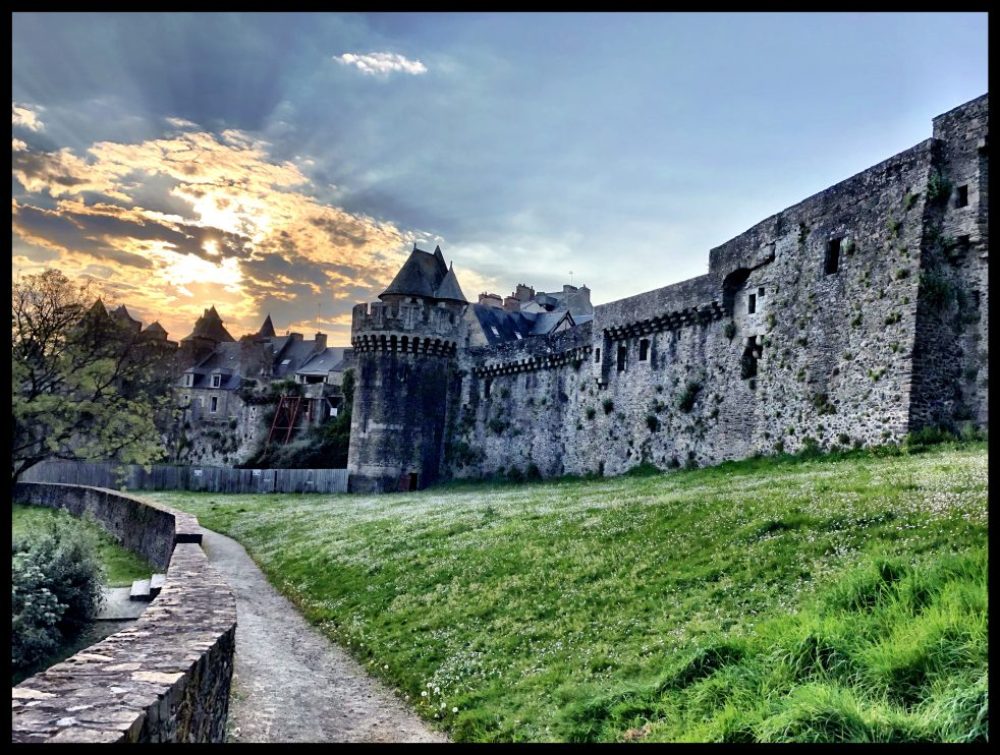
We continued our Conqueror’s Trail – he was also called “the Bastard”, but Bastard’s Trail doesn’t quite have the same ring to it – by pulling into the even smaller town of Falaise. It was mid-November by now so there were almost no other visitors apart from us. I imagine, though, that the place can be thronging in the high season. I mean, one look at the magnificent, chalky ramparts, towers and donjon of the château standing watch over its town is more than enough to get your tourist juices flowing.

Odd Camouflage – WWII Sherman Tank on Display Near the Centre-Ville Car Park

But first things first. As per usual, we arrived in town at lunchtime. We were hungry. And those tourist juices don’t just create themselves. So we nipped into a brasserie just opposite the castle and grabbed a bite to eat, stuffed in like sardines with locals who, I think, found us to be a curious diversion while they loudly bantered with each other over their meals. We all seemed to have a nice lunch and, by the time we walked out the door, they were laughing with us instead of at us. It was fun. And that little spark of connection between two cultures is always a rewarding feeling. So, we’ll take that as a win. Off to the château!


The illegitimate offspring of a duke and a local tanner’s daughter, William spent much of his early years in Falaise. In the very castle which we were privileged to visit that day. There has been a stone fortification of some kind on this rocky mound since circa 960. You can wander freely around the outer ramparts but there is a fee charged to enter the hub of the château-fort: the donjon. The square, imposing form of the principal surviving stone structure inside the walls has been restored – in some areas quite heavily. For some reason, the restorers erected a gargantuan concrete and steel-beam structure in front, apparently in an attempt to reference the original entrance but in a very post-modern, brutalist manner. We both found it to be a bewildering choice.


Once inside, we discovered that the main hall of the Norman keep has also been handled in a very strange way. The best way we could think to describe it is “early 2000’s exhibition hall chic”. But the good news is that the rest of the donjon has been much more sympathetically restored. There are several levels to see, even up to the rooftop for some nice views of the town and surrounding countryside. Overall, it’s a rewarding place to visit and worth the price of the ticket.

La Trinité

We are always keen to visit a nice church and there are two within easy walking distance from the castle. Our favorite was the most ancient and interesting L’Église de la Trinité. The current edifice stands facing the lovely Hôtel de Ville and the château beyond. It originates from the 13th century and after, but there has been a church on the spot since at least the 9th century. So, yeah, kinda old. La Trinité was heavily damaged during World War II but lovingly and expertly rebuilt. Of special note are the substantial portions built in the French Renaissance style (porch, various chapels). Quite special and beautiful. But the whole church is a gem and definitely a must-see.

Châtelet of Our Dreams – La Porte dés Cordeliers

Falaise has retained many vestiges of its 12th century town defenses. One special point along this circuit is the Porte dés Cordeliers. A picture-perfect châtelet guarding one entrance into the medieval town, this charming remnant completely entranced us both. It is sadly empty and seemingly abandoned, but so incredibly beautiful to our eyes. As we took our many photos, we madly schemed with each other as to how one could purchase it and make it the perfect home. This poor, neglected piece of history is crying out for help. We really hope it receives some attention soon.

Falaise War Devastation

We liked Falaise. Though small, and having suffered horribly during the last war, it is bursting with history. We ran out of time so we were unable to visit the museum dedicated to the experiences of the citizens of Falaise during the war (Les Civils dans la Guerre) but we hope to return to see it someday soon. A thriving commercial district lines the axis of the town too. So there are plenty of shops to browse. It was a fun time. And our only regret was that we didn’t have more time to spend there.

Bayeux and Falaise. You should visit them. We’re certainly glad that we did.

Closing the Door on Another Adventure